
Residential construction projects move through a predictable sequence of phases. Each stage is meant to produce the information that the next stage depends on.
Design defines the scope of the build. Estimating turns that scope into quantities and costs. Procurement converts those quantities into purchase orders. Construction executes the work on site.
In theory, that sequence keeps a project aligned. Each phase hands the next team the numbers, drawings, and decisions they need to move forward.
In practice, the handoff often breaks. A builder completes an estimate and sends quantities to suppliers for pricing. The schedule is created in another tool. Purchase orders move through email threads.
Weeks later, when framing begins, the crew is working from numbers calculated earlier in a spreadsheet that no longer reflects the latest design decisions.
Nothing in the process was skipped. The phases happened in the correct order. The problem is that the information generated in one phase did not carry over to the next.
This guide walks through the six construction phases and shows what must be confirmed at each stage so that the estimate, purchasing, and site work all use the same numbers, and the job doesn’t lose money once construction begins.
What Are Construction Phases
Construction phases are the distinct stages a building project moves through from initial concept to final handover. Each phase involves different activities, participants, and deliverables, but the phases are connected by the information they produce.
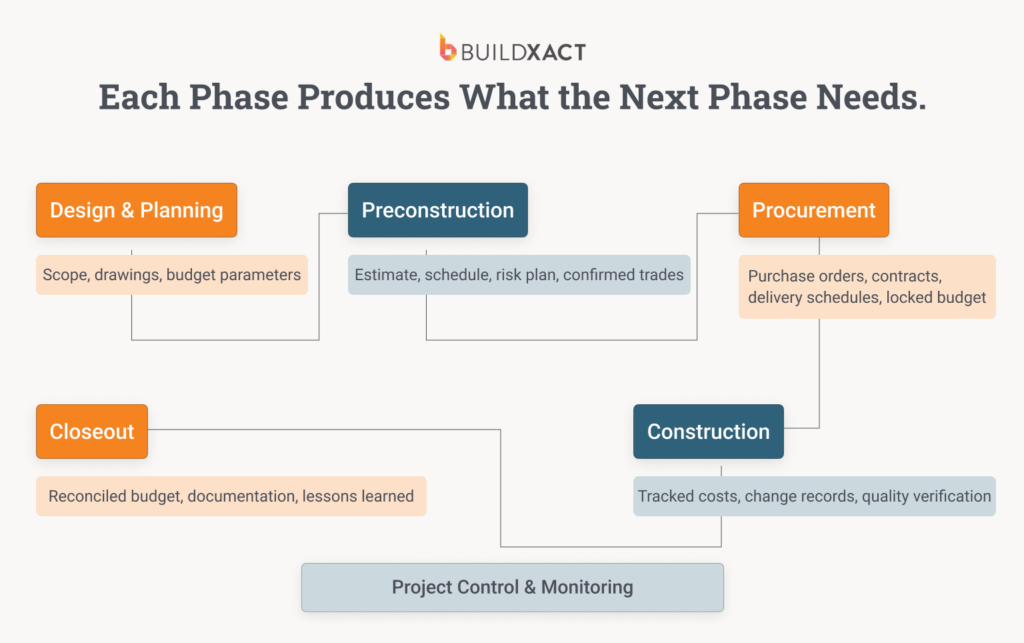
Design produces drawings and an approved scope. Preconstruction converts that scope into an estimate and a schedule. Procurement turns the estimate into purchase orders. Construction executes against those commitments. Closeout reconciles what was spent against what was planned.
The exact number of phases varies depending on how sources group these steps. Some lists include five, others six or more. The number matters less than what each phase produces, because every phase generates information that the next phase depends on.
When those outputs carry forward, the project moves smoothly from one stage to the next. When they don’t, the next phase begins with incomplete or outdated information, and you discover the gap only after construction has already begun.
To see where those handoffs happen, let’s look at the phases of a construction project and what each stage is supposed to produce before the next begins.
Phase 1: Design And Planning: From Rough Idea To Buildable Scope
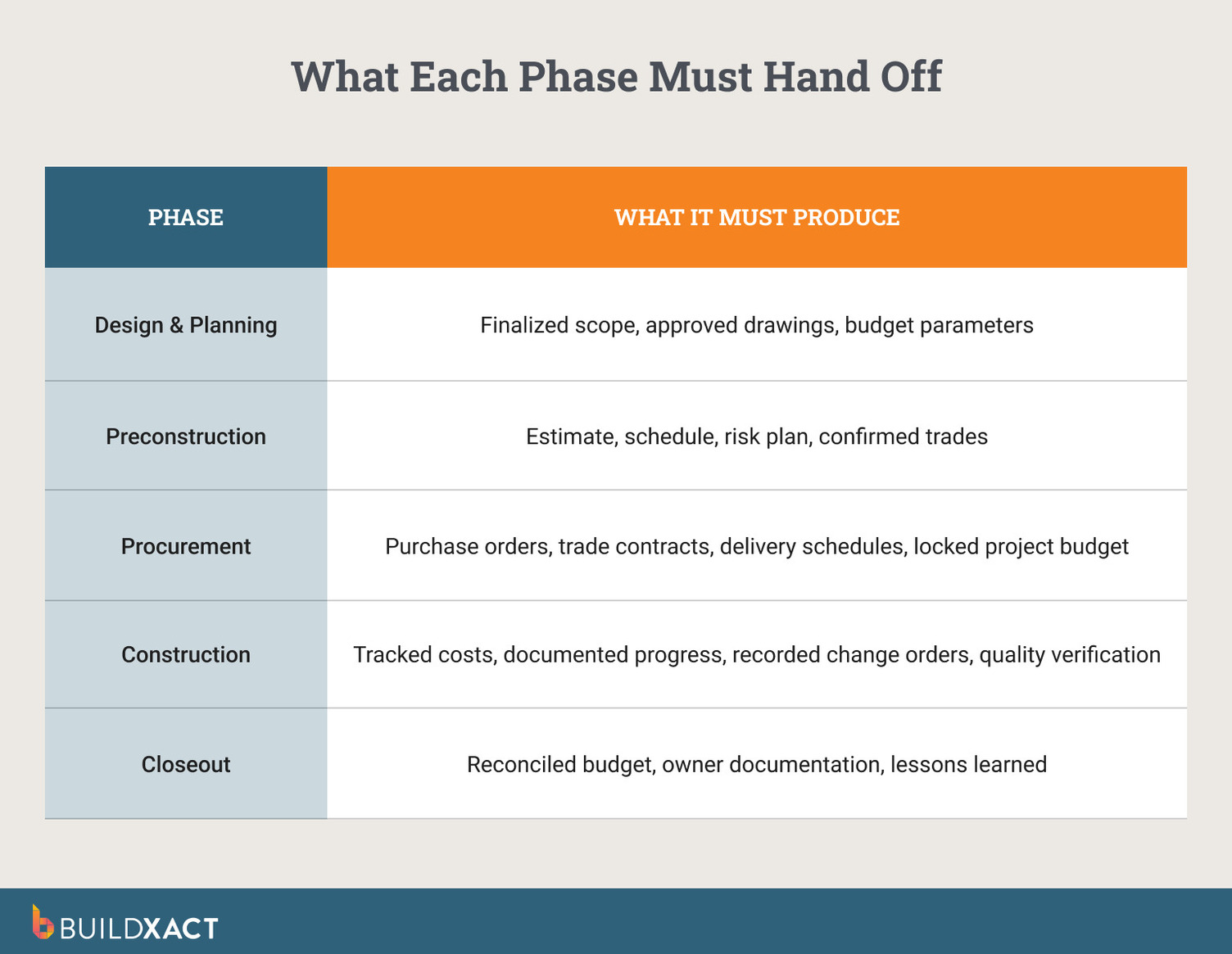
Every project starts with an idea. Design and planning turn that idea into something the rest of the project can actually make use of: approved drawings, locked scope, confirmed budget parameters, and a realistic read on whether the project is worth building at all.
Is the project worth building?
In this phase, feasibility comes first. Before architects finalise anything, two questions need honest answers: Does the site support the intended build, and does the budget support the intended design?
Builders who skip this step move the problem into preconstruction, where it costs more to go back and redo this phase. Owner-builders sometimes discover a design is significantly over budget only after paying for multiple rounds of plan changes, because site constraints and budget realities weren’t reconciled before design work began.
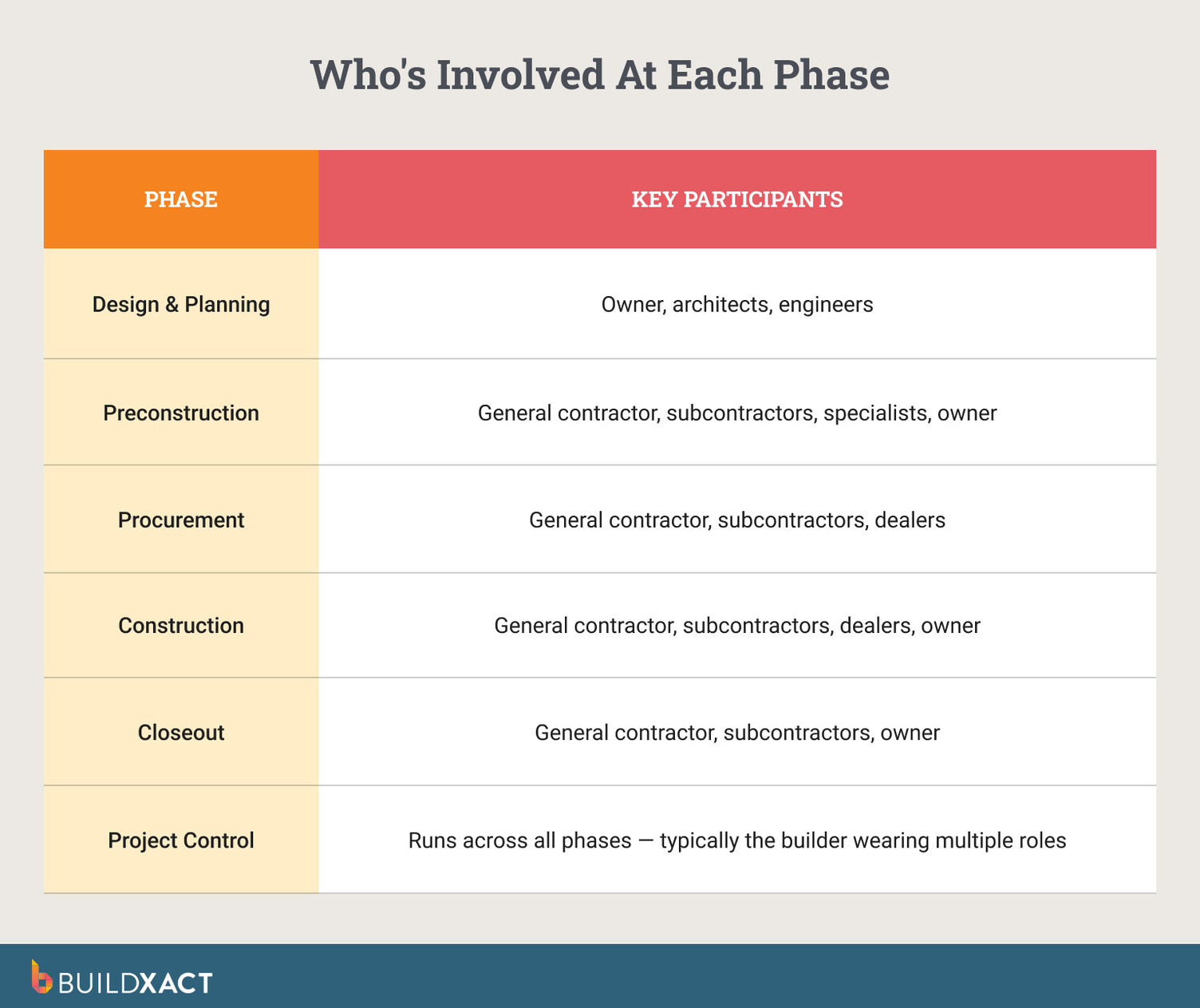
Locking the scope before costs start moving
Once feasibility is done, the scope gets locked. Architects and engineers produce drawings and specifications, then decide on materials, systems, and dimensions.
The output that matters is a set of approved drawings detailed enough that trades can price from them without guessing. Builders who get this right treat it as a line-item commitment, room by room, selection by selection, with standard and custom options explicitly called out so that price differences reflect scope differences rather than assumptions.
That level of detail is where design most commonly falls short. GIRI’s synthesis of rework research found that design changes, errors, and omissions account for 78% of total rework costs across reviewed projects. Most of what looks like a construction problem started here.
If this handoff breaks: Preconstruction estimates against incomplete drawings. Quantities are wrong, bids are based on assumptions, and the schedule has no reliable scope-to-sequence to work against. The cost of correcting the scope at that stage is significantly higher than the cost of catching it here.
Phase 2: Preconstruction: Setting The Baseline
By the time preconstruction begins, the drawings are approved, and the project has a green light. What it does not have yet is a baseline: the estimate, schedule, and risk plan against which every decision from procurement through closeout will be measured.
Preconstruction builds that baseline. For residential builders managing the process alone, this is also the phase when the most expensive mistakes begin to occur.
Catching problems while they are still cheap
Site surveys, soil testing, and permit preparation take place here before funds move toward construction. Risk and safety planning happen alongside them. None of this work is glamorous, but it is the last point in the project where problems remain inexpensive to fix.
A soil issue discovered during preconstruction requires an adjustment. The same issue discovered after the footings are poured becomes a crisis. Anything skipped or deferred here returns later at full cost.
The estimate anchors the entire phase
The most important output of preconstruction is the estimate. It is not just the number used to win the job. It becomes the reference document for procurement, scheduling, and job costing.
- If the quantities are wrong, procurement orders the wrong materials.
- If the cost codes lack structure, job costing cannot map actual expenses.
- If the schedule does not flow from the estimate’s work breakdown, it becomes a calendar rather than a sequencing tool.
When the estimate cannot carry forward into later phases, the project drifts, and because the baseline lacked structure, you can’t reconstruct where the overrun started.
Why baseline information breaks
Many small builders still prepare estimates in spreadsheets, and the problem is that the information in them does not flow forward automatically.
Procurement must re-enter quantities manually. Job costing cannot map actual costs back to the estimate structure. The duplication seems minor in preconstruction but compounds in every subsequent phase.
Joshua Bradley, owner of BradWay Construction, described what that looked like before he changed his system:
“Before, we’d write a name down, then it would make it to an email, then it progressed to a piece of paper, then to a spreadsheet. It became like four or five places where I was keeping this information.”
What this phase must hand forward
Preconstruction must produce a baseline that the rest of the project can rely on:
- A structured estimate with quantities and cost codes
- A construction schedule derived from the estimate’s work breakdown
- A risk plan
- Confirmed trade partners
The estimate also needs clear scope inclusions and exclusions so procurement can build purchase orders directly from it without re-entering information.
Once that baseline exists, the next phases proceed with the same numbers.
When it does not, procurement starts sourcing without reliable quantities, the schedule gets rebuilt from memory, and by closeout, there is nothing meaningful left to reconcile.
Phase 3: Procurement: From Estimate To Purchase Orders
Procurement is where the estimate stops being a document and becomes a set of binding commitments. Purchase orders go to suppliers, subcontractors sign contracts, and materials get scheduled for delivery.
Procurement works smoothly only when ordering draws directly from the estimate rather than starting from scratch.
Turning the estimate into purchase orders and contracts
When the estimate and the procurement system connect, quantities, specs, and costs carry over without anyone having to re-enter them.
When they don’t, you end up manually transferring data across whatever combination of tools and paper trails the job uses, creating duplicate records and errors that accumulate costs at every phase transition.
What the build crew needs before breaking ground
Before construction starts, the crew needs confirmed purchase orders, signed trade contracts, delivery schedules, and a locked budget.
Each of those items needs to trace back to the estimate. When any of them remain unresolved or are built on assumptions rather than the estimate’s actual line items, construction begins with gaps the crew has to work around.
When this breaks
Materials arrive late or incorrectly because the purchase order didn’t reflect the estimate. Trades show up without a clear scope because contracts are based on assumptions rather than on the estimate’s line items.
The budget baseline is already compromised before a shovel hits the ground, and construction tracks against a number that was never clean to begin with.
Phase 4: Construction And Execution: Where The Plan Gets Tested
By the time construction starts, months of planning have gone into the project. The crew is on site, trades are working their sequence, materials are arriving, and the builder is making daily decisions that affect both cost and schedule.
What gets tested now is every assumption baked into the estimate, the schedule, and the procurement decisions that came before it.
Where the plan meets reality
Site preparation begins, trades work within their scopes, and the builder manages resources against a schedule developed weeks or months ago.
The same person who built the estimate, set the schedule, and managed procurement is now on-site supervising the build, answering questions from the trades, and managing client expectations simultaneously.
Every variation is data you either capture or lose
Scope changes, schedule shifts, and cost deviations happen on almost every job. The difference between finishing in control and reaching closeout with a gap nobody can explain comes down to whether those deviations get recorded against the baseline as they happen or reconstructed from memory weeks later.
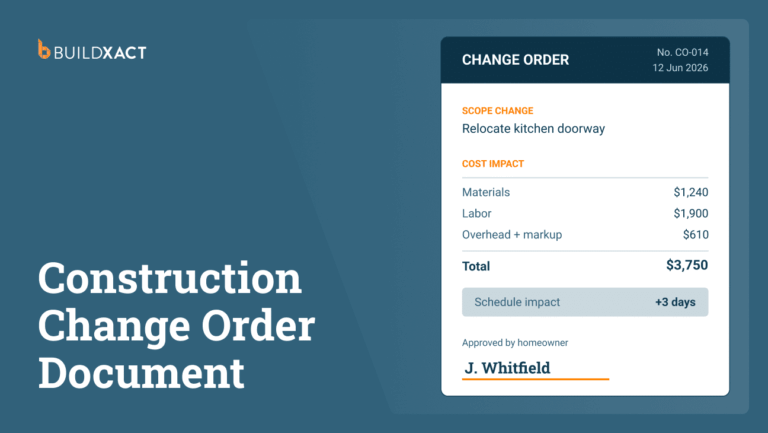
Every variation carries three pieces of information: scope change, cost impact, and schedule impact. When you capture that data against the original estimate in real time, the job stays traceable. When it doesn’t land anywhere, drift accumulates.
Before the crew moves on
Documented progress, costs tracked against the estimate, recorded variances, and completed quality checks. Closeout depends on this record existing, so it doesn’t build it. When the crew moves on before the trail is complete, closeout becomes reconstruction rather than reconciliation.
Phase 5: Post-Construction And Closeout: Reconciling The Numbers
Most builders treat closeout as the finish line. The crew moves on, the punch list gets worked through, and the owner takes possession. What actually happens is a comparison: what was quote against what was spent, and whether the data trail is still intact enough to run it.
Final walkthroughs and getting systems right
The builder and owner walk the project together, identify deficiencies, and subcontractors return to correct them. Warranties, manuals, as-built drawings, and certificates of occupancy are handed over to the owner.
Reconciling what you quote against what you spent
When the estimate is linked to actuals throughout the project, reconciliation simply means comparing two sets of numbers. When that connection broke somewhere along the way, the builder tries to reverse-engineer costs from whatever records exist.
GIRI’s research synthesis found that rework is so endemic across the industry that many organizations build expectations of time and cost overruns directly into their procurement processes. The closeout gap isn’t exceptional. For builders without a connected data trail, it’s the norm.
Jaime Hommerding of XPRES Kitchen and Bath described what visibility changed: “Buildxact has given us the ability to identify some of those areas that are a little bit more expensive, that we were just kind of writing off as not a big deal. And now it’s given us the ability to track some of those smaller pieces to better manage our profit margin.”
Turning this project’s data into your next project’s advantage
Closeout ends this project and sets the baseline for the next one. When the estimate, actuals, and variation record connect, the builder finishes knowing where the margin went, which cost codes ran over, and which assumptions need to be adjusted for the next bid.
When they don’t connect, those lessons leave with the job. The next estimate starts from the same incomplete picture as the last one.
Phase 6: Project Control And Monitoring: The Discipline That Connects Every Phase
Project control doesn’t start when construction does and ends at closeout. It runs the entire length of the project from the moment the estimate is built through the final budget reconciliation.
The three things it tracks are:
- Work quality against specifications
- Schedule against milestones
- Costs against the estimated baseline.
When those three stay connected, the builder can see what’s happening while there’s still time to respond.
The discipline that runs alongside every phase
Every phase produces data that project control depends on. Design produces the scope. Preconstruction produces the estimate and the schedule. Procurement produces committed costs. Construction produces actuals and change records.
Closeout produces the final reconciliation. Project control is what keeps those outputs connected as the project moves forward. Without it, each phase hands over its data and hopes the next one picks it up intact.
For the residential builder managing all of this without a dedicated PM, estimator, or controller, there is no safety net below that handoff.
Why tracking fails when your data lives in five different places
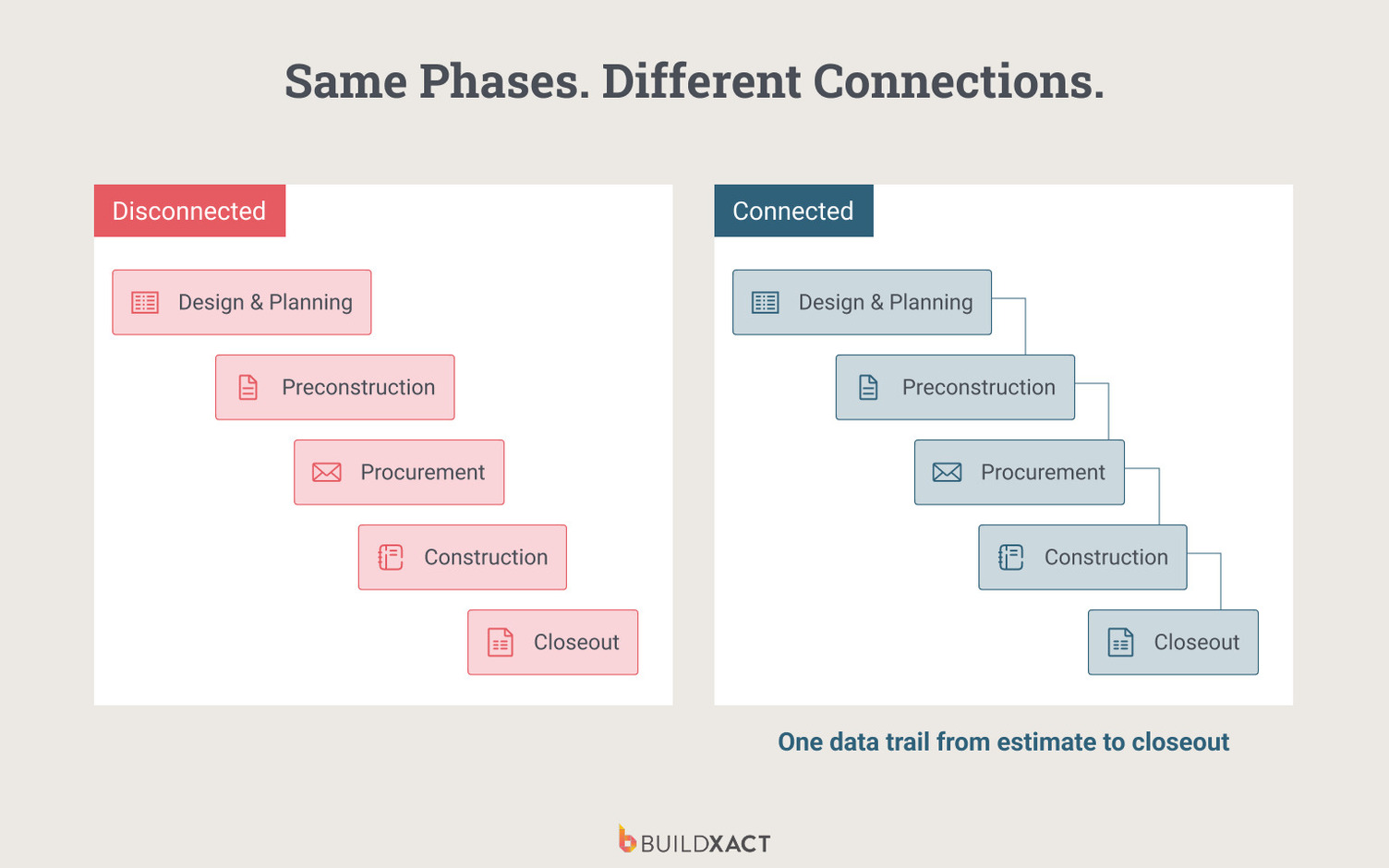
JBKnowledge’s Construction Technology Report found that 71% of estimating workflows run in spreadsheets, 46.1% in project management software, and 29.8% in scheduling software.
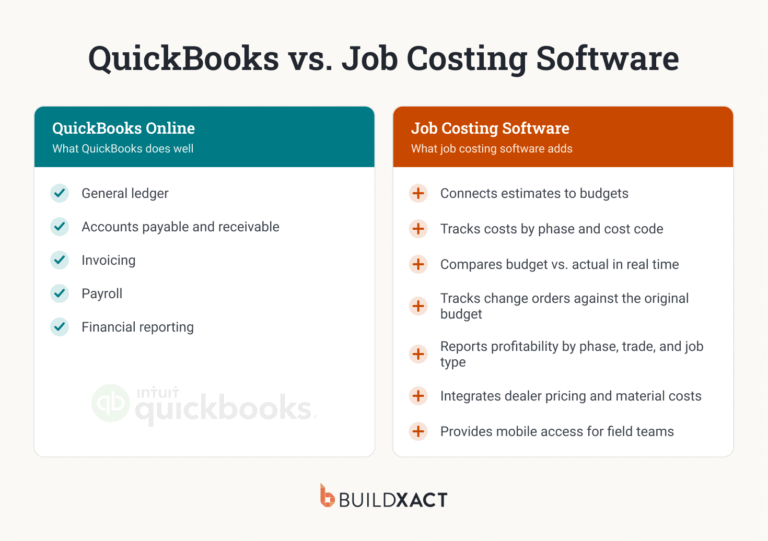
When each of those functions runs in a separate tool, the builder manually reconciles across them: re-entering data, checking whether numbers still match, and catching discrepancies that the tools can’t surface automatically.
That cost isn’t a line item anywhere. It’s the hours spent every week making sure disconnected systems still agree with each other.
Jordan Copeland of Norse Ironworks described the mental load before his systems connected:
“The hardest thing for me to do before was to switch gears from work mode to home mode because there was so much going on the work side of things, so many things to keep track of, that I would worry there was something I wasn’t doing or that I would forget to do.”
What it looks like when the estimate feeds everything downstream
When the estimate flows into the schedule, the schedule flows into purchase orders, and actuals track back against the baseline, the builder can see where the job stands without having to reconstruct it from scattered records.
When data created in the early phases remains available and usable in the later phases, control becomes possible rather than aspirational.
When Construction Phases Stay Connected, Project Admin Stops Compounding
Construction phases work when the information created in one stage carries forward into the next.
When that connection breaks, the estimate never reaches procurement, the variation never updates the budget, and closeout becomes an exercise in reconstructing decisions made months earlier.
For residential builders managing projects alone, those gaps compound quickly. No one else catches the quantity error before it becomes a purchase order or flags cost drift before it shows up at project closeout.
Keeping project information connected across phases prevents those problems from arising.
Buildxact was built for residential builders who manage estimating, scheduling, purchase orders, and job costing themselves. When those phases run in a single system, the data generated early in the job continues to guide the work through to completion.
Start for free or book a demo to see how Buildxact keeps your construction phases connected.