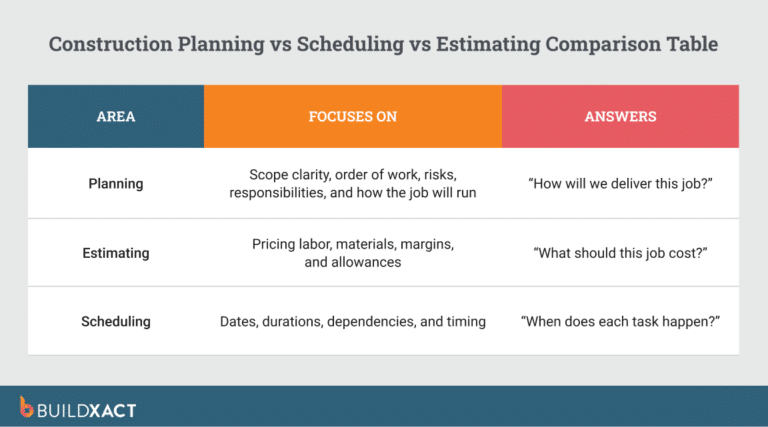

A construction estimator determines the cost of a project before work begins, including materials, labor, equipment, and subcontractors. That number determines whether a contractor wins the job and whether the project is profitable.
In large construction firms, estimating is a dedicated role supported by teams and formal systems. In residential building and remodeling, the owner or PM usually estimates between site visits, dealer calls, and crew problems.
On paper, the process sounds straightforward: review the plans, measure quantities from the plans, price the materials, and send the bid. When mistakes happen, the solution seems obvious. Be more organized. Double-check the numbers. Slow down.
But the issues persist. Bids take too long. One missed line item erases thousands in margin or clients lose momentum before the bid is even submitted.
The problem is rarely effort but structure. In residential building businesses without dedicated estimating systems, you often end up manually connecting drawings, spreadsheets, dealer emails, and bids.
As project load increases, bids go out late, line items are overlooked, and pricing updates fail to make it into the final bid.
To understand why that happens, let’s look at what a construction estimator is responsible for and how the process unfolds in practice.
What Is a Construction Estimator?
A construction estimator converts drawings and specifications into a cost model for a project.
That means measuring quantities from plans, calculating material and labor requirements, identifying equipment needs, and accounting for subcontractor work. The result is a detailed breakdown that determines how the job will be priced.
That breakdown is the project’s financial control point by:
- Setting the margin before work begins
- Determining whether the bid is competitive
- Defining the baseline against which actual costs are judged
If the estimate is incomplete, based on outdated pricing, or missing scope, the consequences don’t surface during the bid. They emerge during construction when a framing package costs more than quoted or when a line item is missed entirely.
By that point, corrections eat into the already-thin margin, and the conversation with the client shifts from building to explaining.
In large commercial firms, estimating is a dedicated function. There’s a team, or at least a role, whose only job is getting the numbers right. They work with standardized cost databases, formal review processes, version-controlled documents, and structured bid approvals. The firm allocates time and overhead specifically to support the bidding process, so estimating isn’t squeezed in between site visits.
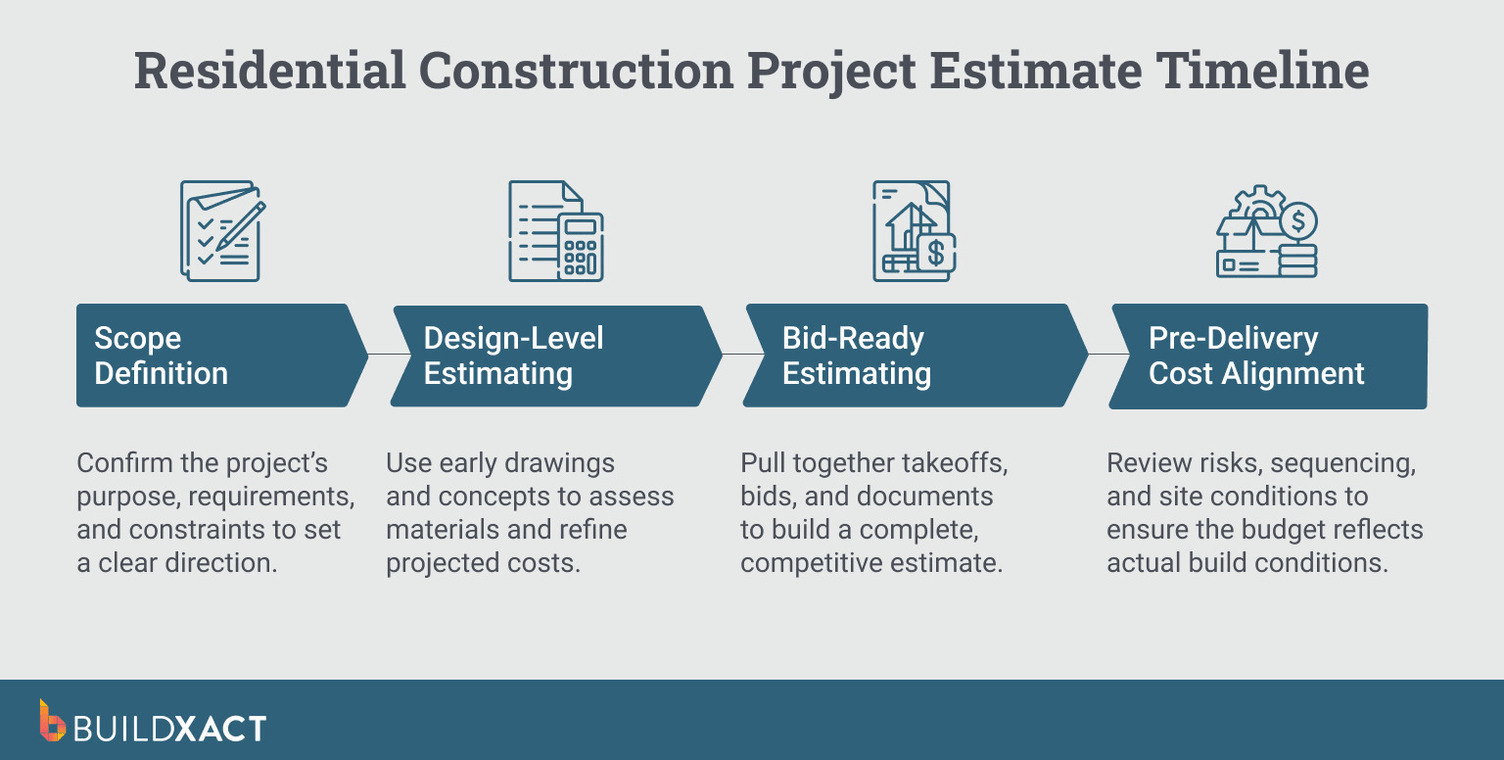
In a residential building business, those same responsibilities land on you, the owner, the project manager, or both. You’re pricing the next project while managing the current one and pulling quantities from plans at the kitchen table after a full day on site. Every bid moves through the same sequence of steps before it goes out the door:
There’s no dedicated review process, no cost database maintained by someone else, and no version control beyond whatever naming convention you’ve settled on for your spreadsheets.
Estimating competes directly with active project management for your time and attention. And the tools most residential builders use are general-purpose. Spreadsheets, email, PDF plans, maybe a calculator app. Each handles part of the process, but none connect to the others.
So you become the connection. You measure quantities in one place, price them in another, assemble the proposal in a third, and carry the context between all of them in your head.
The process depends on your memory, your consistency, and your willingness to do it all again when something changes, because it usually does.
What Construction Estimating Involves (Beyond the Math)
From the outside, estimating looks like arithmetic. In practice, most of the time goes to tracking down the information required before anyone can price the job.
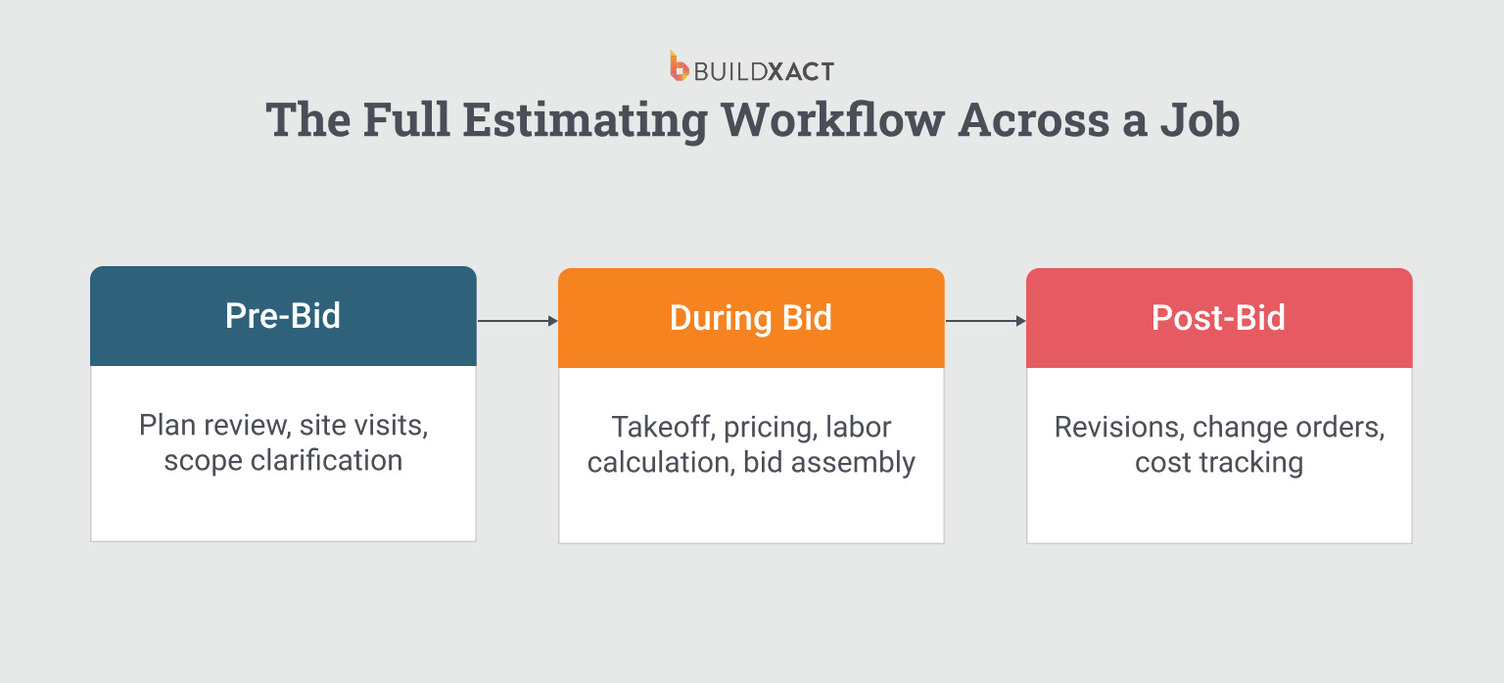
Before the bid: Defining scope clearly
Before pricing begins, you review plans and specifications to pin down the scope. You identify materials, finishes, structural components, and the trades you will subcontract. Drawings leave gaps.
Site visits expose conditions the plans do not show. You clarify permits, drainage issues, access constraints, and trade requirements before locking in pricing.
If the scope remains unclear at this stage, the estimate carries that uncertainty forward.
During the bid: Measuring and pricing under a deadline
You pull quantities from the drawings and price every component from foundation to finish. While you work, dealer quotes arrive at different times. Material costs change, subcontractors book other jobs, and you’re left assembling the bid while key inputs continue to shift.
The difficulty lies in keeping quantities, dealer pricing, labor assumptions, and revisions aligned as the document evolves. Each update forces you to reconcile numbers across multiple places. Under deadline pressure, that reconciliation takes time.
After the award: Turning the estimate into a budget
Once you win the job, the estimate becomes the project budget. You compare what you priced against what you actually spent, line by line. That review reveals where labor ran long, where materials spiked, and where scope was incomplete to inform how you will improve the next estimate.
When that review does not happen, the same assumptions carry into the next job unchanged.
The Skills That Separate Fast, Accurate Estimates From Costly Guesses
What separates experienced estimators from new ones isn’t math. It’s judgment. Knowing what to include that the plans don’t show. Anticipating where costs will drift before they do. Deciding where to hold a tight number to stay competitive and where to pad for contingency.
That judgment develops through exposure, but it develops faster when your system captures what happened on previous jobs rather than relying on memory.
Catching the missing scope before it becomes a cost overrun
Plans don’t always say everything. An architect draws the framing but doesn’t specify the flashing detail. A site plan shows grade but doesn’t flag the drainage issue you’d spot on a walk-through.
Your job is to measure what’s on the drawings, interpret what’s implied, question what’s missing, and reconcile the gap between what the plans show and what the site actually needs.
When you miss scope, the cost shows up as materials you never priced, labor you never included, or a margin hit you absorb because the conversation with the client isn’t worth having.
None of these is large enough to trigger a red flag on its own. But they accumulate:
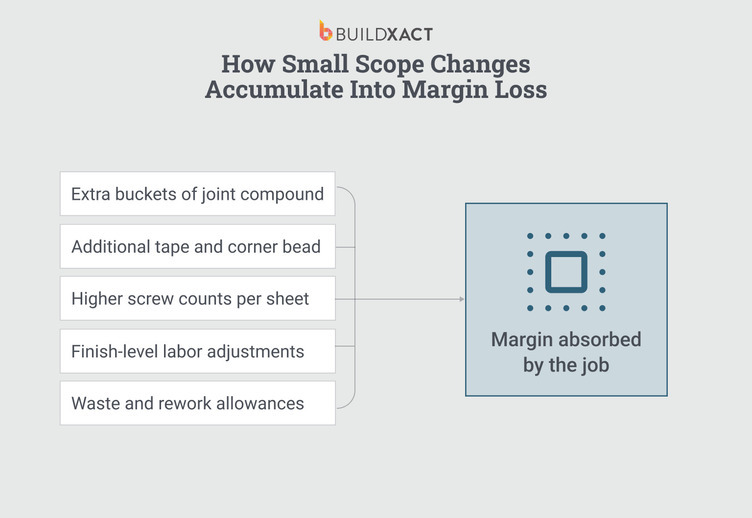
Scope misses aren’t usually carelessness. They happen when plans assume knowledge you didn’t have, or when nothing in your process flags what the architect didn’t draw. Attention alone can’t catch what was never visible in the first place.
The skill is building a check against the places scope typically hides, shaped by project type and by where your past estimates missed.
On a bathroom remodel, that’s waterproofing, backing for grab bars, and vent relocation. On new builds, it’s site prep the plans assume someone else will handle: temporary power, tree protection, driveway access for deliveries.
You also read the drawings against each other. The floor plan says one thing about a wall. The elevation says another. The structural sheet contradicts both. The experienced estimator asks the question before pricing begins rather than discovering the conflict on site.
Producing accurate estimates under deadline pressure
You compete on both timing and price. When your bid arrives two days late, the client has often moved on, sometimes to a higher bid that showed up sooner.
You’re measuring quantities, collecting dealer pricing, applying labor assumptions, and assembling the proposal in parallel. When time compresses, the moments where you move a number from one document to another are where errors enter.
You price from a dealer quote, enter the total into the proposal, and if the dealer revises after you’ve moved on, the proposal number doesn’t update.
The skill is ordering the work so that the things most likely to change don’t sit in the estimate longer than necessary by:
- Starting with the takeoff, so quantities don’t move once measured
- Applying labor rates from standard templates, because those hold week to week
- Sending pricing requests to dealers with your submission date in mind, so quotes come back fresh rather than three days stale. Pricing goes in last, confirmed, and current
- Deciding which line items hold placeholders until confirmed pricing arrives
The framing package, concrete, and roofing remain open until you have a dealer quote in hand. You don’t plug in a number that never gets revisited.
The review before submission becomes a checklist, not a scavenger hunt. Bids go out on time without the knot in your stomach because you built the estimate in an order that matched how the information actually arrives.
Pricing from current dealer data, not assumptions
Your estimate is only as current as the prices in it. You gather pricing directly from dealers and subcontractors, confirm lead times, verify availability, and compare competing quotes before you finalize costs. That’s the process when it works.
When you work from last quarter’s spreadsheet or carry a number forward because it’s close enough, your pricing drifts from market reality. You win the job on a number that made sense three weeks ago, and lose margin on the same line item because the cost moved.
The gap between quoted price and actual cost rarely shows up at bid time. It shows up on the invoice, weeks into the job, when the framing package or concrete pour costs more than the budget allows, and there’s no room left to absorb it.
The skill is knowing which line items can tolerate a carried-forward number and which ones can’t. Lumber, concrete, roofing, anything where pricing moves with the market, gets a fresh quote for every bid. Labor rates and standard hardware that hold month to month can carry forward with a quick check.
Protecting margin from small, overlooked line items
Margin rarely disappears in one dramatic error. It leaks. A waste factor you forgot to apply, a soft cost that dropped out during a revision, and a dealer price update that made it into one version of the bid but not the final document.
Since you know the numbers, the problem is that the process requires you to carry the same figure through the digital takeoff, cost sheet, and proposal, and keep them aligned through every revision. Each manual re-entry is a place where one version falls out of sync without anything flagging it.
Experienced estimators build the check into the sequence. Waste factors and soft costs go into templates, so you don’t have to remember them. These are the kinds of line items that tend to drop out between revisions when they’re not baked into the template:
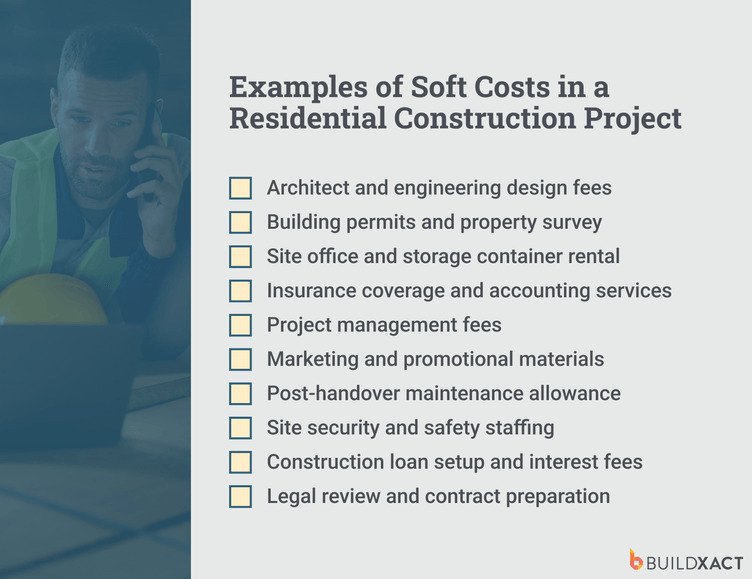
When a dealer price updates, the first step is to identify every document that contains that number, not just the one you’re looking at. Revisions follow a fixed path: takeoff first, cost sheet second, proposal last, every time.
The individual misses are small, but they’re consistent enough to show up in your year-end numbers as margin that eroded across projects and can’t be traced back to any single bid.
Tracing every number back to a clear cost source
When a client questions a line item or you need to revise a bid quickly, you need to know where every number came from. Which dealer? Which version of the quote? What assumptions went into the labor figure?
When cost history sits across scattered emails, saved quotes, and personal spreadsheets, you spend more time reconstructing decisions than making new ones. A revision that should take twenty minutes takes two hours because half of it is archaeology.
The skill is a consistent habit of noting the source alongside the number when entering the estimate. The dealer name and quote date are next to the material cost, the basis for the labor rate, and the version of the plans the takeoff was pulled from.
That takes seconds per line item during the build, but it saves hours during revisions because you’re not re-pricing from scratch to answer a question the estimate should already contain.
Applying contingency without killing competitiveness
You work with incomplete information on every bid. You choose contingency buffers and decide where tight numbers hold and where they need a cushion. Add too much, and you lose the job. Add too little, and you absorb the risk.
The difference between a contingency that’s a guess and one that’s informed is whether you can see what happened on past jobs.
Here, you don’t need a formal system but a habit: when the job wraps, pull the original estimate, compare it against final costs on the five or six biggest line items, and note where the gap was.
After ten jobs, patterns emerge. Concrete runs 8% over your template number. Framing labor holds. Electrical subs come in under on remodels but over on new builds.
Those patterns turn contingency from a flat percentage into a targeted adjustment. You add cushion where the data says you need it and tighten where it says you don’t. Your bids get more competitive on the line items you price well and more protected on the ones that tend to drift.
Why Estimation Breaks, Even When You Follow Best Practices
You already walk the takeoff twice, double-check dealer pricing before sending the bid, and slow down when something looks off. And yet the estimate still drifts.
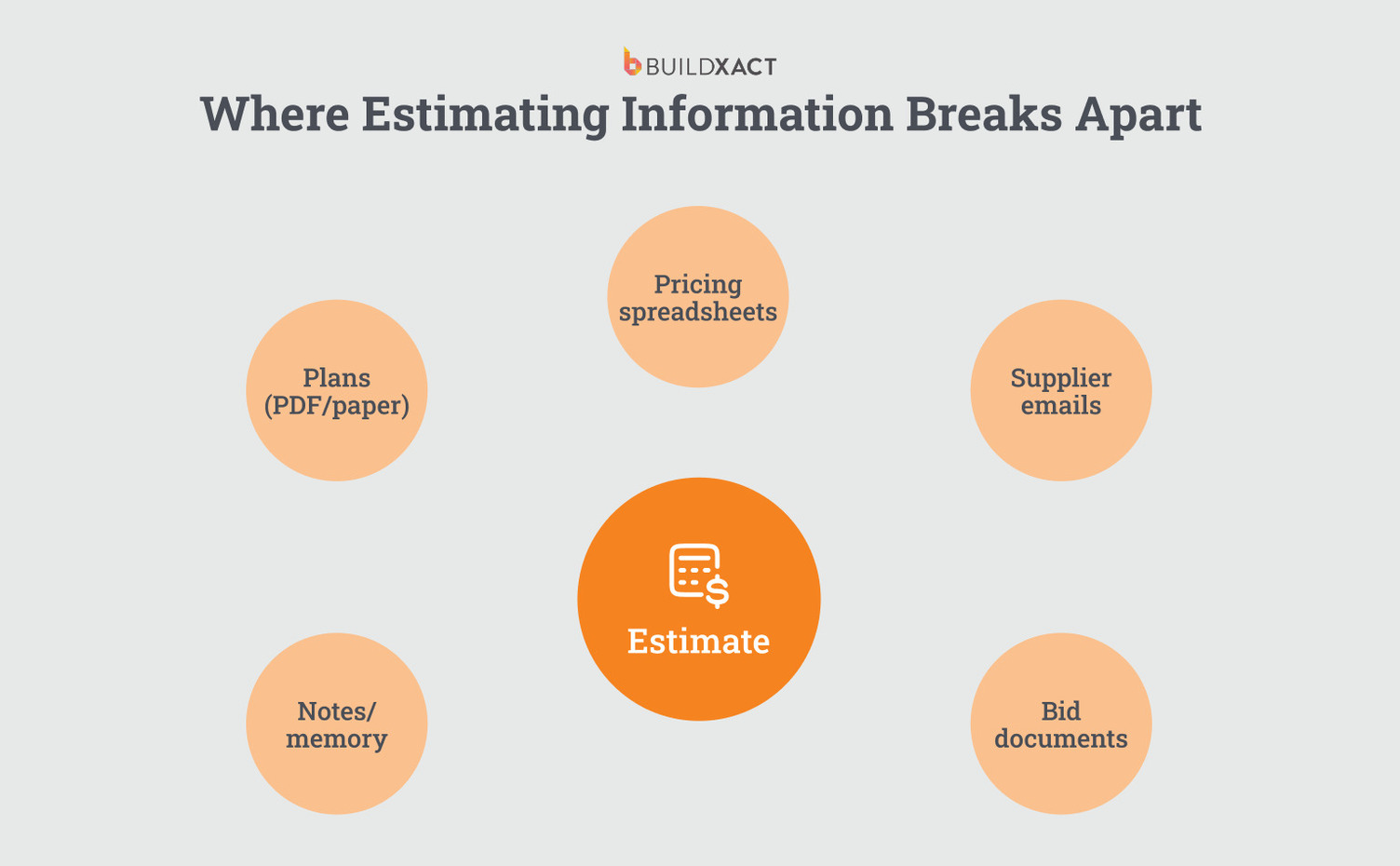
The breakdown starts with how scope, pricing, and revisions stay aligned across separate files, emails, and tools. What follows breaks down where that alignment slips and why effort alone doesn’t prevent it.
The information is fragmented by default
Every estimate begins with a retrieval problem. Before you price a single number, you have to track down and assemble the inputs: the latest plan set, the most recent dealer quotes, your labor rates from the last similar job, and whatever site notes you made off the notepad.
Most of that lives in different places, and none of it is organized for your next bid. The first hour of estimating often isn’t estimating at all, but gathering the information you need. You’re the human bridge connecting all the data that needs to be in the estimate:
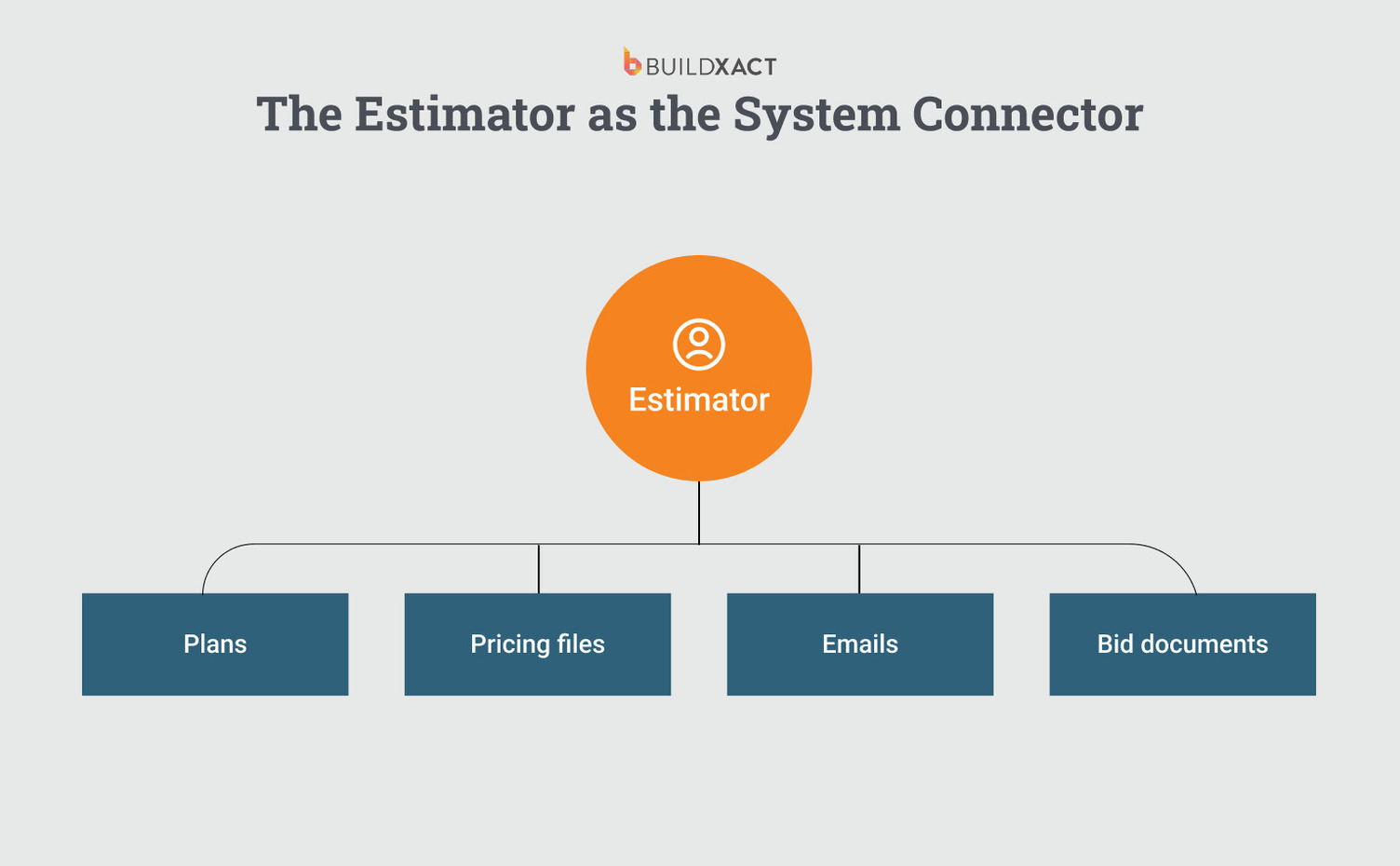
That gathering happens fresh on every bid, even when the work is nearly identical to a job you priced three months ago. The assembly doesn’t compound because nothing from your last estimate carries forward in a way that would make the next one start faster.
And when something shifts between the day you pulled a quote and the day the bid gets finalized, nothing flags the change. The price of lumber moves, lead time extends, or a revised plan set comes in, and the only thing linking those numbers is whether you remember to check back.
The process requires re-entry at every stage
Gathering the information was the first challenge. Keeping it consistent through revisions is the second.
Bids rarely go out unchanged. A quantity adjusts, a dealer updates pricing, or your client changes the scope. Each revision touches the same number in multiple places, and each place needs to be updated independently.
The tools don’t know about each other, so a price change in your cost sheet doesn’t reflect in the bid. A scope adjustment on the plans doesn’t flag which line items in the estimate are now wrong.
That means every revision becomes a manual chain: find every document that contains the affected number, update each one, and confirm that there are no errors in the revisions you make.
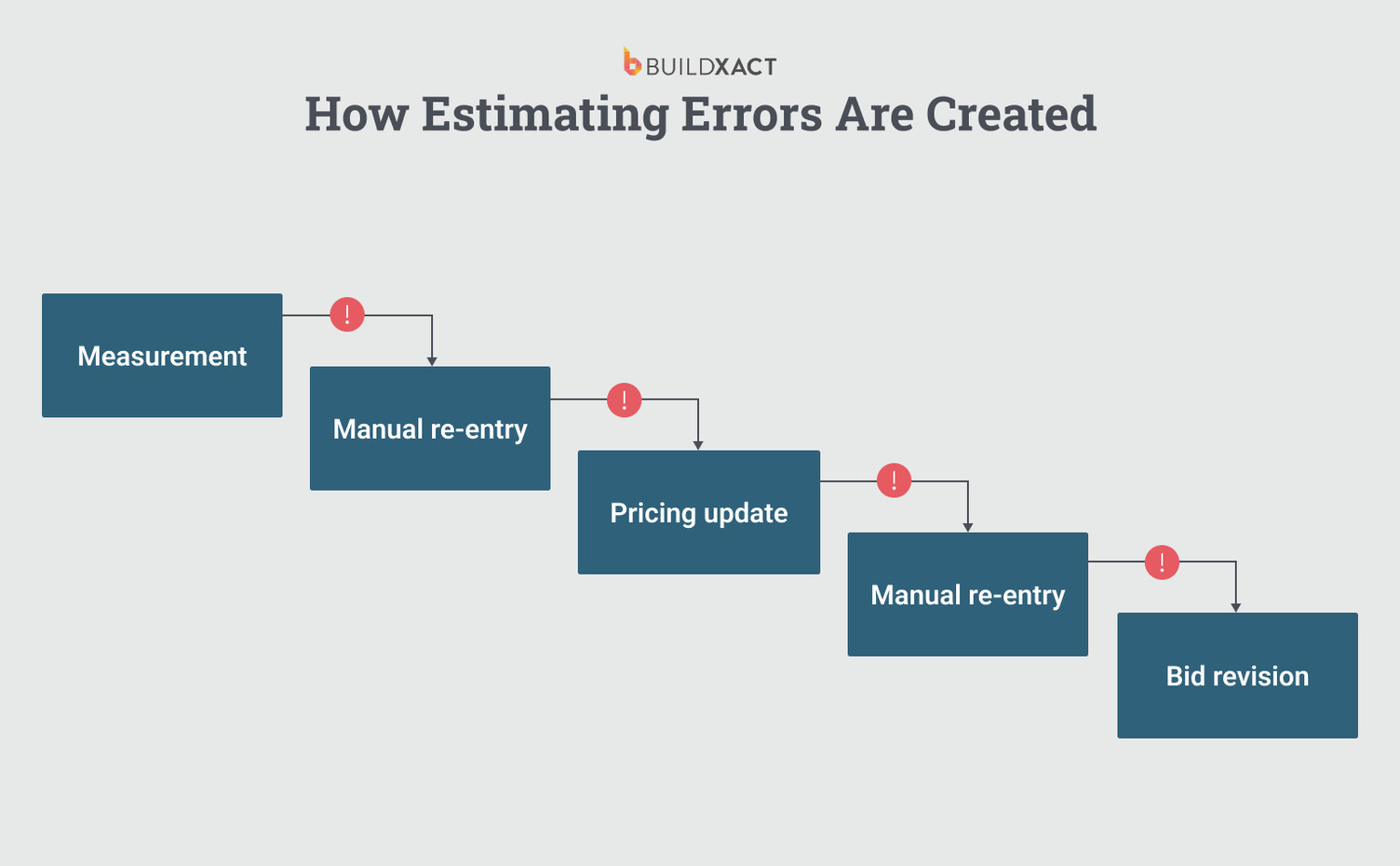
The more revisions a bid undergoes, the more links there are in that chain. Three revisions across three documents are nine manual updates, any one of which can fall out of sync.
Version control depends on memory
After enough revisions, your documents may all contain correct numbers. Just not the same correct numbers.
The takeoff reflects the latest quantities, but the cost sheet still carries last week’s dealer pricing. The proposal matches the cost sheet but not the takeoff.
Nothing in the workflow enforces alignment because there’s no mechanism that connects a changed number to the other places it appears. Revisions stay consistent only as long as you remember every place a figure lives and manually confirm each one.
The errors that come out of this don’t look like math mistakes. They look like a bid that was internally sound, but described two different versions of the job by the time it went out the door.
The feedback loop that rarely closes
After the job wraps, another bid is already waiting.
Your actual material costs, labor overruns, and missed line items don’t always get compared line by line against the original estimate. Not because the review doesn’t matter, but because there’s no built-in step that makes it simple enough to fit into a schedule that’s already full.
Without that comparison, the same estimating blind spots carry forward from project to project.
You improve through intuition over time, but slowly, because the system doesn’t clearly surface what went wrong to allow you to correct it. The patterns are there. They’re just never measured.
What Modern Estimation Looks Like
Understanding why estimation breaks is only useful if it actually resolves. The fix isn’t trying harder. It’s removing the manual bridging that causes the failures in the first place.
One system, one workflow
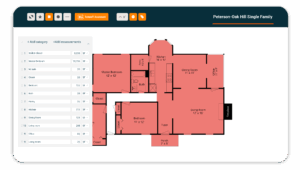
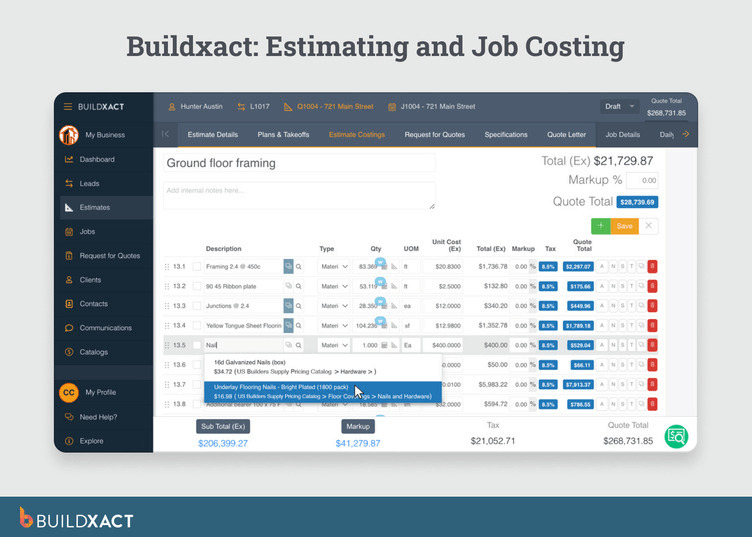
Modern estimation connects the steps that used to be scattered. Plans come in digitally. The takeoff happens on screen, with measurements flowing directly into the estimate without re-entry.
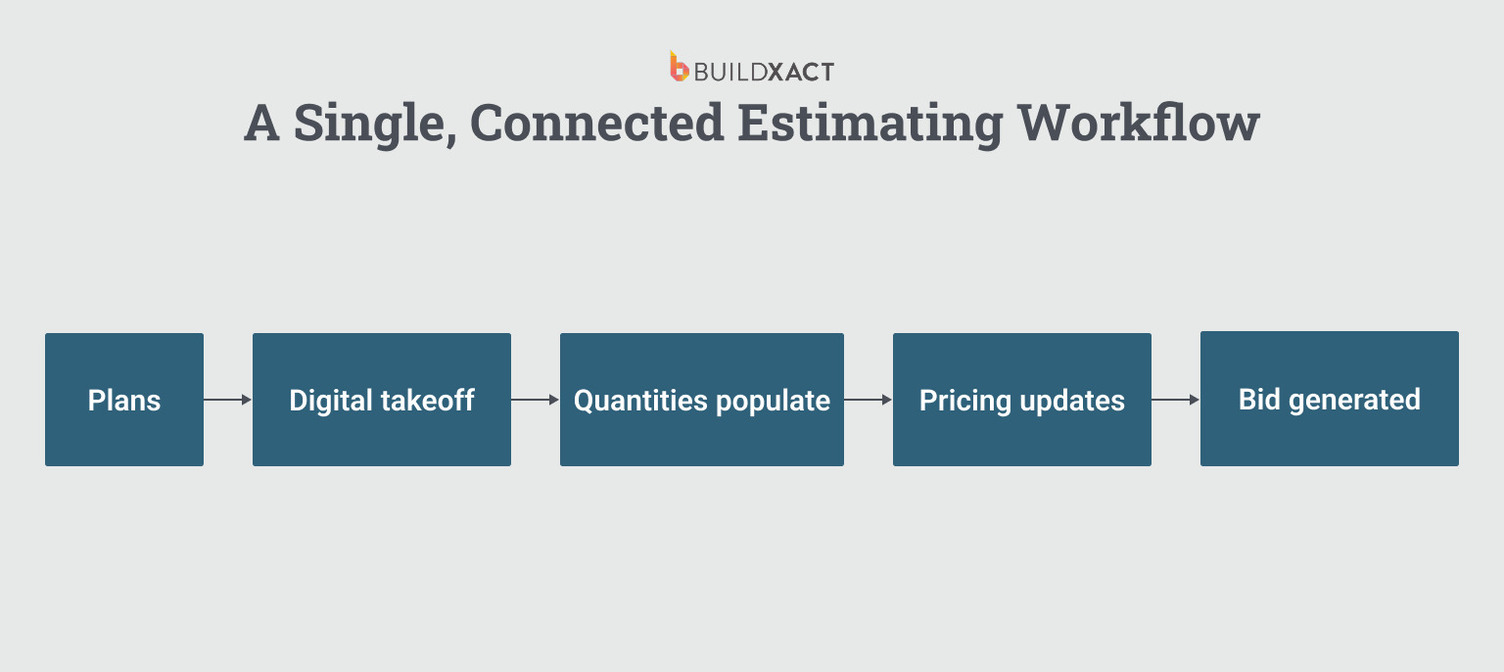
Dealer pricing pulls in live, so the numbers reflect what materials actually cost today. The bid generates from the estimate itself, not from a separate document that has to be rebuilt every time something changes.
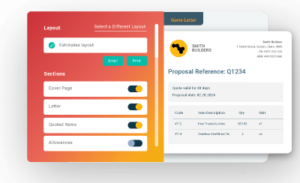
With our Blu takeoff assistant, the digital takeoff feeds directly into your cost estimate, so the workflow structures itself this way. Digital takeoff feeds directly into the cost estimate. The proposal pulls from the same data set, so when quantities change, the estimate updates without requiring re-entry across multiple documents.
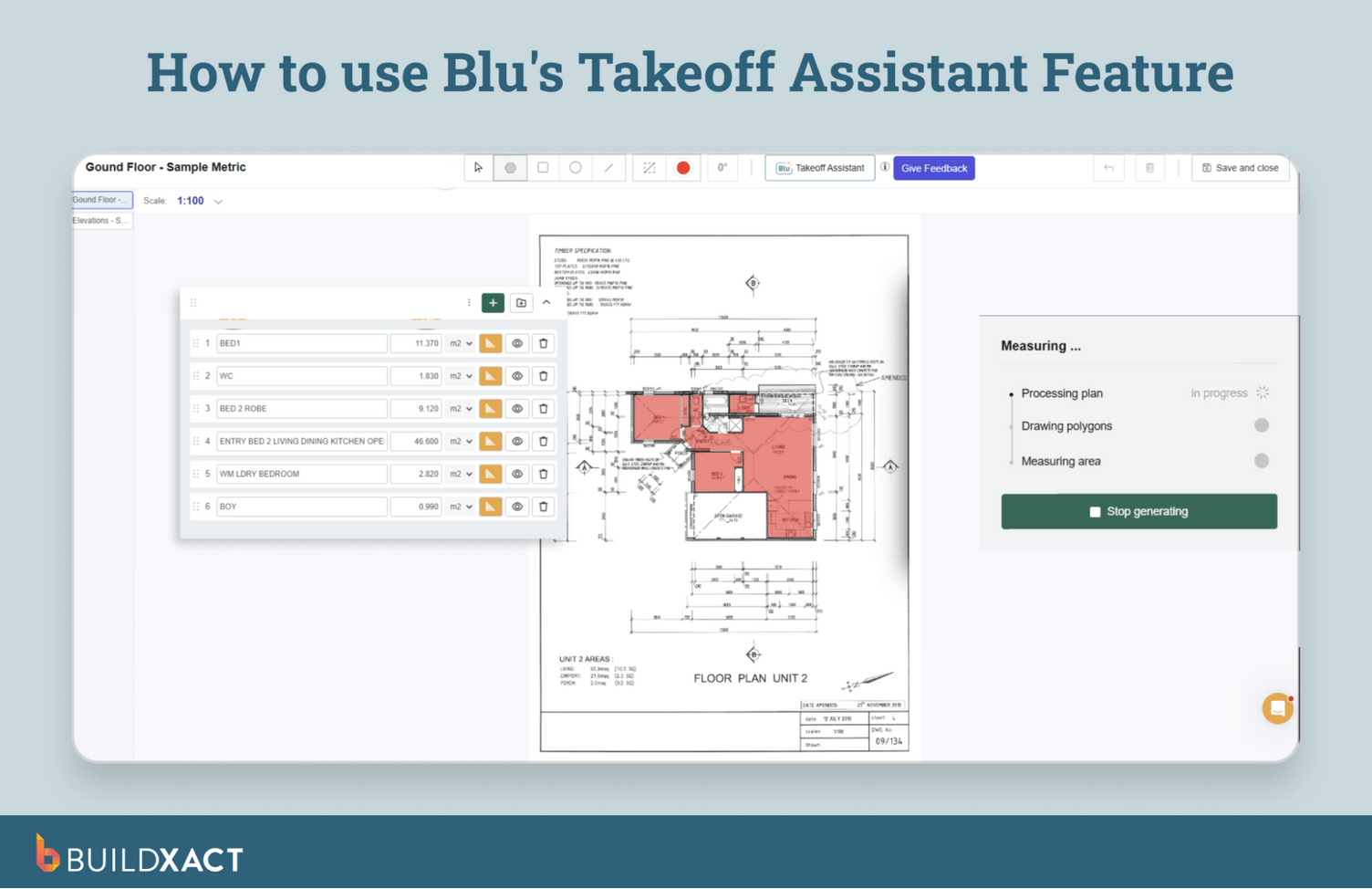
The work that used to take a weekend, measuring from plans, building the cost sheet, chasing dealer quotes, assembling the proposal, can happen in an afternoon. Not because the estimate is less thorough, but because the re-entry steps that consumed most of your time are gone.
Pricing that updates itself
Live dealer pricing lets you lock in current-day costs in the estimate, instead of waiting for dealer callbacks or referencing a spreadsheet from last quarter.
Buildxact integrates dealer pricing directly into the estimating environment. When material costs change, your active estimates are automatically updated.
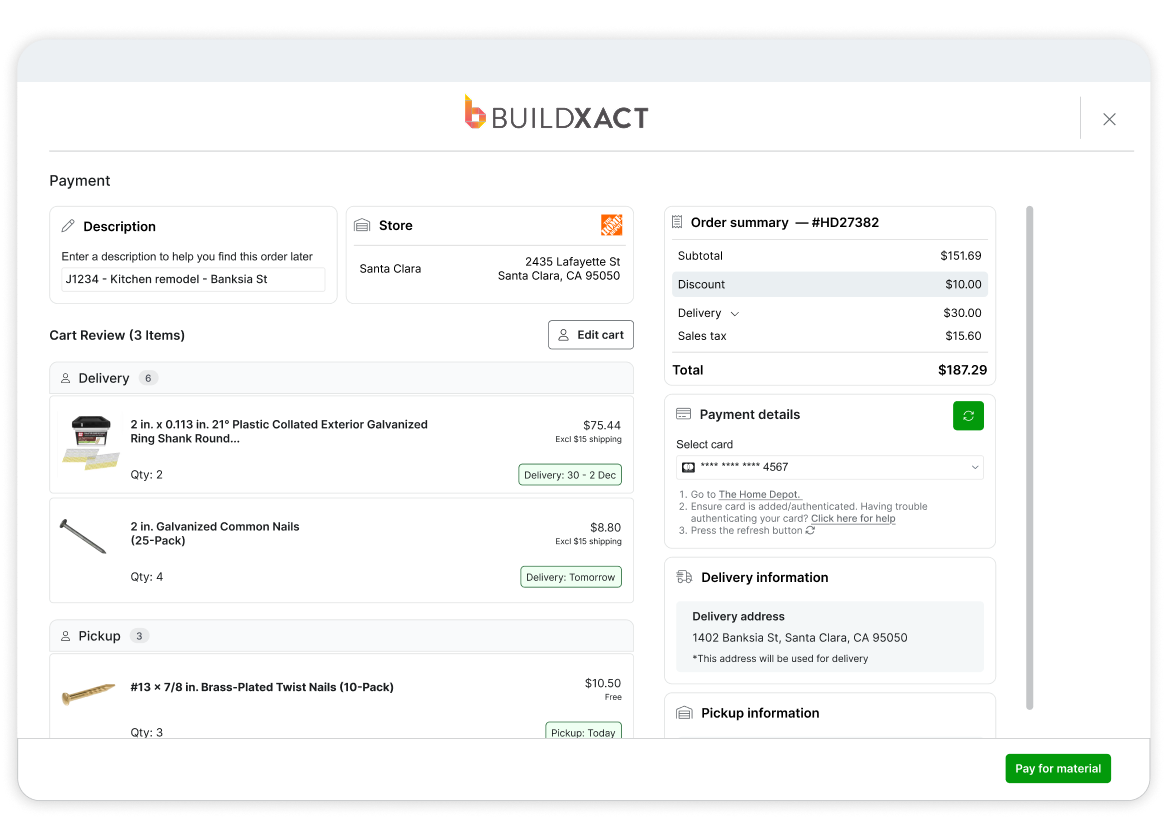
You quote today’s prices, not last month’s. And when pricing moves mid-project, the impact shows up in your estimate immediately, not three weeks later when you’re reconciling invoices against a budget that was already out of date.
Every estimate starts with what you already know
Assemblies and templates capture what you’ve learned from past projects. A kitchen remodel isn’t a blank spreadsheet. It’s a set of known material relationships, labor requirements, and cost patterns your system already holds. New jobs don’t start from zero. They start from what the last ten jobs taught you.
Buildxact’s Blu estimate generator supports assemblies that bundle materials and labor into reusable components. When you price a kitchen remodel, the estimate is based on prior configurations rather than rebuilding each line item from scratch.
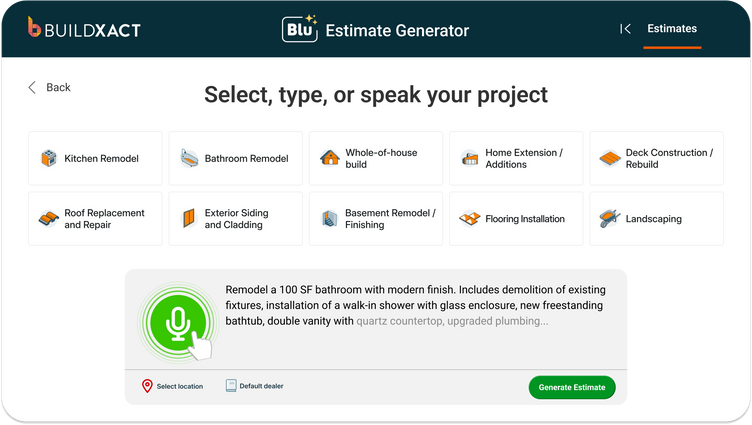
The small items that quietly bleed margin, silicone, baseboards, trim, waste factors, are built into the template rather than dependent on whether you remembered them the night before the bid goes out.
Where the feedback loop finally closes
In a connected system, the estimate not only produces a bid but also provides a complete view of the project. It becomes the project budget.
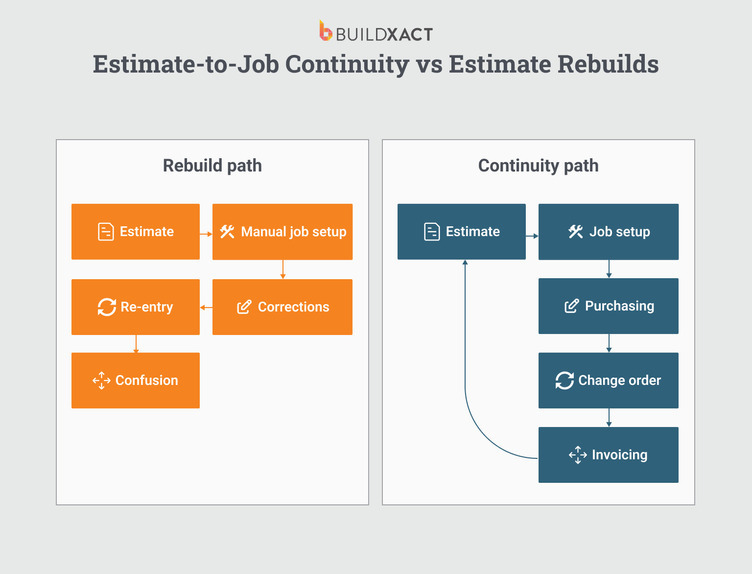
Actual costs are tracked against your original assumptions line by line, so the comparison that rarely happened with disconnected tools now happens by default.
Buildxact carries the estimate forward into project management and cost tracking. When a job wraps, you can see exactly where material costs ran over, where labor hours drifted, which line items held, and which didn’t.
That data feeds your next estimate. The kitchen remodel template, which was already good, becomes even more accurate because it now reflects what the last three kitchen jobs actually cost, not what you assumed they’d cost.
The shift isn’t just speed, though the speed matters. It’s that every completed project makes the next estimate tighter, because cost data flows back into the system instead of sitting in a folder no one opens again.
Estimation Doesn’t Have to Be a Second Shift After a Day on the Job Site
Estimation isn’t about being good at math. It’s about speed and accuracy working together, winning the bid, and protecting the margin once you do.
For most residential builders, the process breaks down because their data lives in 5 different places, and they’ve become the manual link between systems that don’t talk to each other.
That setup works when you’re running a few jobs a year and can afford the time to reconcile everything by hand. It starts to collapse when the volume picks up and the re-entry that used to take a weekend now competes with every other part of running the business.
What resolves it is a connected system that keeps takeoff, pricing, and quoting in one place, so information flows through the estimate instead of being re-entered across documents, and estimates get faster without becoming less accurate.
Start using Buildxact for free or book a demo and see what estimation looks like when the workflow holds it together instead of you.