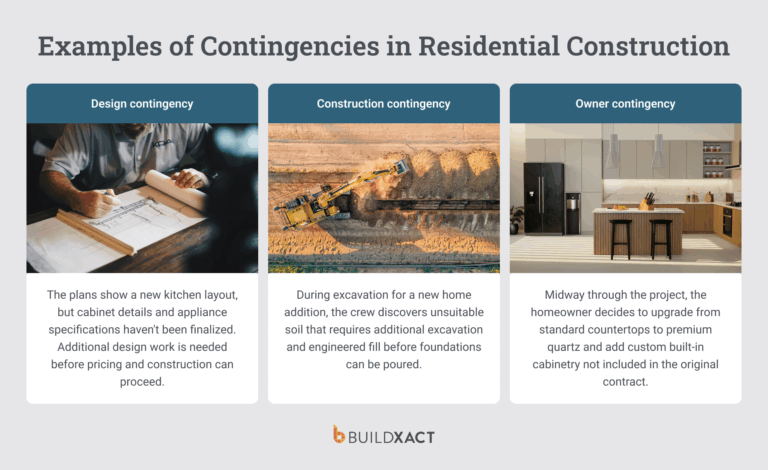



Residential construction management is the process of planning, coordinating and managing a home build or remodel to keep the project on schedule, within budget and on track for the planned margin.
The work you do on the building site is only part of running a successful residential construction project.
Every job also depends on accurate estimates, well-planned schedules, controlled costs, reliable subcontractors, and a clear view of progress from start to finish.
And as your business and workload grow, managing all those moving parts becomes more complex. Estimates need to hold up once work begins. Costs need to stay visible against the original budget. Schedules need to keep crews and subcontractors moving. And throughout the job, you need to know whether you’re still on track to deliver the margin you planned.
In this guide, we’ll explain how to improve your residential construction management at every stage of the project lifecycle, with practical systems for planning, scheduling, cost tracking, site management, and project closeout.
Key Takeaways
- Residential builders need repeatable construction management processes that can scale as they take on more projects.
- The estimate is the project budget baseline. Every phase of management ties back to it.
- Real-time cost tracking helps builders identify cost and margin issues while there is still time to act.
- Strong construction management helps builders maintain control over costs, schedules, teams, and margins as their business grows.
- Start with the phase creating the greatest risk to your projects or margins, then improve your processes from there.
How to Manage Residential Construction Projects as Your Business Grows
What happens in one stage of a residential project rarely stays there. A scheduling delay can push back several trades, while a cost overrun can reduce the margin left at closeout.
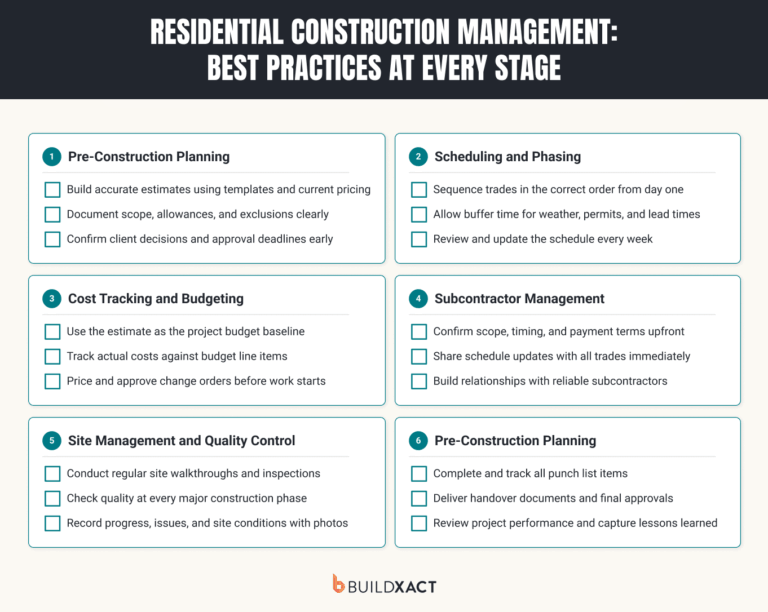
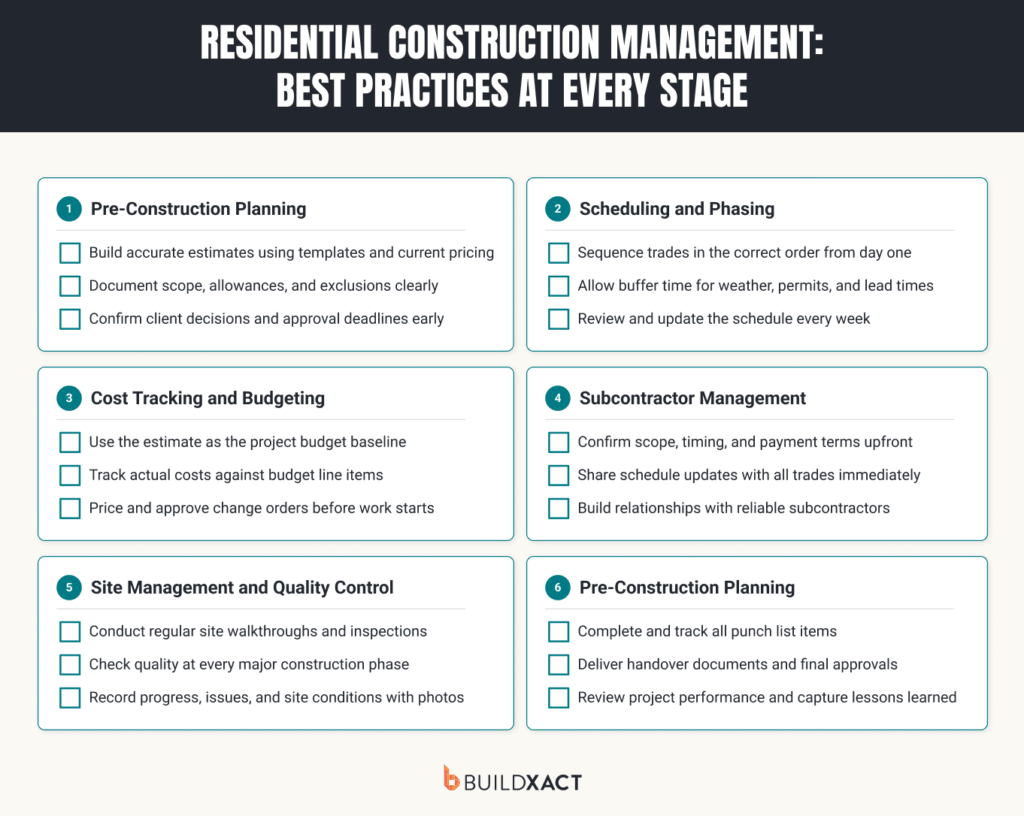
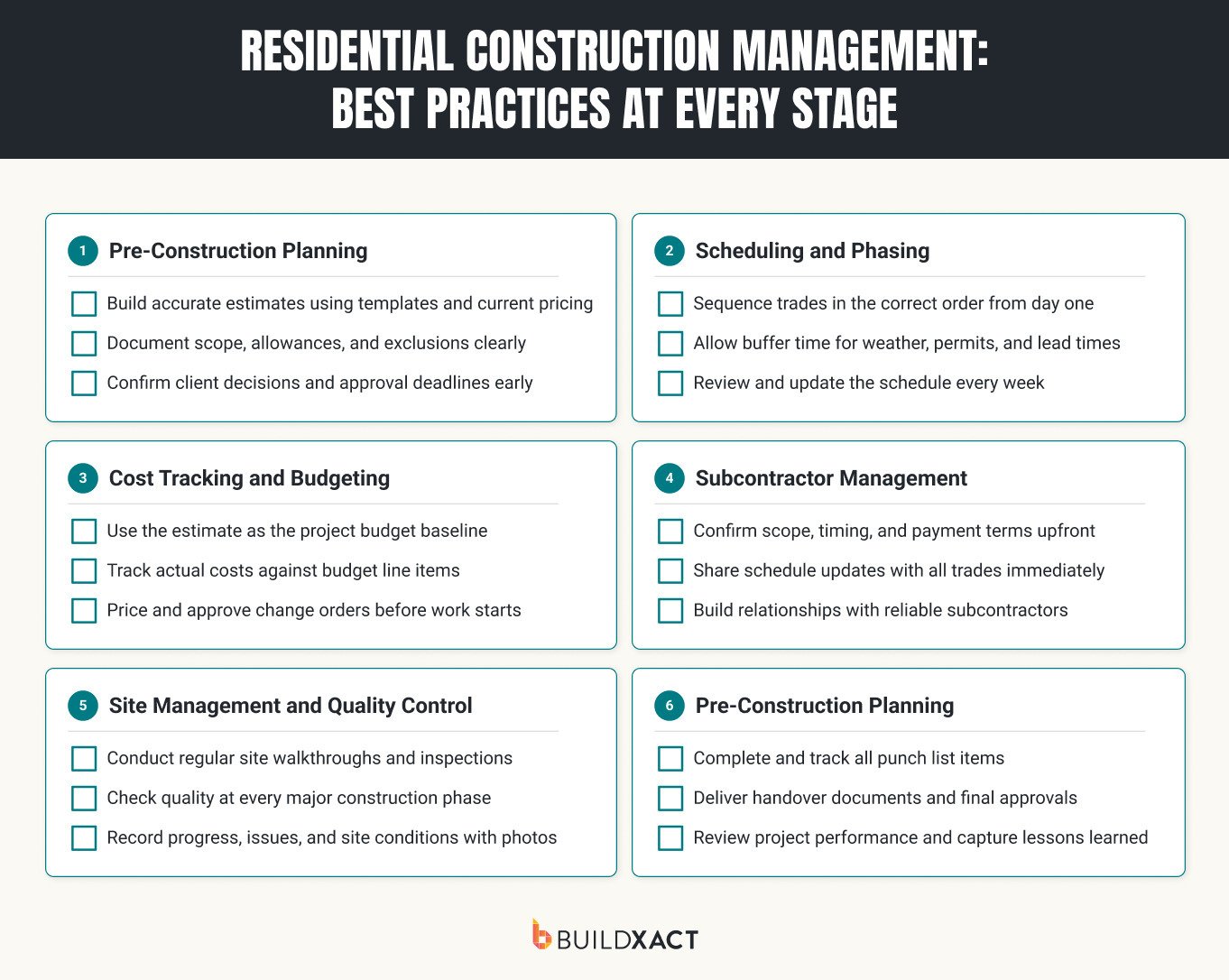
Breaking project management into six phases makes it easier to see where those problems start and put the right controls in place at each stage. Use the following framework to review how you currently run your jobs and identify where your process needs tightening.
1. Pre-construction planning
The decisions you make before work starts have a major impact on what happens once you’re on site. If the estimate misses costs or the scope leaves room for interpretation, you’re starting the job with problems already built in.
Speed up estimates and bids
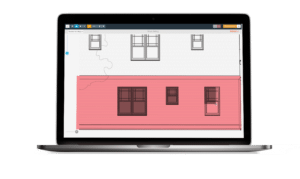
A detailed estimate gives you a reliable financial baseline for the job. Build it around accurate quantities, current material and labor costs and everything required to deliver the agreed scope.
Reusable estimate templates and assemblies can also save you from rebuilding common parts of a job every time you bid. This makes it easier to price work consistently as bid volume increases.
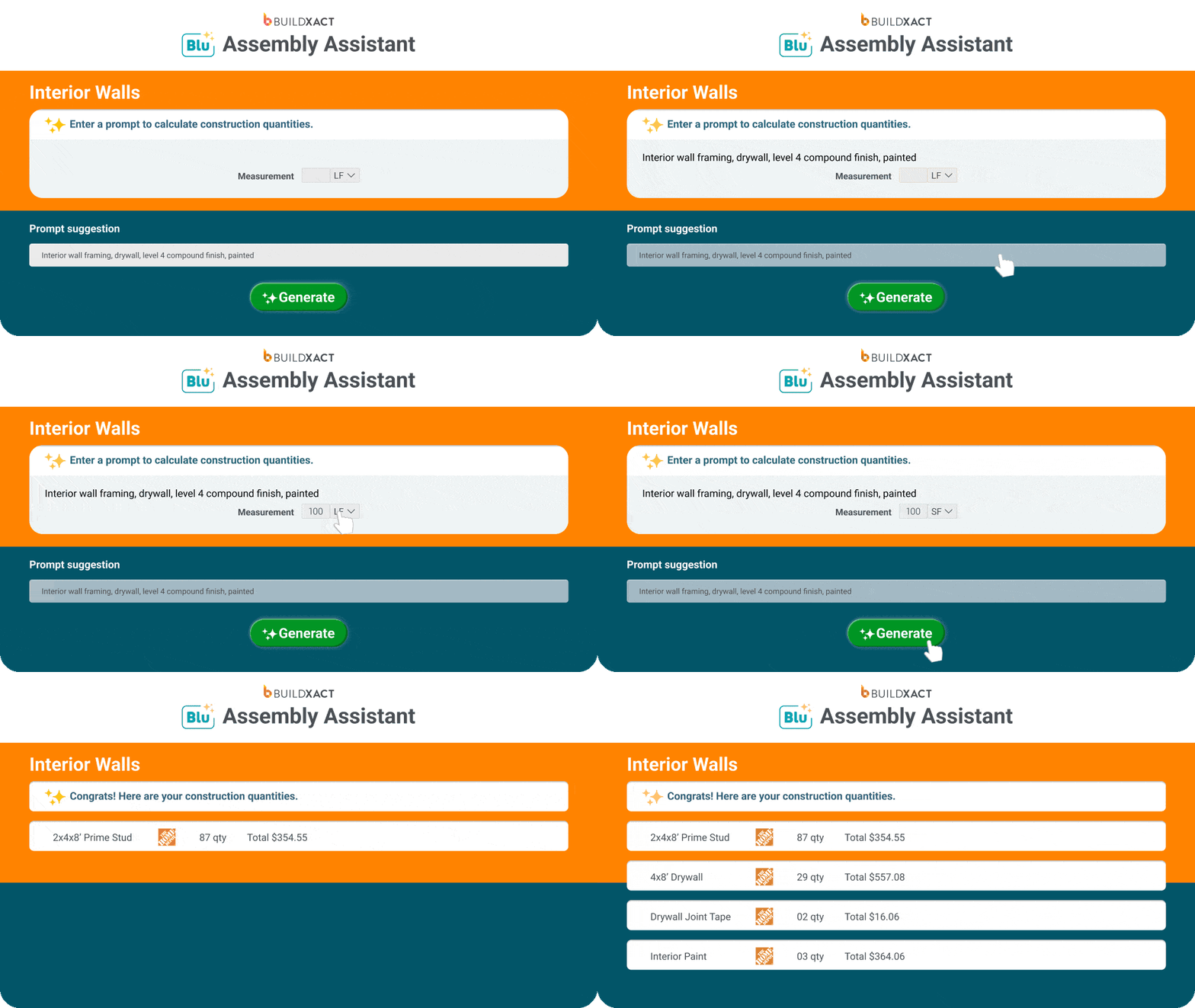
Buildxact data shows builders can save 30% of their estimating time by using templates and saved assemblies.
Set clear expectations on scope
Document exactly what the price includes before work begins, including allowances and exclusions. Set expectations around the project timeline and when homeowners need to make key decisions.
A clear construction scope gives you something concrete to refer back to when a client requests additional work. That makes it simpler to identify a genuine change, price it properly and protect the margin built into the original job.
2. Scheduling and phasing
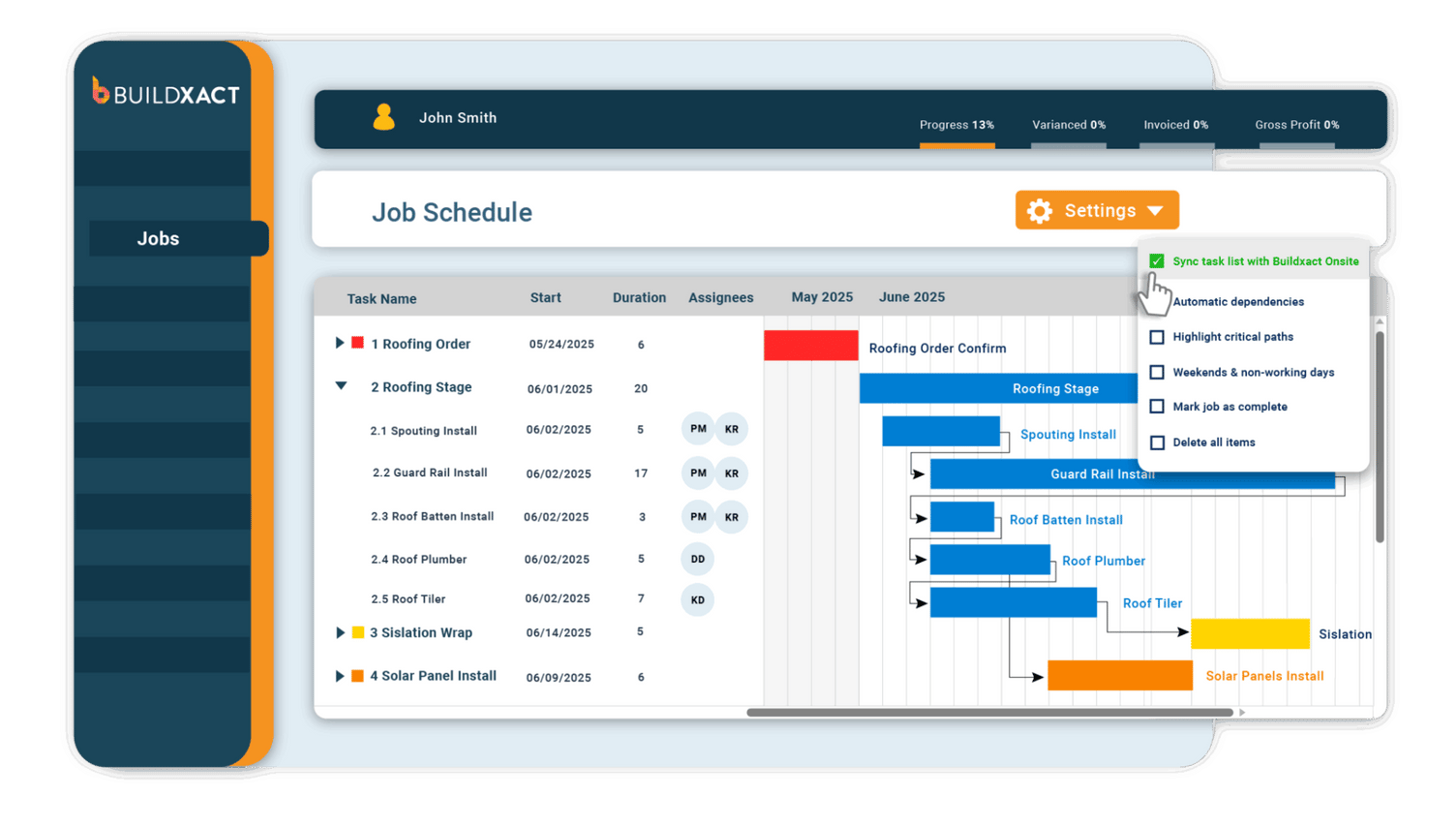
A construction schedule does more than put dates against tasks. It shows how each stage of the build depends on the one before it, helping you coordinate crews, subcontractors, materials and client decisions in the right order.
Build a robust project schedule
Break the project into logical phases such as foundation, framing, mechanicals and finishes. Then sequence the work around the dependencies between them. Framing needs to be ready before rough-in starts, for example, and rough-in needs to be complete before walls are closed.
Allow for the delays you can reasonably anticipate, too. Weather, permit approvals and material lead times can all affect when the next phase can begin. A realistic schedule gives you room to manage those issues without every delay immediately pushing back completion.
Keep the schedule on track
Review the schedule weekly rather than waiting for a missed date to tell you something has gone wrong. Check upcoming work, confirm subcontractor availability and adjust dates when conditions change.
Make those updates visible to everyone affected. A current schedule gives everyone involved a clearer picture of what happens next and reduces the knock-on effect of people working from old dates.
Buildxact customers complete 56% more jobs on time, an important advantage when you’re coordinating several active projects.
3. Cost tracking and budgeting
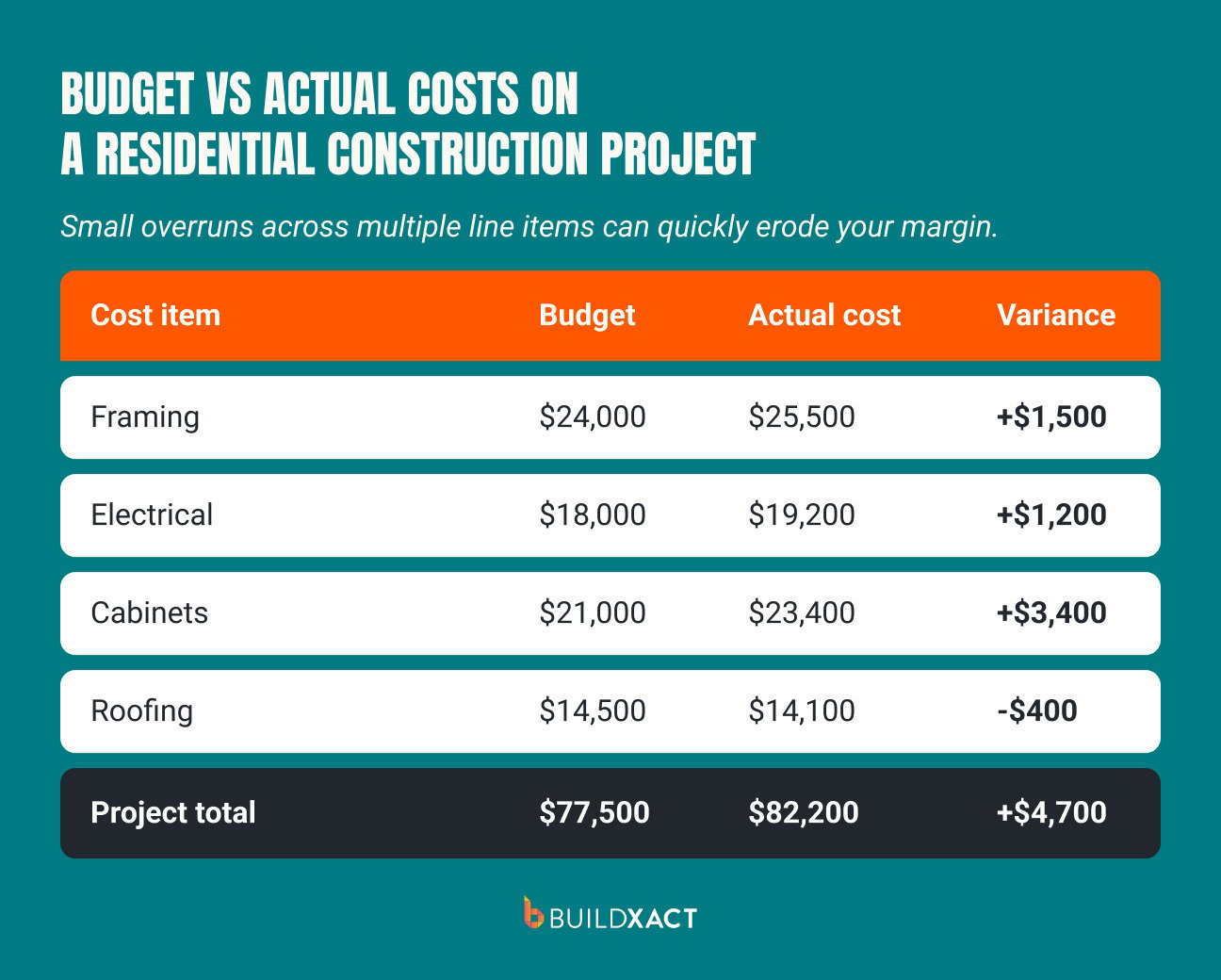
Your estimate tells you what the job should cost. Once work begins, cost tracking tells you whether those numbers are holding up.
That connection is important; finding out a job went over budget after closeout doesn’t give you much chance to do anything about it.
Track costs in real time
Use the accepted estimate as your project budget baseline, then compare actual and committed costs against it throughout the build.
Track costs at the line-item or cost-category level rather than relying only on the overall project total. If framing materials or electrical labor are running over, you can see where the variance is coming from and how it could affect the remaining budget and planned margin.
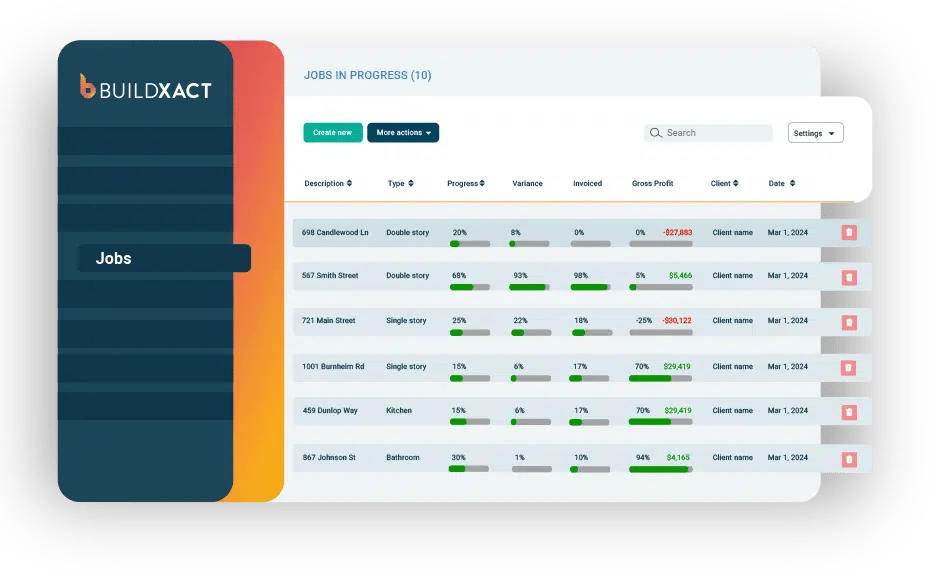
Regular estimate-versus-actual checks also give you better information for future bids. If the same category repeatedly costs more than estimated, you know the numbers need adjusting next time.
Reduce change order chaos
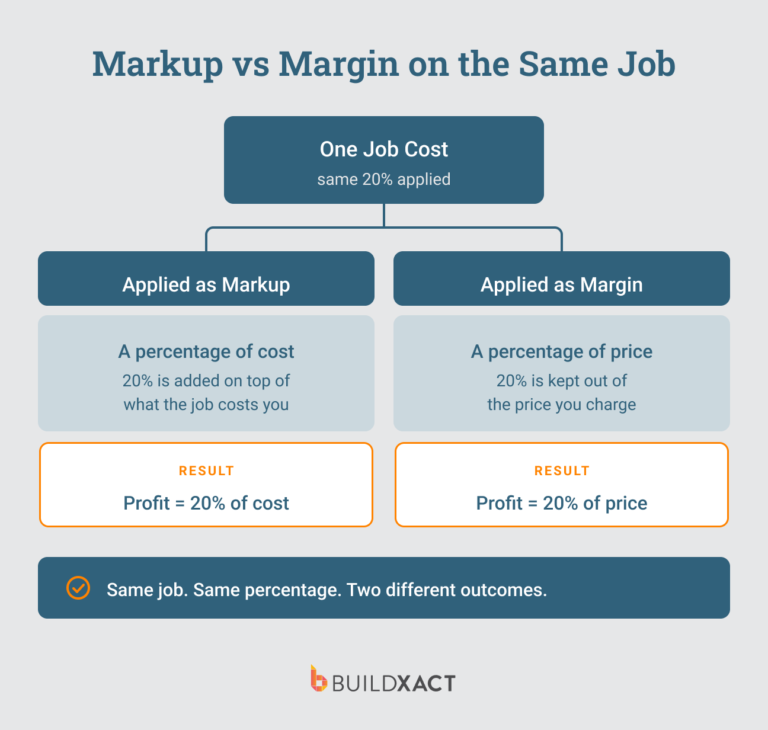
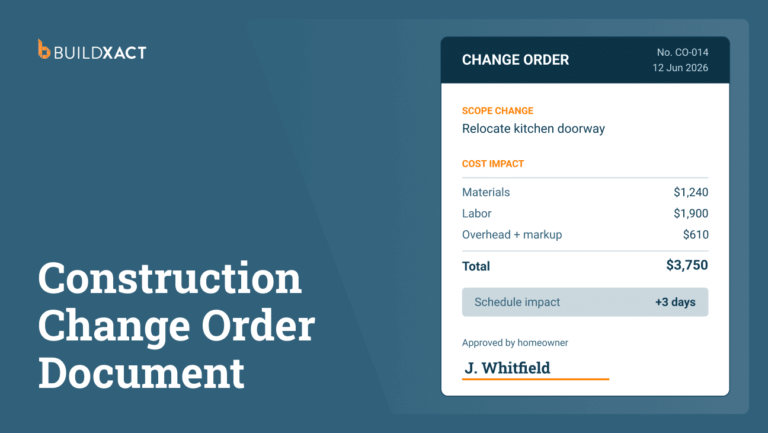
Scope changes need the same financial control as the original work. Document the change, price the additional materials, labor, subcontractor costs and markup, then get written client approval before proceeding.
Once approved, update the project budget so you’re measuring the job against its current scope. Otherwise, additional work can look like an overrun when it should have been accounted for and billed separately.
4. Subcontractor management
A subcontractor delay rarely affects only one task. If plumbing runs late, cabinetry or tile work may have to be rescheduled. That can push later trades back and ultimately delay project completion.
Reliable subcontractor management comes down to setting expectations early and coordinating trades as the job progresses.
To manage subcontractors more effectively:
- Choose subs based on past performance: Look beyond price to reliability, quality of work and how well they communicate when plans change.
- Set expectations before work starts: Confirm the scope, schedule and payment terms so everyone knows what they’re responsible for.
- Coordinate trades on site: Make sure the site is ready and sequence overlapping trades so one crew isn’t holding up another.
- Address problems early: Deal with performance issues and scheduling conflicts before they affect later phases.
- Build a reliable sub network: Keep track of the subcontractors who consistently deliver so you have dependable people to call as you take on more work.
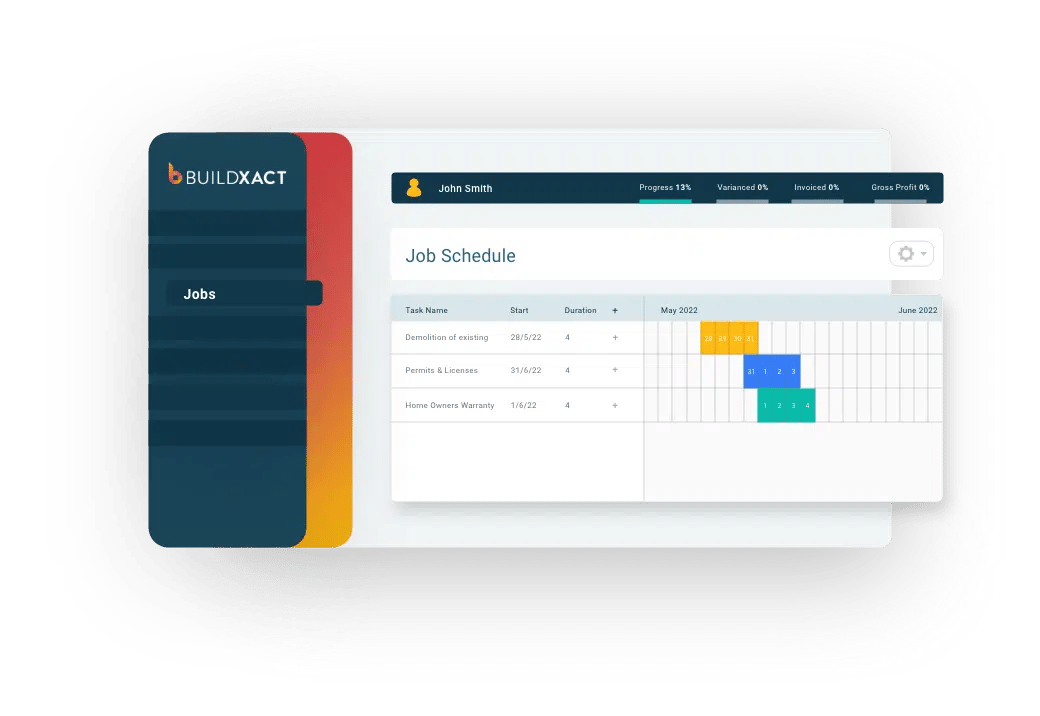
Keeping subcontractor work on track is a common construction challenge. A study by Construction Management found that nearly 11% of subcontractor visits ended with work left incomplete, while fluctuations in subcontractor output were identified as a significant cause of project delays.
5. Site management and quality control
While a schedule shows what should happen, it’s the day-to-day site management that tells you whether it actually is.
Regular checks help you catch workmanship issues, delays and changing site conditions while there is still time to deal with them.
Build these practices into the way you manage each job:
- Conduct regular site walkthroughs: Use daily checks for immediate issues and weekly walkthroughs to review overall progress.
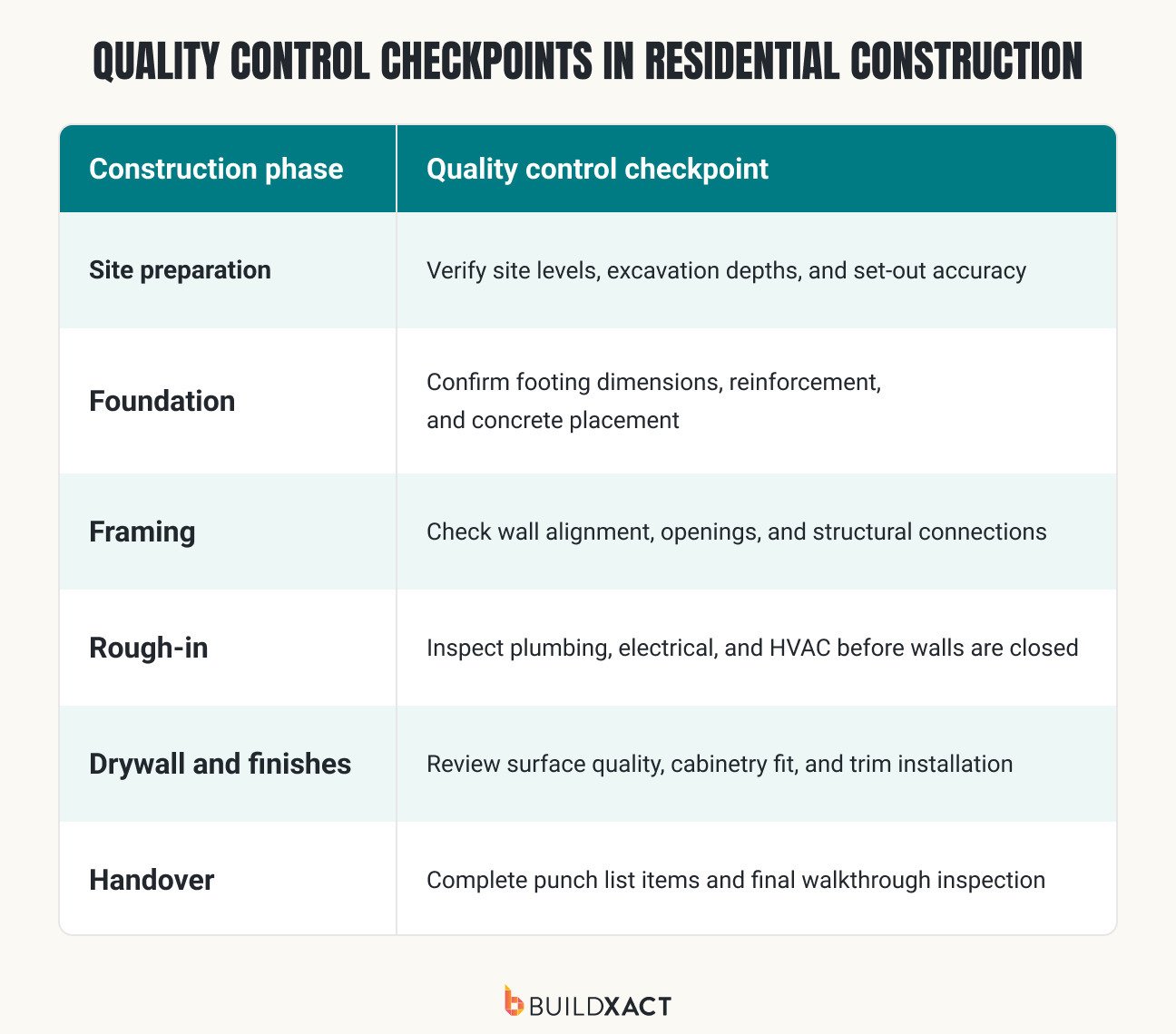
- Set quality checkpoints: Inspect work at key stages before the next phase begins or covers it up.
- Document site conditions and progress: Use photos and site notes to maintain a clear record of completed and outstanding work.
- Maintain site safety: Keep required safety controls in place and address hazards as they arise.
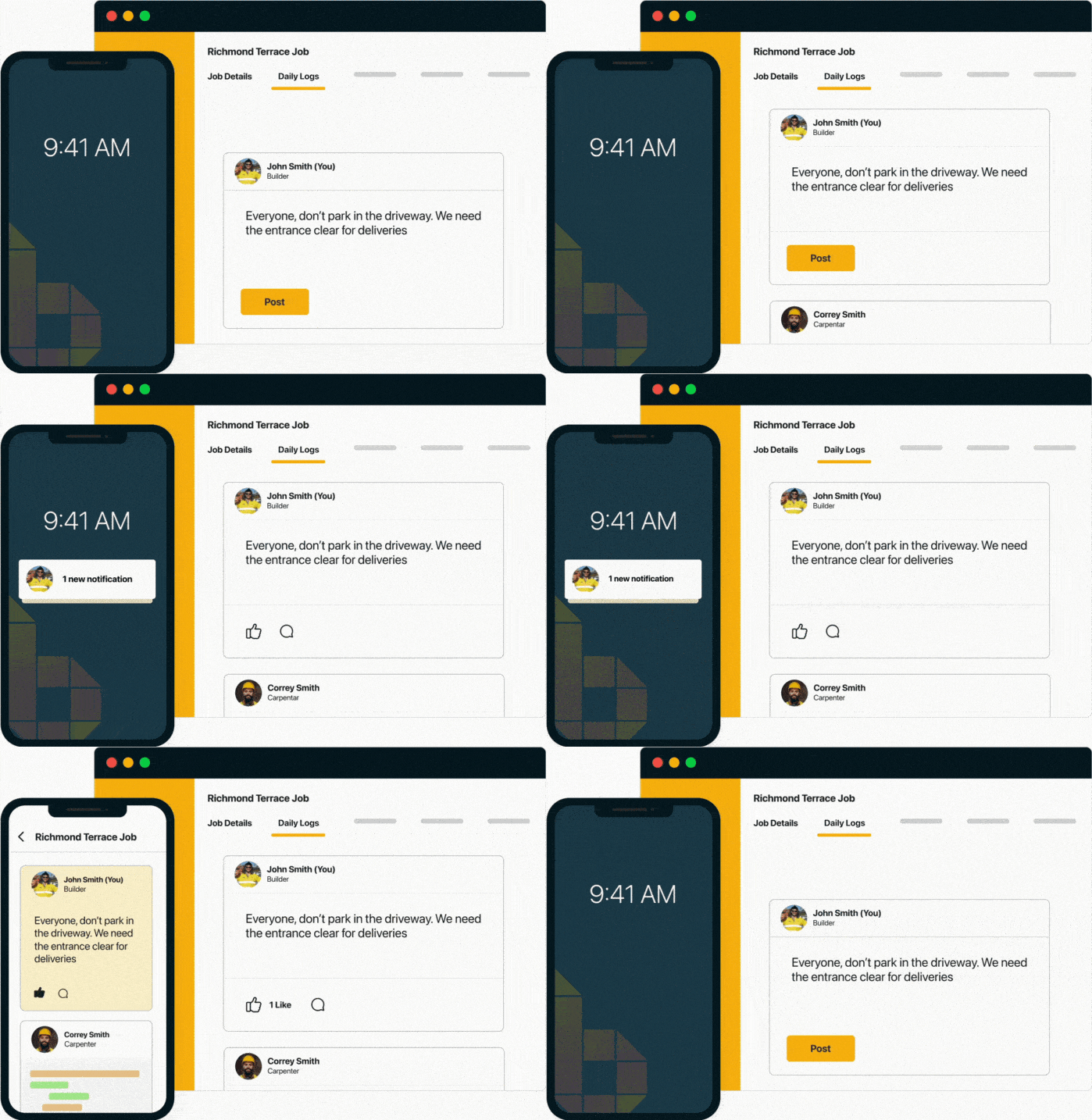
Catching an issue during the relevant phase is usually faster and less expensive than discovering it during final inspection. Consistent site checks help prevent small quality or progress issues from turning into delays that affect the wider project.
6. Project closeout
Closeout is where you finish the current job properly and capture information that can improve the next one.
A repeatable process helps clear outstanding work, give the homeowner a professional handover and make sure nothing gets forgotten as your team moves onto another project.
For a stronger project closeout:
- Work through a structured punch list: Record outstanding items, assign responsibility and track each one through to completion.
- Complete final inspections: Resolve remaining issues and provide the certificate of occupancy where applicable.
- Perform a client walkthrough: Review the finished project with the homeowner and provide the relevant handover documentation.
- Review project performance: Compare final costs and margin with the estimate, assess schedule performance and identify what could work better next time.
- Request reviews and referrals: Once outstanding work is complete and the homeowner is satisfied, ask them to share their experience or recommend your business.
The internal review is particularly valuable as project volume grows. Lessons from actual costs, scheduling and subcontractor performance can feed into the way you estimate and manage future jobs, helping you make each project more predictable and profitable.
How Software Supports Residential Construction Management
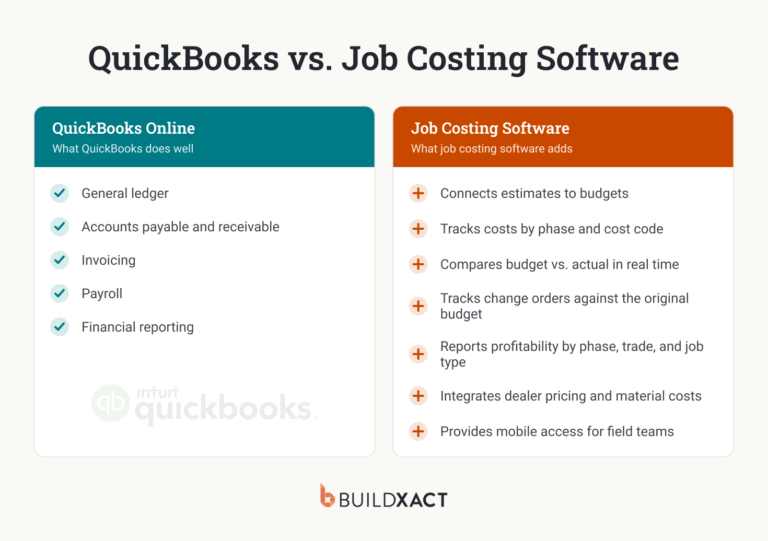
The value of construction management software comes from giving you a clearer view of how each job is performing against the numbers you priced at the start.
For growing residential builders, that means looking beyond the volume of features a platform offers. Instead, focus on whether it supports the numbers, schedules and job information you rely on throughout the build.
Key features to look for include:
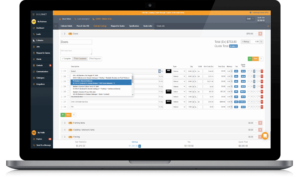
- Estimate-to-project continuity: Carry the accepted estimate into the project, so the scope, quantities and costs you priced remain the reference point as work progresses.
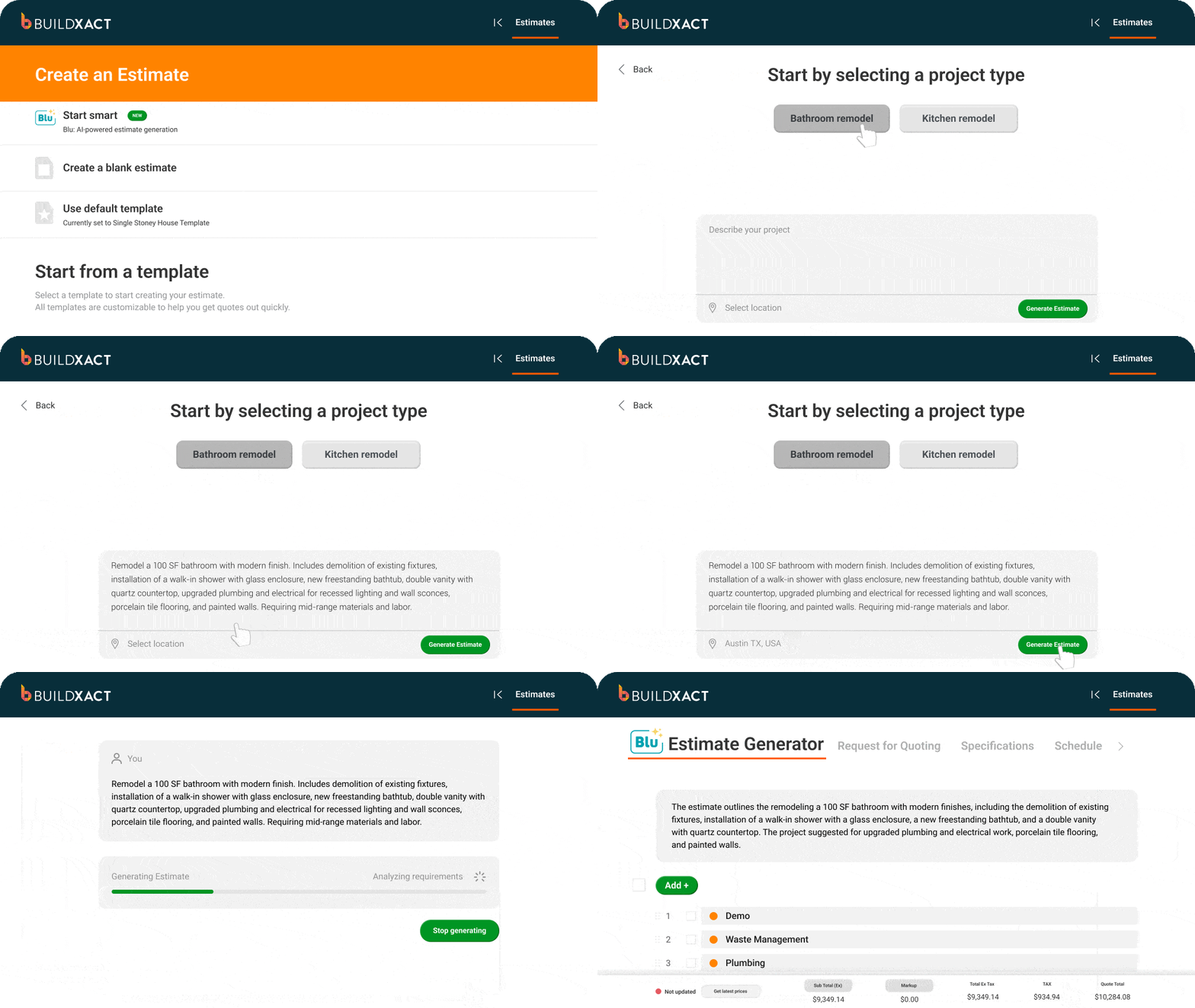
- AI estimate review: AI tools that automatically check estimates for potential errors before the bid goes out help you catch costs that could otherwise eat into your margin.
- Estimate vs. actual tracking: Compare estimated, committed and actual costs to see where a job is moving away from budget and what that means for your planned margin.
- Flexible scheduling: Adjust dates when conditions change and keep subcontractors working from the latest project schedule.
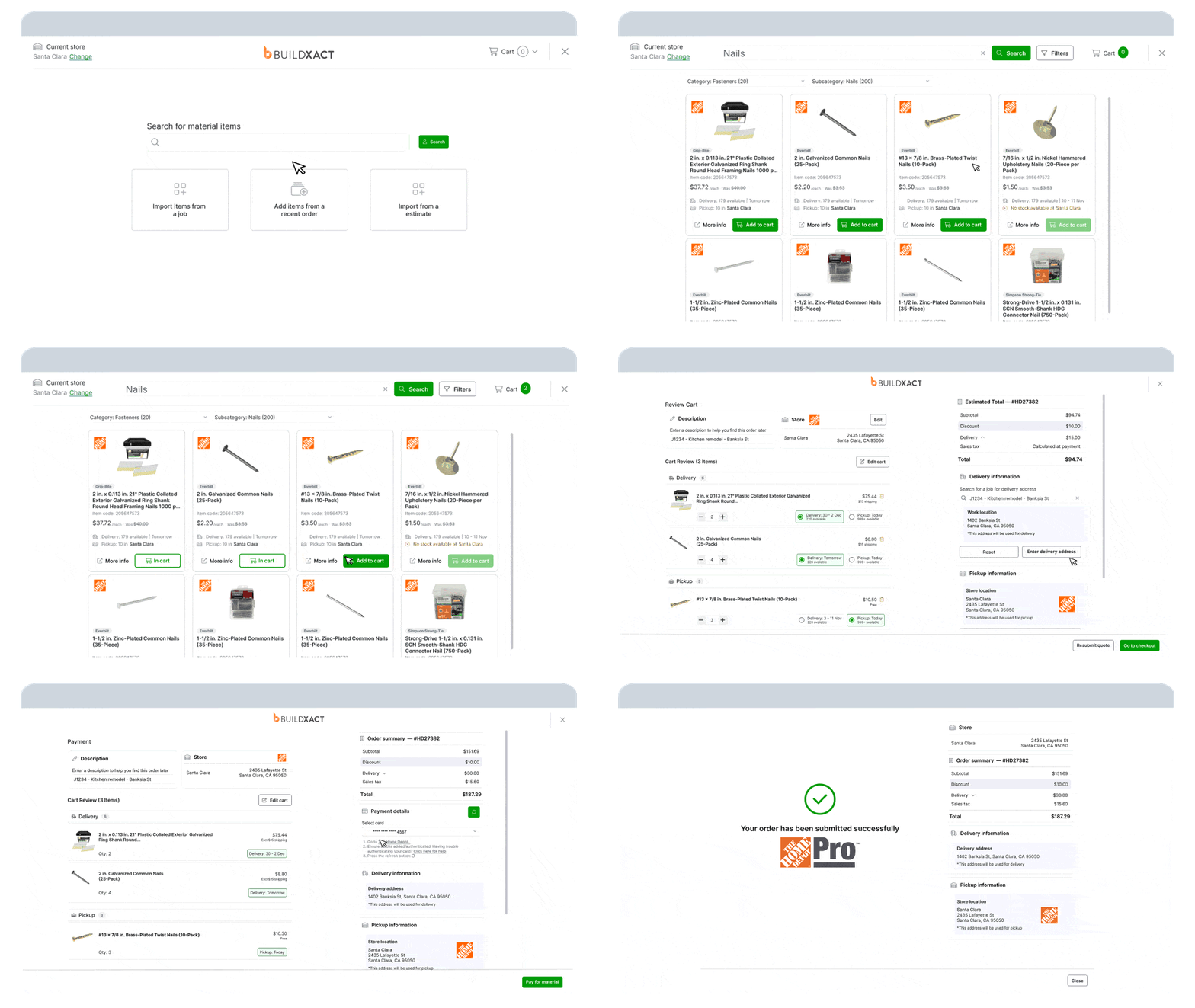
- Current material pricing and purchasing: Use current dealer pricing when estimating and carry material quantities into purchasing workflows when you’re ready to order.
- Mobile access: Give your team access to current schedules, project details and updates on their mobile device while they’re on site.

These capabilities help you keep the same level of control as you take on more work. Buildxact customers have recorded 30% higher win rates and 94% revenue growth over 18 months, showing what stronger estimating and project processes can support as a residential construction business scales.
How BradWay Construction Scaled With Better Construction Management
Buildxact Customer Story – BradWay Construction & Restoration
For Josh Bradley of BradWay Construction and Restoration, growth meant finding a better way to manage the work behind each project. Estimating in spreadsheets took hours, with Josh often rebuilding bids from scratch for every new job.
After adopting Buildxact, BradWay could reuse estimating templates, access current material pricing and manage project information more efficiently. Josh described the impact as “almost like hiring a couple of people at a much lower cost.”
That meant Josh could spend less time rebuilding estimates and more time running and growing the business. BradWay’s sales more than doubled, showing how better systems can help growing residential builders take on more work without adding the same amount of admin.
Residential Construction Management: FAQ
What does a residential construction manager do?
A residential construction manager plans and coordinates a home build or remodel from pre-construction through closeout. This includes managing budgets, schedules, subcontractors, purchasing, site progress, quality and client communication to keep the project on track.
Do small home builders need to hire a construction manager?
Not necessarily. Many small residential builders manage projects themselves or share the responsibility across a small team. As the business grows, repeatable processes and clear project visibility can help you manage more work effectively without immediately adding another management role.
How can construction management software help residential builders?
Construction management software helps builders manage projects more consistently by supporting estimating, scheduling, cost tracking, purchasing and on-site coordination. Connecting project costs back to the original estimate also makes it easier to see how each job is performing against budget and planned margin.
Keep Costs, Schedules, and Margins on Track With Better Residential Construction Management
Good residential construction management shows up in the numbers: jobs priced accurately, costs caught before they eat into margin and projects delivered when promised.
Buildxact helps you carry the information from your estimate through the job, so you can see how costs and margins are tracking while there’s still time to act. Builders using Buildxact can create estimates up to seven times faster and complete 56% more jobs on time, helping growing teams manage more work without losing control of the jobs already underway.
Start for free with Buildxact and see how it can help you run more profitable residential projects.