

On paper, RFPs and RFQs are straightforward. However, once a project is underway, pricing requests slow down because clients, subs, and dealers read the same request differently.
You sent a pricing request on Monday afternoon. The client scans it and forwards it to a partner or designer.
A subcontractor prices part of it, skips the rest, and asks follow-up questions before committing. By the end of the week, you’re reconciling partial numbers and explaining assumptions, rather than moving the job forward.
By the time a usable price arrives, you’ve spent more time figuring out what the vendor priced than writing the request. Clients ask for “an RFP,” then push back when your response includes assumptions or options. They wanted a number they could compare.
Then the subcontractor follows up because the request mixed judgment and pricing in the same document.
Even when you use the right document, pricing breaks as soon as scope, allowances, or selections change.
What’s slowing things down isn’t the request itself; rather, it’s treating judgment and pricing like they belong in the same step.
This guide explains the practical difference between RFPs and RFQs in construction, why pricing control slips after requests go out, and how keeping requests tied to live estimates helps pricing stay aligned as jobs change.
What Is an RFP in Construction?
An RFP (Request for Proposal) asks vendors to explain how they would solve a problem, not just what they would charge.
In construction, builders use an RFP when the scope is still taking shape. You know the outcome you want, but multiple approaches could get you there, and each approach affects cost, risk, and timing. This often shows up in design-build projects, complex renovations, and specialty systems, where judgment matters as much as materials.
An RFP requires vendors to explain their recommended approach, outline assumptions, propose a timeline, and price the work based on how they plan to execute it. The response combines planning and pricing.
You evaluate capability, experience, and fit, not just the number at the bottom.
An RFP assumes the proposal process will clarify and refine the scope rather than lock it in upfront.
What Is an RFQ in Construction?
An RFQ (Request for Quote) asks vendors what a defined scope will cost, not how they would approach the work.
In construction, builders use an RFQ once the scope, quantities, and specifications are clear enough that pricing accuracy matters more than flexibility. This usually applies to material procurement, trade packages, and repeat work where the requirements are already known.
An RFQ requires vendors to price the same line items against the same quantities so you can compare responses directly. At this stage, no one is rethinking the work or reshaping the scope. Vendors are pricing what’s already been decided.
You evaluate price and commercial terms against a known scope.
An RFQ assumes the inputs will stay stable after you send the request, so the quoted price can hold.
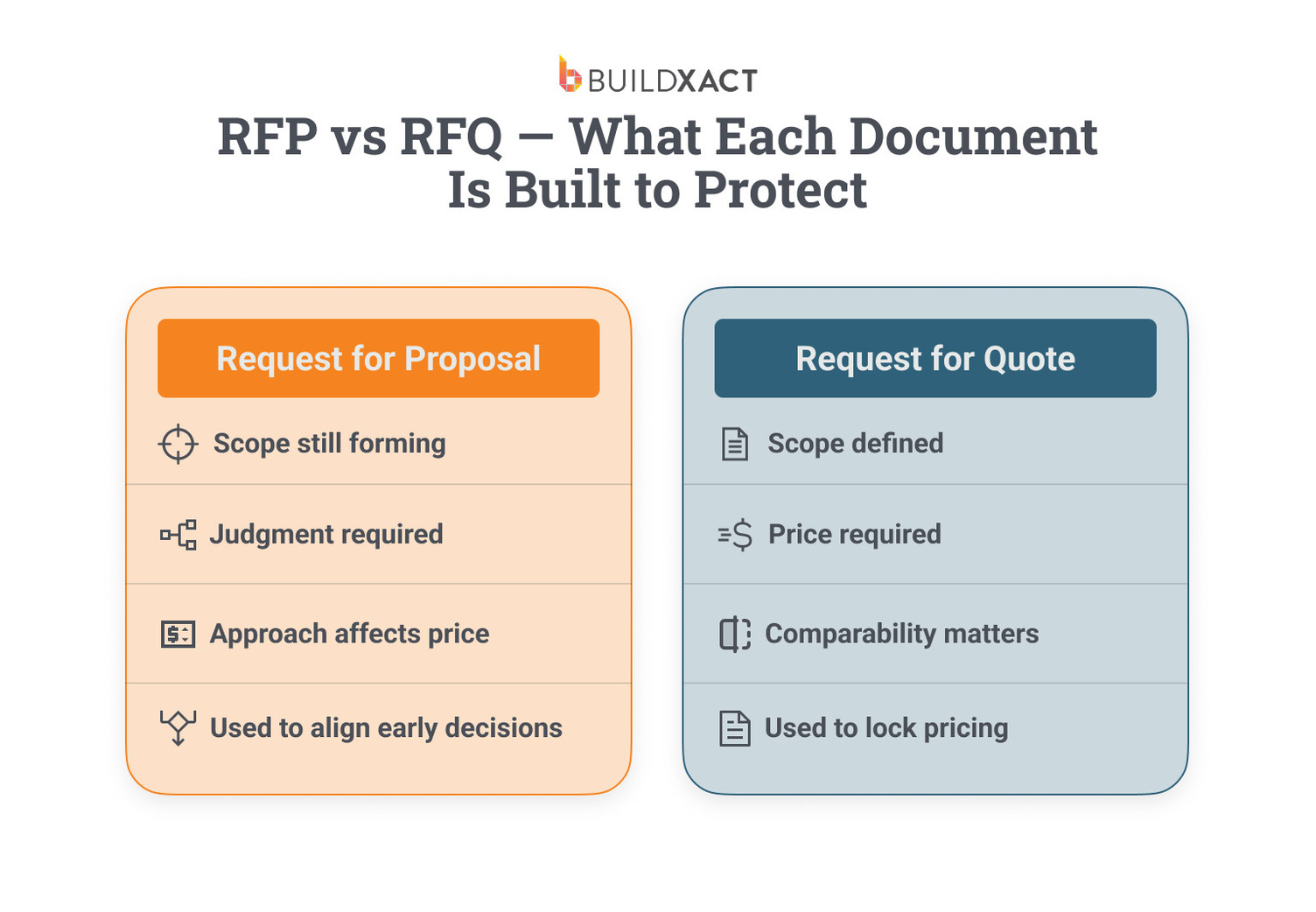
RFP vs RFQ: How Each Connects and Diverges in Construction
RFPs and RFQs aren’t interchangeable documents. In a construction project, they form a sequence.
You use an RFP first, while decisions about approach, scope, and responsibility are still in motion. At this stage, the goal isn’t to lock a number. It’s to align on how the work should be done before pricing hardens.
You will follow up with an RFQ once those decisions are finalized. Now the priority shifts to pricing accuracy; getting comparable numbers against a defined scope so the job can move forward with confidence.
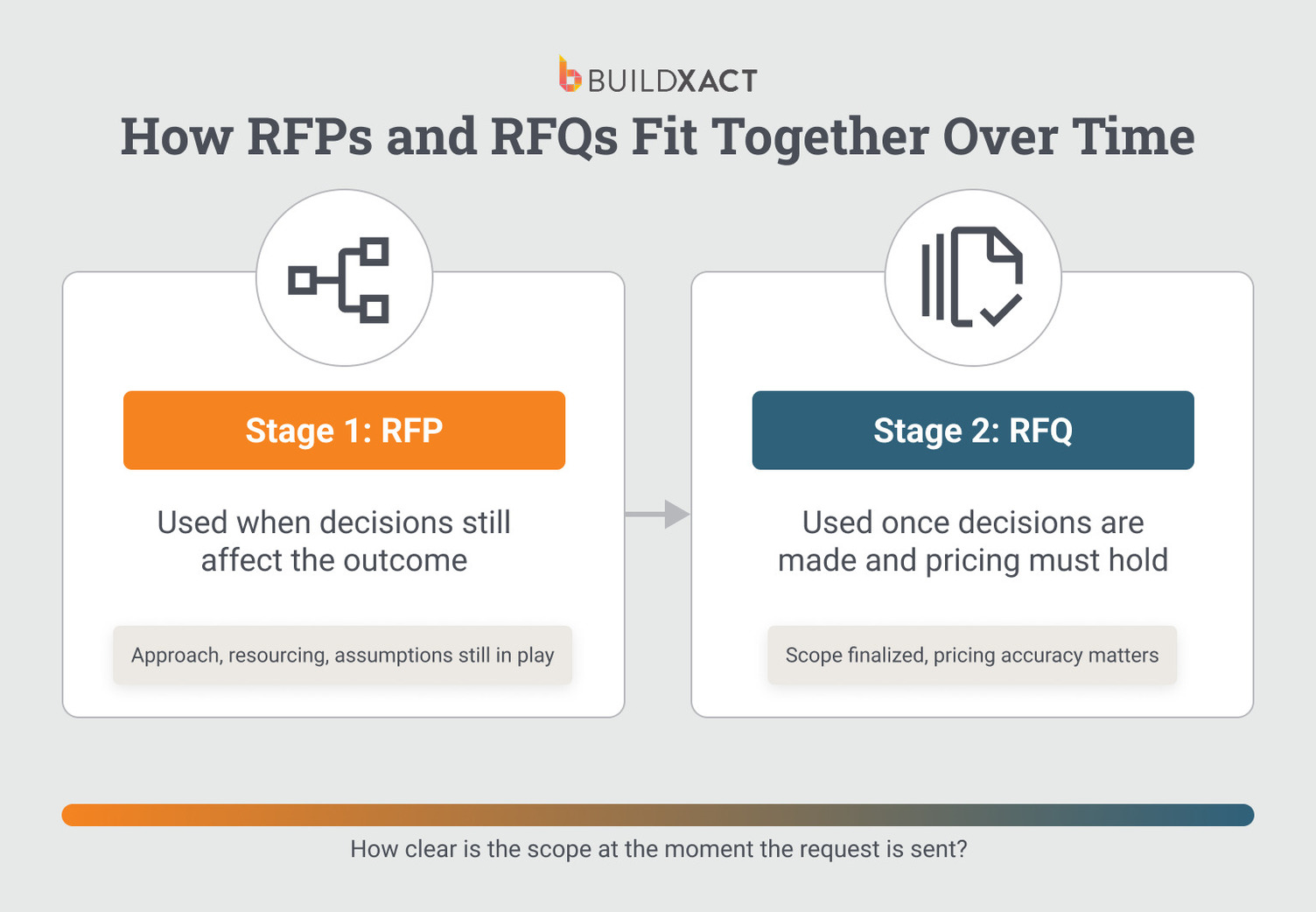
When you use RFPs and RFQs in this order, pricing confirms decisions instead of standing in for them. When you blur or swap the sequence, pricing starts carrying assumptions it was never meant to hold.
How they connect: The sequential relationship (RFP → RFQ)
You use an RFP to settle decisions while there’s still room to shape the work. At this point, you’re comparing approaches: how vendors plan to execute, what they assume, and where cost, timing, and risk trade off.
Once you choose an approach and lock the scope, you shift to an RFQ. Now you’re no longer weighing options. You’re asking vendors to price the same defined work so you can compare numbers and commit with confidence.
Handled this way, pricing confirms decisions you’ve already made instead of forcing you to make them through the numbers.
How they diverge: The diagnostic relationship (RFP vs RFQ)
RFPs and RFQs diverge based on what they ask pricing to depend on.
An RFP lets pricing depend on judgment. You use it when more than one approach could work, and when early decisions will shape costs, risks, and outcomes. At this stage, you’re evaluating capability, experience, and fit, not locking a number.
An RFQ lets pricing depend on a settled scope. You use it once specifications stop moving, and cost comparison becomes the primary decision. Now the priority shifts to comparability, speed, and commercial clarity.
The easiest way to see this difference is to line them up side by side and look at what each document asks vendors to commit to.
| Dimension | RFP | RFQ |
| What it’s meant to protect | Alignment on how the work should be done | Pricing certainty against a defined scope |
| Decision stage | While the approach, scope, and responsibility are still forming | After the scope and specifications have settled |
| What pricing depends on | The proposed approach and underlying assumptions | The agreed scope and quantities |
| What you ask vendors to do | Propose a solution and explain their reasoning | Price the same line items and quantities |
| Type of response you get | Methods, assumptions, and a price range | Comparable quotes |
| How you evaluate responses | Capability, experience, and fit | Price and commercial terms |
| Role pricing plays | Informs decisions | Confirms decisions |
Put simply:
- RFP = “Help me figure this out.”
- RFQ = “Tell me what this costs.”
When you treat RFPs and RFQs as a sequence, pricing behaves accordingly. Problems start when you apply the sequence at the wrong point in the job.
When to use an RFP vs an RFQ
Choosing between an RFP and an RFQ comes down to one question: what decisions are still open in the job?
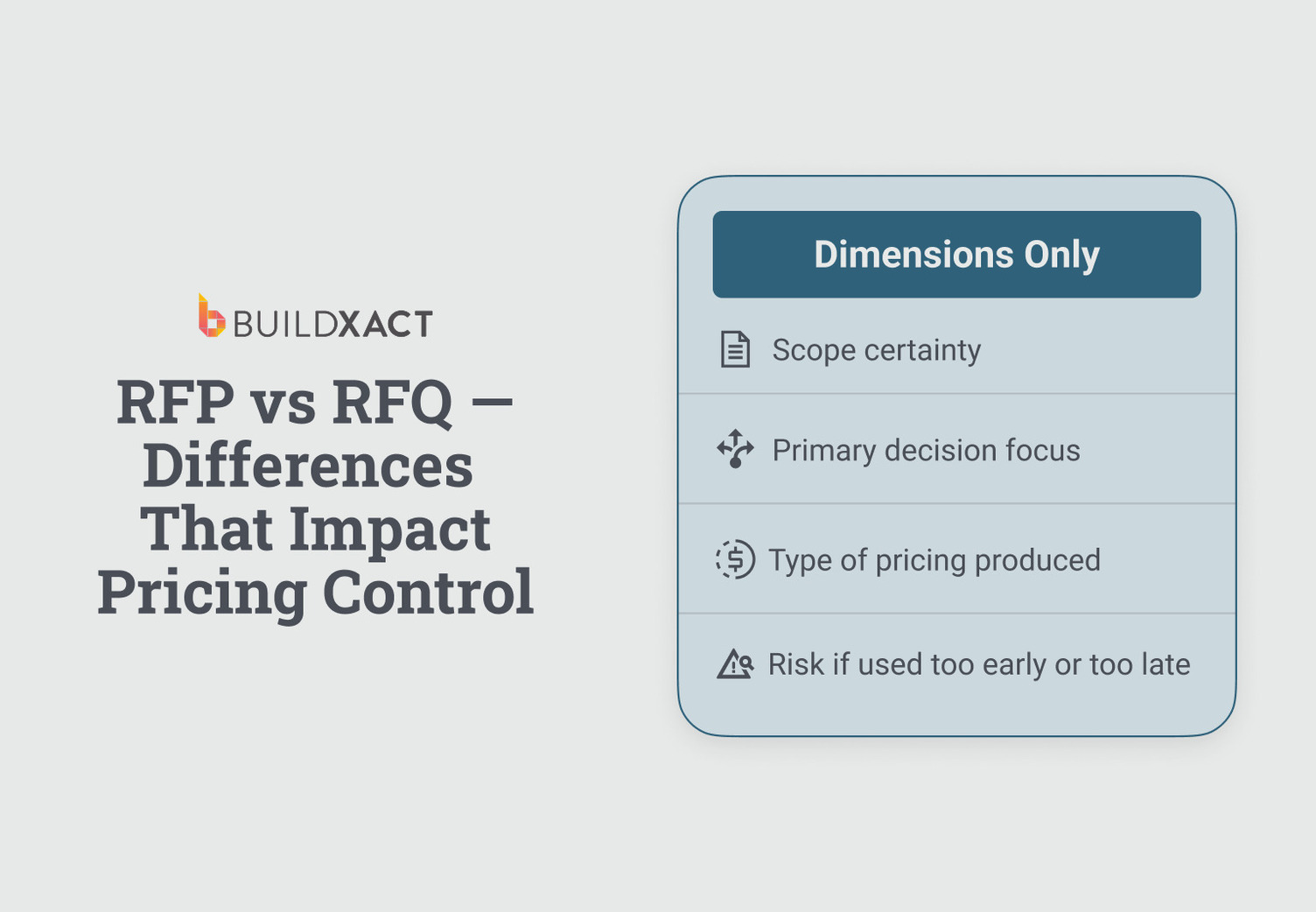
Use an RFP when scope decisions still affect price
Use an RFP when decisions about approach, sequencing, or resourcing will materially affect the cost of the work. At this stage, locking in a fixed number too early pushes assumptions into pricing before the job has taken shape.
The goal here isn’t to commit to a price. It’s to understand how different vendors would approach the work, what they assume, and where risk sits. Pricing ranges help you plan and compare approaches, but they don’t lock anything in yet.
Use an RFQ when you finalize the scope and pricing
Use an RFQ once scope, quantities, and selections stop moving, and pricing accuracy matters more than approach. At this stage, the work is defined, and the risk shifts to delays, misquotes, or discrepancies in the numbers.
The goal now is comparability. You’re asking different parties to price the same work so you can move forward without reinterpreting intent. Precision matters more than flexibility here. Used at the right moment, an RFQ helps confirm pricing decisions as schedules tighten and commitments stack up.
How to Keep Your RFP or RFQ Connected to Your Estimate for On-Track Pricing
RFPs and RFQs mark decision points. When a pricing request stops living inside the construction estimate, pricing stops reflecting the job and starts reflecting a moment that’s already passed.
Why disconnected RFPs and RFQs break pricing control for builders and remodelers
Every pricing request carries assumptions about scope, quantities, and timing. When that request exceeds the estimate, whether in a PDF or an email thread, pricing freezes in place.
The job doesn’t. Scope shifts, selections change, and decisions move forward, but the numbers stay stuck. Builders discuss changes without re-pricing them everywhere they matter. Quotes come back without clear inclusion or exclusion.
To keep things moving, someone re-enters numbers by hand and hopes nothing slips.
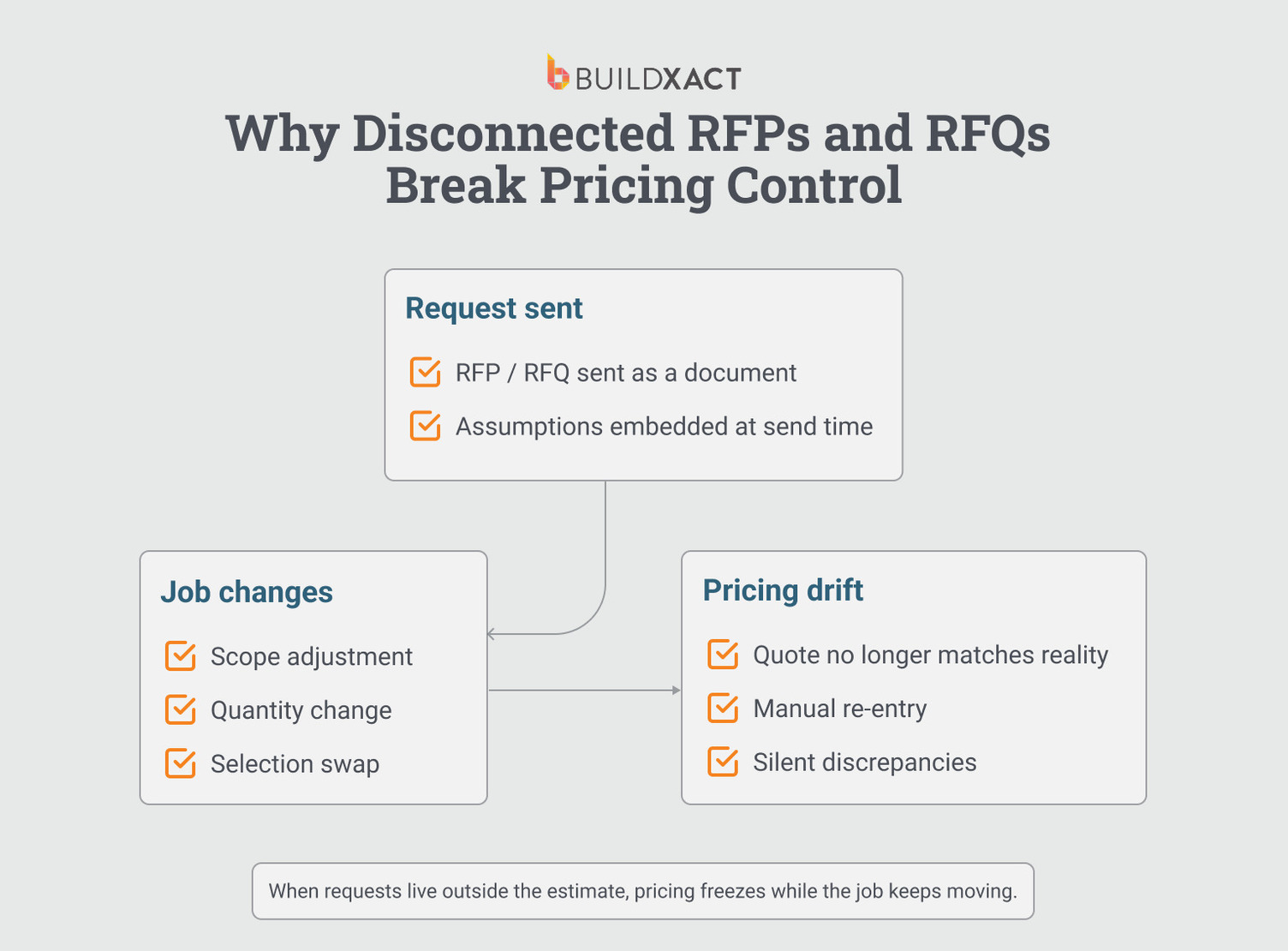
That’s where control breaks. What starts as admin work turns into pricing risk. Stale numbers erode margins, slow decision-making, and trigger clarification cycles because no one can see the current pricing state in one place.
This pressure has increased as competition tightens. Contractors protecting margin today do so by keeping scope, quantities, and pricing aligned as the job evolves, so the numbers move with the decisions.
What “connected” estimating workflows look like for residential builders
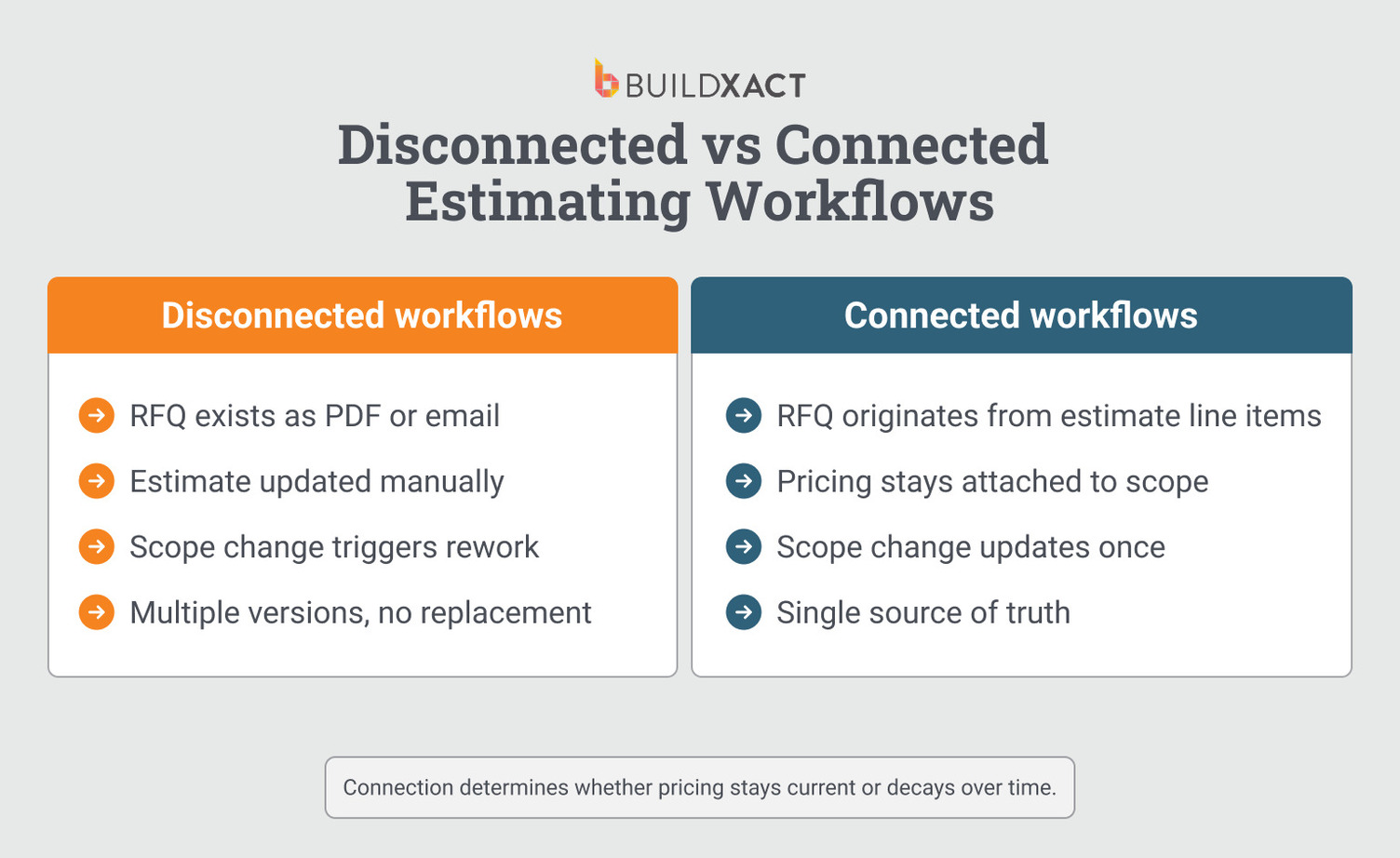
In a connected workflow, pricing requests start inside the estimate, not as separate documents.
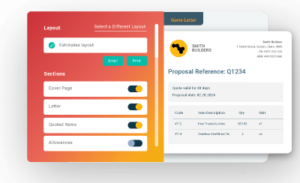
You generate RFPs or RFQs directly from estimate line items, so quantities, scope, and assumptions travel with the request. When dealers respond, their pricing updates the estimate itself instead of living in PDFs or email threads.
That connection removes re-entry. Pricing updates once and carries forward automatically. When scope changes, quantities and costs update together, so pricing stays aligned without retracing decisions or rebuilding numbers.
In Buildxact, the estimate remains the system of record throughout the job. Requests stay tied to live project data, pricing flows back into the estimate, and every downstream document pulls from the same source of truth.
When workflows operate this way, pricing stays up to date as the job changes. You revise faster, make decisions with confidence, and avoid the quiet drift that comes from disconnected handoffs.
How connected RFPs and RFQs protect margins as jobs change
Residential jobs change midstream: selections shift, quantities adjust, and scopes get revised.
In disconnected workflows, each change forces a pricing reset. Builders either pause to rebuild numbers or push forward and absorb the difference.
Connected workflows behave differently. Because RFQs stay tied to estimate line items, changes update pricing at the source. When a scope item changes, quantities and costs are adjusted together, and the updated pricing is automatically carried forward.
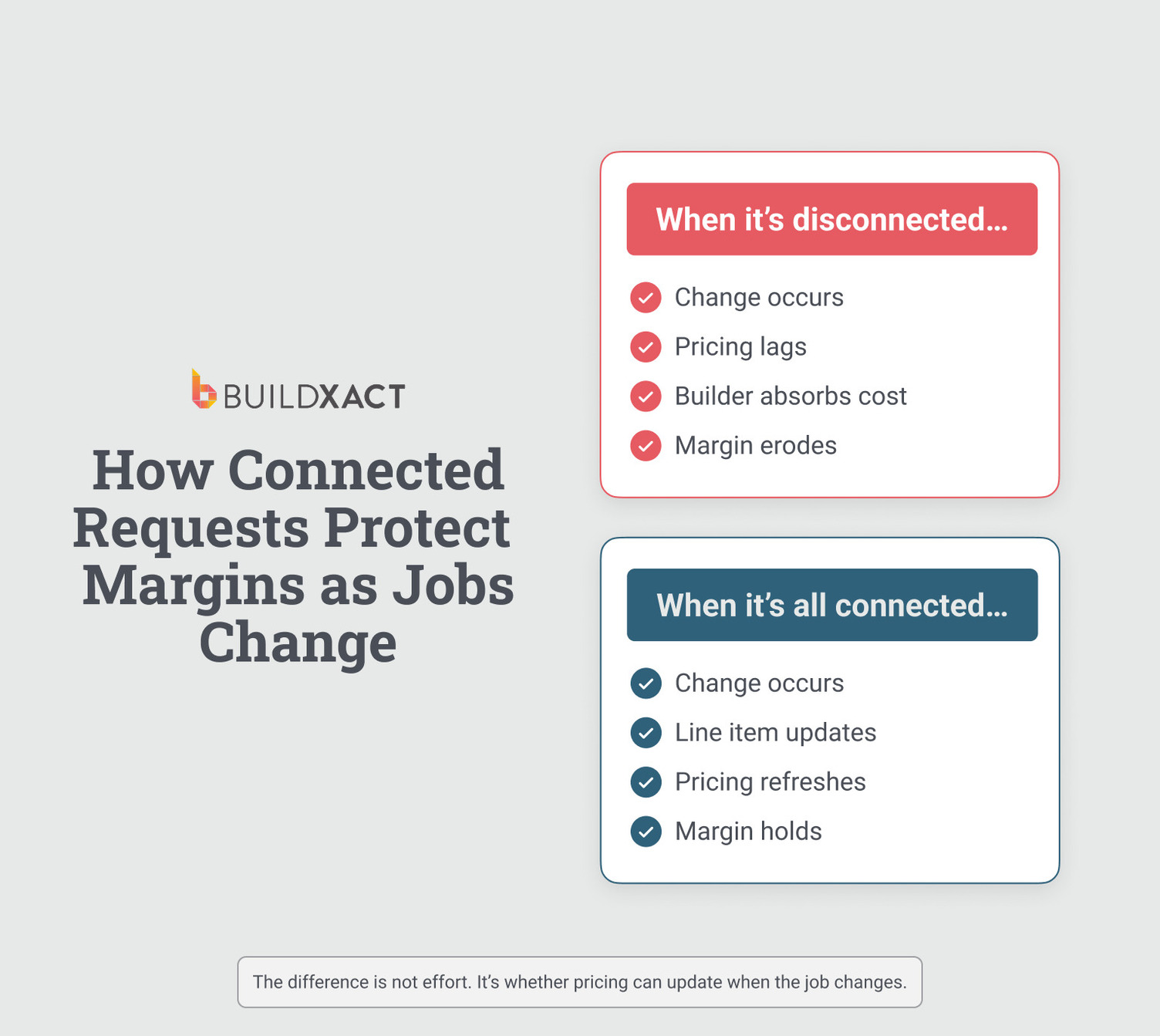
In Buildxact, that continuity runs through the entire job record. Updated pricing flows from the estimate into proposals, variations, and invoices without re-entry or reconciliation. You carry the current price forward as decisions change.
That’s how margin holds by keeping pricing aligned with the job’s live state from the moment decisions shift.
A pre-send check to keep pricing on track
Before you send an RFP or RFQ, take a minute to sanity-check whether the pricing will hold as the job progresses.
| Check | What to look for |
| Am I asking for solutions or pricing? | If the request combines judgment and pricing in a single step, vendors will make assumptions you didn’t intend, and pricing will come back uneven or incomplete. |
| Is this request tied to live scope and quantities? | If the request is based on a static document rather than live estimate data, the pricing reflects a snapshot in time. The moment the scope or selections change, the numbers are already out of date. |
| If something changes tomorrow, what happens to pricing? | If updating pricing means chasing emails, re-entering numbers, or reconciling versions, control is already slipping. Pricing should update where the work lives. |
This check doesn’t slow you down. It tells you—before you hit send—whether the request will stay aligned as the job progresses or lead to rework later.
Preserve Profits and Pricing Integrity with Connected Software
RFPs and RFQs work when you use them for the jobs they’re designed to do. RFPs help shape decisions while scope and approach are still forming. RFQs confirm pricing once those decisions are set. The documents themselves aren’t the problem.
Pricing control breaks in two predictable places: when judgment and pricing get mixed into the same request, and when pricing drifts because requests live as disconnected snapshots while the job keeps changing. That friction shows up whether you’re responding to clients or sending pricing to dealers.
The real shift isn’t better documents. It’s keeping pricing connected to the estimate so that scope, quantities, and costs move together as decisions change.
That’s what Buildxact supports. Requests stay tied to live project data, pricing updates once, and downstream documents pull from the same source of truth. If you want to see how that works, start a free Buildxact trial or book a demo to keep pricing where the work actually lives.