
You send the proposal on Friday afternoon, and by Tuesday morning, there’s no reply. Not even a clarifying question.
When you follow up a few days later, the homeowner tells you they went with someone else because their proposal “felt more detailed” or “made them more comfortable.”
Most builders’ first instinct is to blame the price, but the price is rarely the problem. The proposal is. You spent hours on the estimate. The quantities, subcontractor pricing, allowances, labor, materials, and margins were all there. The number was tight.
But by the time the proposal reached the client, most of that detail had been compressed into a short summary and a final number. A single number replaced the line items, with the exclusions left vague and the allowances unexplained. The assumptions that mattered most never left the spreadsheet, so the client never saw them.
From the builder’s side, that feels efficient. From the homeowner’s side, it feels risky.
The builders who win the jobs they want create proposals that show where the money goes, what’s included and what isn’t, and what happens once work begins. That level of clarity builds trust long before construction starts.
Here’s how to write a construction proposal that does that well: what to include, what to gather before writing, how to phrase each section, and the common mistakes that cost builders bids.
What Is a Construction Proposal
A construction proposal is a formal document that a contractor sends to a prospective client, outlining the scope, price, schedule, terms, and exclusions for a specific project. It takes the builder’s estimate and turns it into something the homeowner can actually read and evaluate.
Scope, exclusions, schedule, allowances, payment terms, and line-item pricing all exist for the same reason: they show the client what the number is attached to before construction starts.
But a proposal isn’t interchangeable with the other documents in a job. Each one plays a different role:
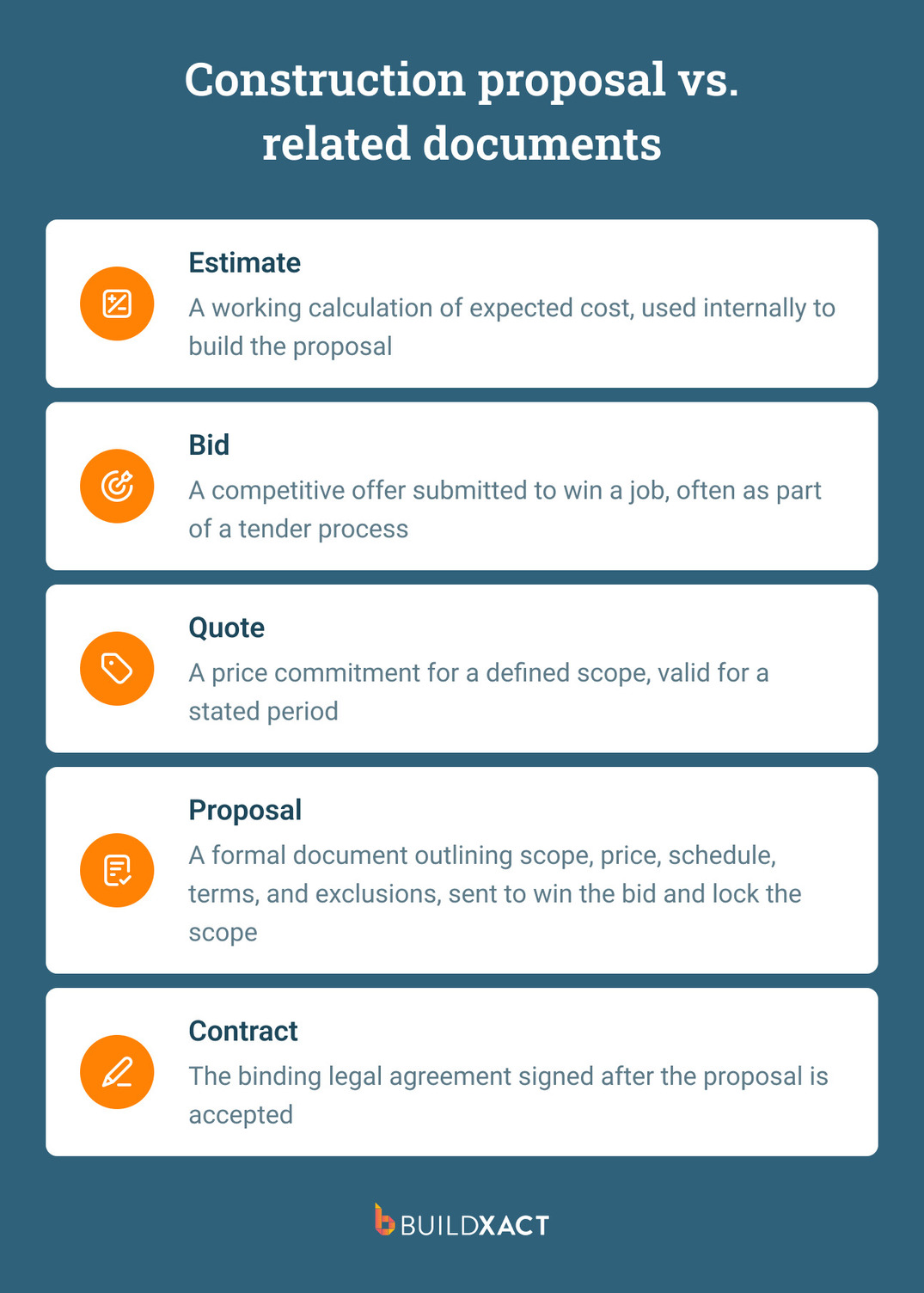
| Document | What it is |
| Estimate | A working calculation of expected cost, used internally to build the proposal |
| Bid | A competitive offer submitted to win a job, often as part of a tender process |
| Quote | A price commitment for a defined scope, valid for a stated period |
| Proposal | A formal document outlining scope, price, schedule, terms, and exclusions, sent to win the bid and lock the scope |
| Contract | The binding legal agreement is signed after the proposal is accepted |
The important distinction is what each document is responsible for. The estimate calculates the work. The proposal explains the work. The contract formalizes the agreement.
When those stay aligned, the homeowner understands what they are agreeing to before construction starts. When they drift apart, the proposal stops feeling believable long before anyone questions the final number.
What to Include in a Construction Proposal
Every section in a proposal answers a question the homeowner is trying to settle before they commit. What exactly am I paying for? What is not included? What happens if something changes? How controlled does this project feel once construction starts?
The sections below are the details homeowners use to decide whether the number in front of them feels understandable, believable, and low-risk.
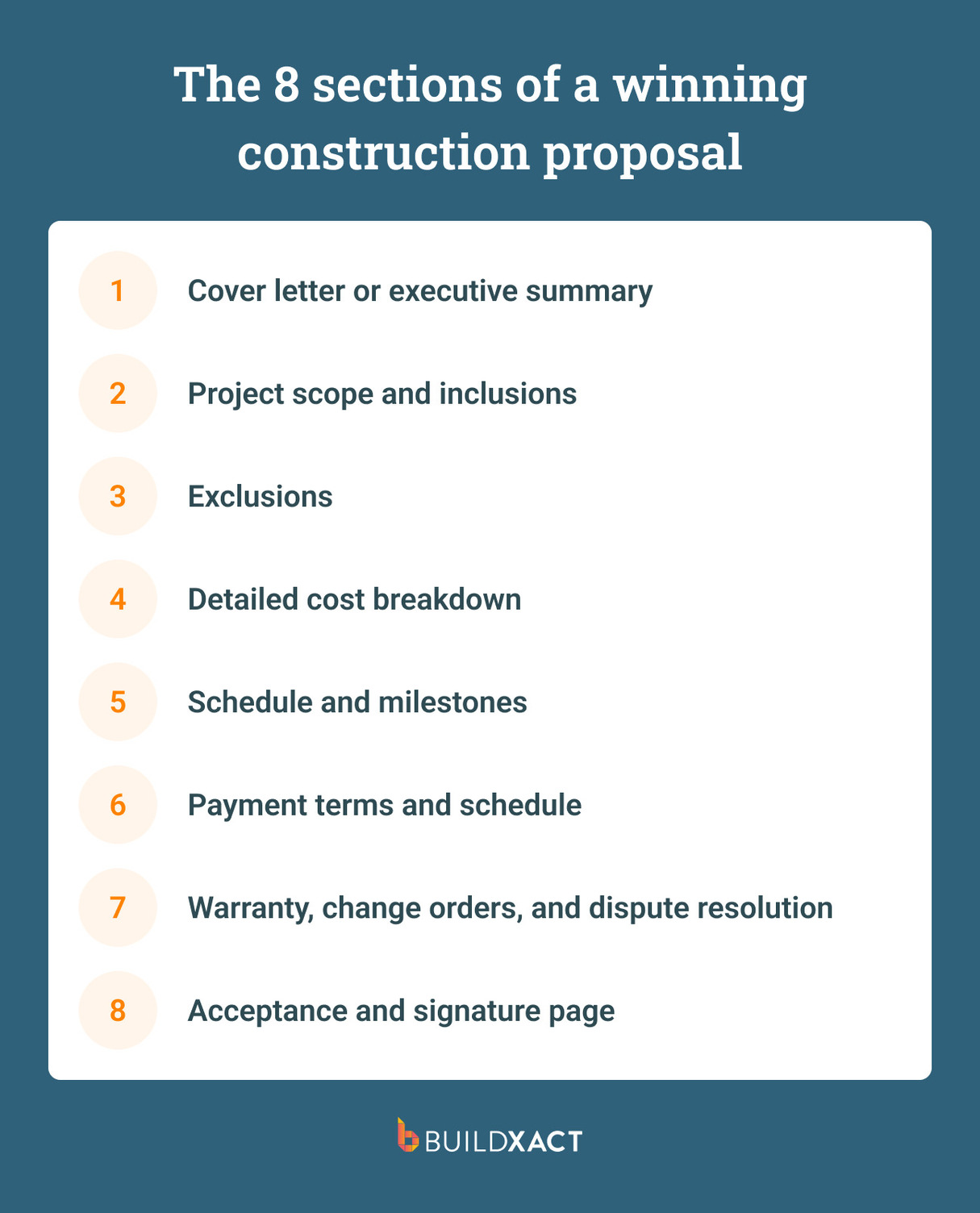
Cover letter or executive summary
A short introduction that frames the project in the client’s own context, not a sales pitch. It signals that you understood the walkthrough, the priorities, and the job they are trying to build.
When the opening reads like a generic template, the homeowner starts questioning whether the proposal was tailored to their project or copied from the last one.
Project scope and inclusions
This is a plain-language explanation of what the contractor will deliver, written using the homeowner’s words from the walkthrough wherever possible.
When the scope is written entirely in builder language (“demo non-load-bearing partition between dining and kitchen”) rather than client language (“open up the kitchen”), the homeowner stops recognizing their own project in the proposal. That gap is where assumptions start drifting apart.
Exclusions
A clear statement of what is not included before work begins.
When exclusions stay vague (“site demolition not included”), the boundary moves once construction starts, and the conversation becomes whether deck removal, disposal, permits, or fixture installation were implied all along.
Detailed cost breakdown
Line items pulled directly from the estimate, organized by labor, materials, equipment, allowances, and dealer pricing.
When the proposal collapses into a single number or a few rounded categories, the homeowner cannot see where the money goes or why one builder costs more than another. The detail you stripped out is often the detail that closes the deal.
Schedule and milestones
A phased timeline that shows major stages of the project, including realistic buffers for inspections, weather, lead times, and sequencing dependencies.
When the schedule is built entirely around best-case assumptions, every delay feels like the builder lost control of the project, even when the cause was outside their control.
Payment terms and schedule
A clear payment structure tied to visible project milestones: deposit, framing completion, rough-in, finishes, punchlist, and final payment.
When payment terms are buried in legal language or reduced to vague percentages, the first invoice becomes a negotiation rather than a step the homeowner already expected.
Warranty, change orders, and dispute resolution
These sections explain what happens when the project changes shape after work begins.
Change orders, warranty coverage, concealed conditions, and dispute procedures matter because remodels rarely unfold exactly as originally scoped. When these clauses get copied from a generic template without being adjusted to the actual project, gaps appear later where neither side thought responsibility was unclear.
Acceptance and signature page
One clear path for moving forward: signatures, dates, and acknowledgment that the proposal will serve as the basis for the contract.
When the acceptance step is missing, buried, or unclear, the homeowner has to stop and ask how to say yes. That hesitation is often where the project loses momentum.
Each section above is designed to carry detail from the estimate into the proposal without sacrificing clarity along the way. When builders recreate proposals from memory instead of from the estimate itself, sections thin out, assumptions disappear, and important context gets compressed into summaries.
What to Gather Before Writing Your Construction Proposal
Before you open the proposal document, you need five things in front of you. With these in place, most of the proposal is already decided. Without them, you are writing from memory, and that is where the proposal stops matching the estimate.
- A complete, verified takeoff. Every quantity in the proposal traces back to this measurement. An overcount at this layer means you pad the price and lose the bid; an undercount means you win the job and absorb the difference. Verify quantities against the drawings before they flow into the estimate.
- A line-item estimate built with assemblies, not from a blank sheet. Assemblies are pre-built bundles of materials, labor, and quantities for specific scopes (framing a wall, hanging drywall, installing kitchen cabinets) that catch the small items memory misses. As estimator Stephanie Perez of TXN Remodeling N Construction puts it:
“With the templates and the assemblies already there, I save a ton of time because I don’t have to remember did I include silicone, did I include baseboards, did I include certain small things you don’t think cost a lot. If you forget about it, it is a huge, drastic loss over time.”
- Current dealer pricing for every material in the estimate. Lumber prices that were accurate when you quoted a different job two months ago will not be accurate today. Stale prices either erode your margin (you absorbed the difference) or kill the bid (you padded for safety). Updated prices flow through to the proposal as defensible numbers the client can verify.
- Exclusions captured at the walkthrough, not at the desk. Specific exclusions only get written when you are looking at the site: the deck that needs to come down before construction starts, the HVAC unit blocking demo access, the tile that might have asbestos under it. These get missed when the proposal is written from memory two days later.
- Scope notes in the client’s own words. What did they actually say at the walkthrough? Write it down. “I want the kitchen to feel less closed off” is different from your interpretation (“remove the wall between kitchen and dining”). The client’s language is what they will recognize when they read the proposal, and what they will measure the finished project against.
With these five things in front of you, most of the proposal is already decided. Scope, price, exclusions, schedule, and language are all in your hands before you open the document. Writing becomes a matter of transferring detail, not creating it.
How to Write Each Section of a Winning Proposal
By this point, you’ve already made the decisions on scope, price, what’s included, what’s excluded, and where the allowances sit. Writing the proposal is where you clearly put those decisions in front of the homeowner.
The homeowner is trying to answer a series of questions as they read: “What exactly am I paying for?” What happens if something changes? Does this builder sound like they have control of the job?
How you write each section shapes those answers.
Show where the money is going
Keith Perez has been in construction long enough to know why contractors lose bids they should have won. It is rarely the price alone.
“Customers don’t want to see a number,” he says. “They want to see a list of where their money is going.”
A proposal that says “kitchen remodel: $48,500” asks the homeowner to trust a number without seeing the reasoning behind it.
The same project, broken into demo, framing labor, framing materials, drywall, electrical, plumbing, cabinetry, finish carpentry, and project management, gives the homeowner something to evaluate rather than react to.
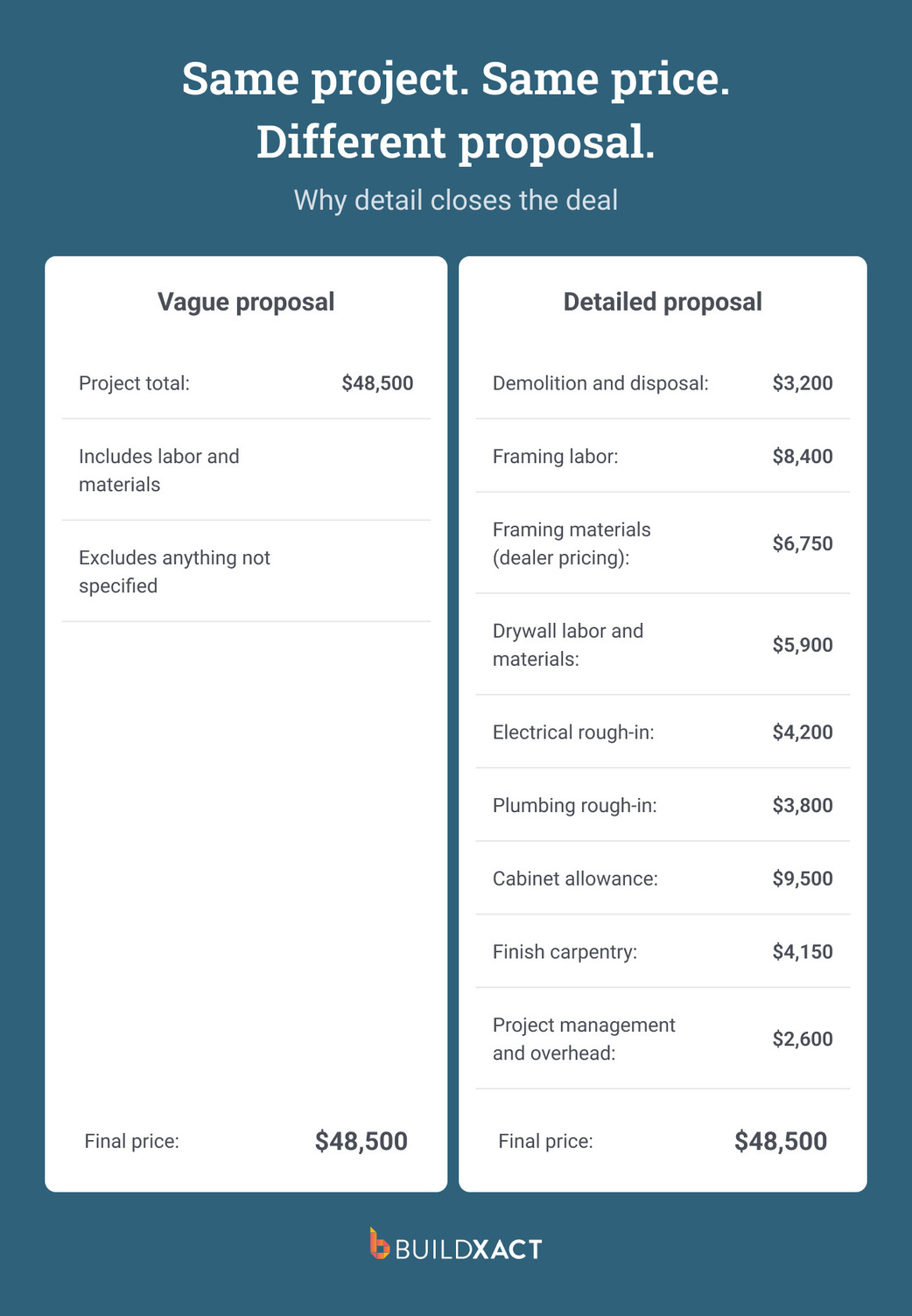
More detail usually creates more questions about line items. That is not a problem. The questions homeowners ask before construction starts are almost always easier than the disputes that arise when assumptions remain hidden.
Write exclusions that still make sense halfway through the build
Vague exclusions do not create clear boundaries. They create arguments later.
“Site demolition not included” leaves room for interpretation once work starts. “Removal of the existing 12’x14′ deck and disposal of demo debris are excluded; owner is responsible for arranging removal before construction begins” leaves far less room for disagreement.
The same applies to owner-supplied fixtures, concealed conditions, asbestos behind walls, or structural damage discovered during demolition. The proposal should already explain what happens if those situations appear.
Specific exclusions are not legal padding. They are how both sides understand where responsibility changes before the project is underway.
Describe the project the way the homeowner sees it
The homeowner looks for their project inside the proposal. If they described the goal as “making the kitchen feel less closed off,” and the proposal only says “demo non-load-bearing partition,” part of the original intent disappears in translation.
Builder terminology still matters. But it should support the homeowner’s understanding of the project, not replace it.
When scope sections drift too far into technical shorthand, homeowners stop recognizing their own priorities in the proposal. That disconnect usually reappears later as misaligned expectations during the build itself.
Build schedules around real-world delays
“Framing complete: week four” sounds clear until inspections get delayed or engineered lumber arrives late. Then the schedule suddenly feels broken.
A schedule that includes visible buffers for inspections, weather, lead times, and sequencing constraints feels different because the homeowner can see how the builder approaches the project before construction starts.
The goal is not to make the timeline look longer. The goal is to make delays feel explainable rather than chaotic when they occur.
Write as if the project is already moving forward
Proposal tone shapes how controlled the project feels.
Some proposals sound like aggressive sales documents trying to close a lead. Others sound defensive and overloaded with disclaimers around pricing. Both create distance.
Strong proposals usually sound calmer than that. The homeowner is treated like someone already in conversation with the builder, not someone being pushed toward a decision. The proposal explains the work, assumptions, schedule, and next steps clearly enough that the client can picture how the project will actually run once construction starts.
That is what homeowners are evaluating the entire time they read the proposal. Not whether remodeling is complicated. They already know it is. They are trying to decide whether the complexity feels visible and controlled before they commit to living through it.
Construction Proposal Templates for Residential Projects
Different residential projects create different kinds of uncertainty for the homeowner. A new build, a kitchen remodel, and a trade-specific bid all require the proposal to surface different details clearly before construction starts.
The template matters because it determines what the homeowner sees first, what gets emphasized, and where misunderstandings are most likely to happen later.
The right template is not the one with the most fields. It is the one that carries the estimate forward cleanly without forcing the builder to rebuild the project from memory.
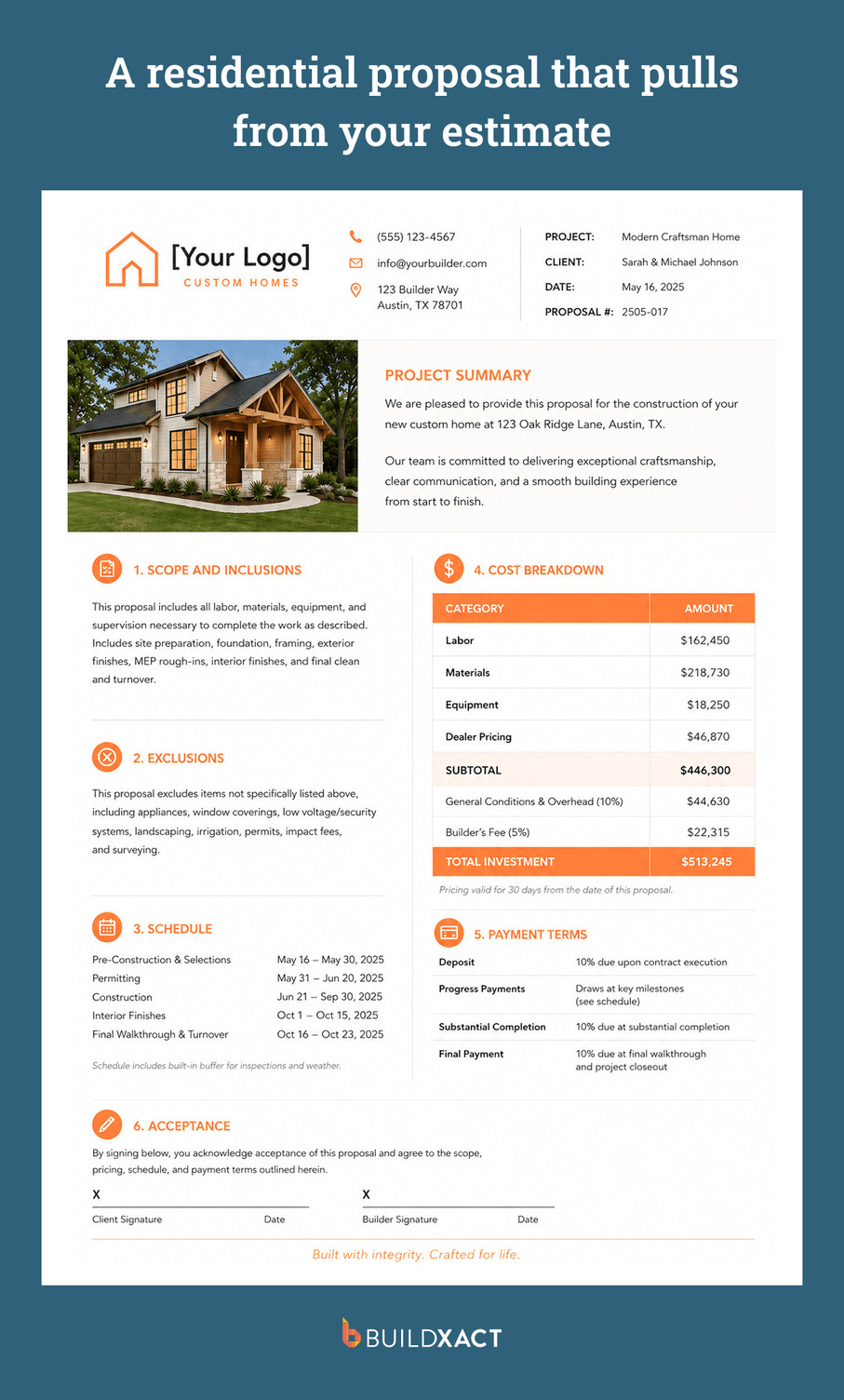
New build proposal templates
New build proposals usually need to make long projects feel understandable before work begins. The homeowner is committing to months of sequencing, selections, inspections, allowances, payment stages, and schedule dependencies all at once.
That is why new build proposals tend to lead with a phase-by-phase structure: site prep, foundation, framing, mechanicals, finishes, and closeout. Allowances for selection-heavy items like cabinetry, flooring, lighting, and countertops are captured early because the homeowner needs visibility into where future price movements may occur.
The proposal is not just explaining the cost here. It is helping the homeowner picture how the project will unfold over time.
Renovation and remodel proposal templates
Remodel and renovation proposals carry a different kind of pressure. The homeowner is not worried about a clean sequence on an empty lot. They are worried about surprises hiding behind walls, disruption inside the home, and whether the original scope will slowly shift once demolition starts.
That changes what the proposal needs to emphasize.
Renovation proposals usually lead with clarity of scope, exclusions, concealed conditions, and change-order expectations because those are the areas where trust breaks down fastest during the build. Language around asbestos, mold, structural damage, fixture allowances, and owner-supplied materials matters more because the project already contains unknowns before work even begins.
This is also where assemblies become valuable operationally. Framing modifications, drywall repair, finish carpentry, kitchens, and bathrooms all contain dozens of small items that disappear when the estimate gets rebuilt manually from memory. The proposal stays tighter when those details carry forward directly from the estimate itself.
Trade-specific proposal templates
Trade-specific jobs like roofing replacements, electrical upgrades, HVAC installs, or basement finishes usually compress the homeowner’s decision into a much shorter comparison window.
The homeowner often reviews multiple proposals side by side, trying to determine whether the contractors are actually pricing the same scope. That means these proposals need to surface scope precision quickly: what is included, what materials are being used, what cleanup looks like, what warranty applies, and where the project begins and ends.
Long introductions matter less here. Clear scope and price structure matter more.
Across all three project types, the template itself matters less than whether the proposal still reflects the estimate accurately by the time it reaches the homeowner. Static Word documents and spreadsheets can organize information, but they still require someone to rebuild the project section by section.
The proposals that remain consistent are usually those generated directly from the estimate, where pricing, scope, exclusions, and revisions continue to update together rather than drifting apart across separate documents.
Download the Residential Construction Proposal Template
The proposal structure covered above only works if the estimate, scope, exclusions, allowances, schedule assumptions, and pricing all stay connected once the document is built.
Download the residential construction proposal template below to use as a starting structure for:
- remodel proposals,
- new builds,
- and trade-specific residential bids.
The template is built around the same principles covered throughout this guide: visible pricing, clear exclusions, allowance management, schedule buffers, and fewer surprises once construction starts.
Common Construction Proposal Mistakes That Cost You the Bid
Six mistakes show up in proposals that lose bids. Each is a pattern that most builders have lived through. Knowing where the fix lives is more useful than knowing the name of the failure.
- Vague exclusions. You wrote “site demolition not included” to keep the proposal short. Six weeks into the build, you are on the phone, explaining why the existing deck was not within scope. The fix is specific exclusions, captured during the walkthrough and written as an attorney would.
- Bottom-line-only pricing. Your proposal says “kitchen remodel: $48,500.” The homeowner cannot see why that number is there, so they cannot trust it. The fix is the line-item breakdown that lets the math do the closing work.
- Slow turnaround. You spend three days rebuilding the proposal from a spreadsheet, and by the time it lands in the homeowner’s inbox, they have already signed with someone faster. The fix is a workflow in which the proposal is generated from the estimate, not from scratch.
- Treating the proposal as the contract. You let the proposal stand in for the binding agreement, but the two are different documents. When they conflict on warranty, exclusions, or change orders, the contract governs. The acceptance page should explicitly signal this: by signing, the homeowner agrees to enter into a contract that incorporates the proposal.
- The free-quote trap. You spend 12 hours producing a detailed proposal for a homeowner who never replies. The fix is a workflow that lets you bid faster, so the time invested per bid is smaller and the follow-up doesn’t depend on remembering when you sent which one.
- Generic templates that don’t pull from the estimate. You rekey line items from your estimate into a Word template, and somewhere in the typing, a row drops or stale dealer pricing remains. The fix is a template that pulls from your estimate in the same workflow.
Each of these six mistakes has a different surface symptom. The next section names what they share.
From Estimate to Signed Proposal: How to Stop Rebuilding the Proposal Every Time
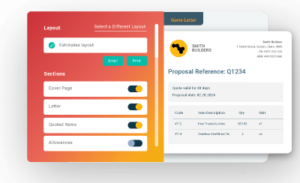
The six mistakes share the same problem underneath: the proposal is built apart from the estimate. When the estimate lives in one tool (or a spreadsheet, or a notebook) and the proposal lives in another, detail dies in the translation between them. Vague exclusions, bottom-line pricing, slow turnaround, and the rest are downstream symptoms of that one architectural problem.
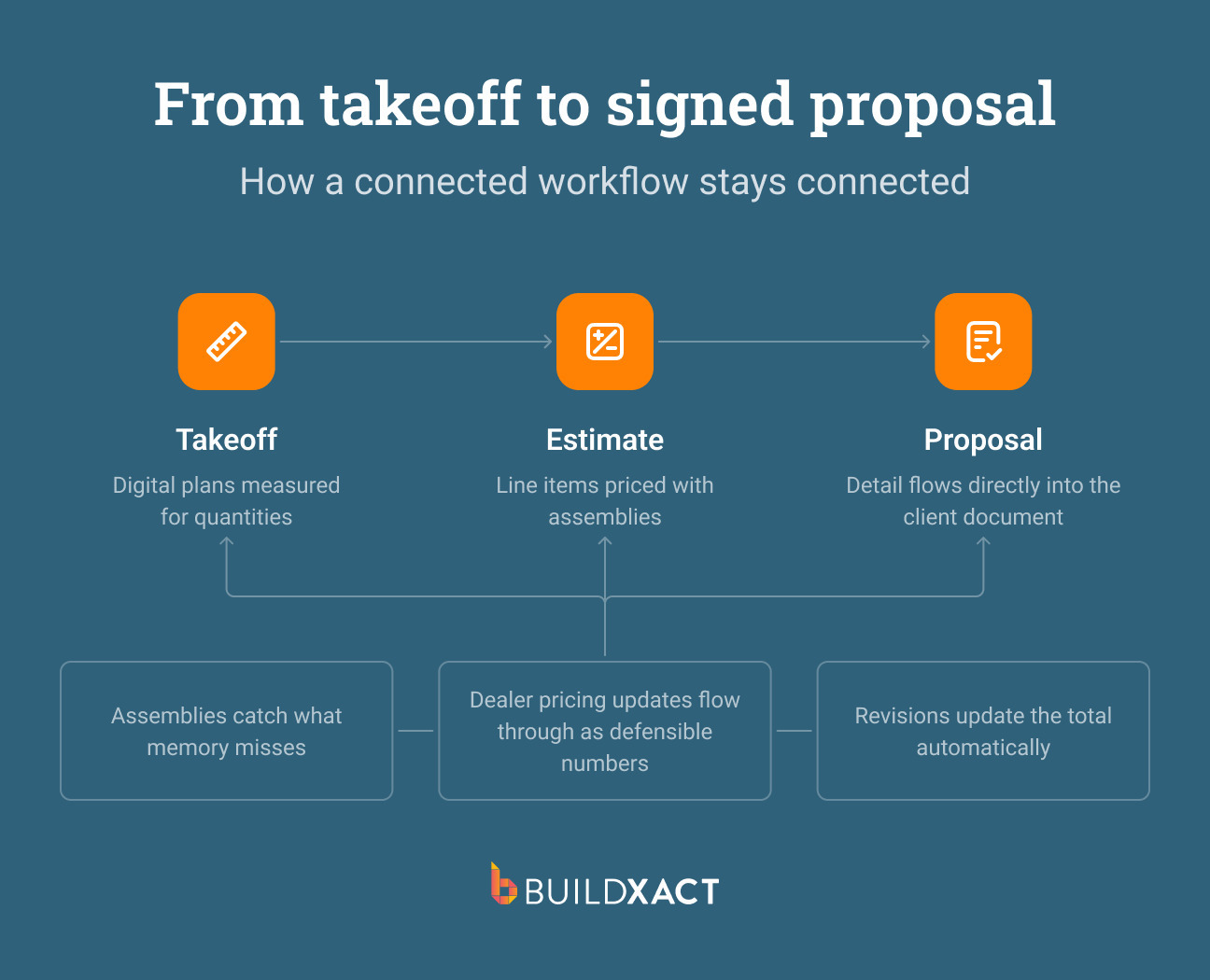
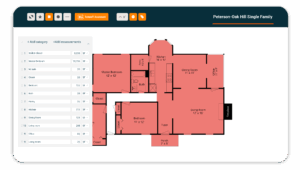
Here is what it looks like when the proposal stops being a separate job: the takeoff flows into the estimate. Assemblies (framing a wall, hanging drywall, installing cabinets) catch the small items that memory misses.
Current dealer pricing applies to every line item, so the numbers are defensible on the day you send the proposal. When the homeowner asks for a revision, the changes are updated in one place and ripple through everything downstream. The proposal generates from the estimate when you are ready to send it, not when you have time to rebuild it.
At Buildxact, we built this workflow specifically for residential builders. Our customers do not lose jobs because they are bad at building. They lose them because they cannot get a detailed proposal out in time. Steve Griffin, an estimator at Just Building Group, describes what happens when the proposal takes too long:
“If you get a customer waiting too long, they go cold and standoffish. You have got to try and bid ’em when they are still excited.”
Detail at speed is what closes the residential bid. The takeoff, estimate, assemblies, dealer pricing, and proposal live in one workflow. The math the homeowner sees is the math you priced.
A Good Construction Proposal Makes the Job Easier Before It Starts
The next time you send a proposal on Friday afternoon, it carries the same tight price as the one before. But this time, the math is on the page where the homeowner can see it. By Tuesday morning, you have an email asking when work can start.
You now have the structure, the prep checklist, the writing techniques, the templates, and the workflow that connects them. The proposal that wins is the one that shows the math and lands while the lead is still hot.
Start for free by opening Buildxact and building your next proposal from your estimate.