

You’ve spent years doing construction framing, finishing, and managing crews for an established contractor.
Now you’re researching what it takes to run your own. The licensing path is clear: document your experience, pass the exam, register the business. Get your name out there, develop a strong portfolio, and consistently deliver high-quality work.
The roadmap is clear — so, why do half of new contractors still fail in their first three years? And how do you ensure you’re a part of the 50% that learned how to become a contractor and make it past the 3-year mark?
This guide covers everything you’ll need to answer that question, secure your business, and do it all the right way the first time around. You’ll learn:
- The various options available to you if you plan to become a licensed contractor
- Making the essentials — estimating, project tracking, job costing, and change order documentation — your most valuable differentiator, singling you out against competitors
- How to close the real gap most struggle with — which isn’t trade skills, nor even business know-how, but the business infrastructure needed to make your venture a profitable reality.
Let’s get to it.
Types of Contractors: Which Path Should You Choose?
The type of contractor you want to be shapes licensing requirements, your business model, and daily operations.
General contractors
General contractors oversee full-scale construction projects, managing subcontractors, securing permits, and serving as the primary point of contact for clients.
NAHB data shows most specialty or remodel jobs fall under $50,000, while GC jobs often start around $150,000 and can exceed $750,000. Higher contract values mean more subcontractors to coordinate, longer permit sequences, and greater exposure when a single subcontractor delays the schedule.
Consider this route if you have experience managing subcontractor schedules, processing draw requests, or handling client communication on jobs exceeding $100,000.
Specialty contractors
Specialty contractors specialize in one trade, such as plumbing, HVAC, electrical, or roofing. Repeating the same type of work allows you to refine workflows, tighten pricing, and increase efficiency.
As Owen Chambers, GM at The Professional Builder, noted in a recent Buildxact webinar:
“Contractors should target 20–25% gross profit margins. One of our members improved from 13.5% to 24% specifically by systemizing repeatable work.”
That jump, nearly doubling the margin, comes from estimating precision you can only build through repetition. A contractor pricing 40 similar kitchen remodels per year knows what labor estimates miss: maybe tile setters consistently take six hours, not the four quoted.
Each job refines and improves the next, and specialty work makes that feedback loop possible. Project management is simpler, but professional estimating and clear client communication are critical, especially when subcontracting under GCs.
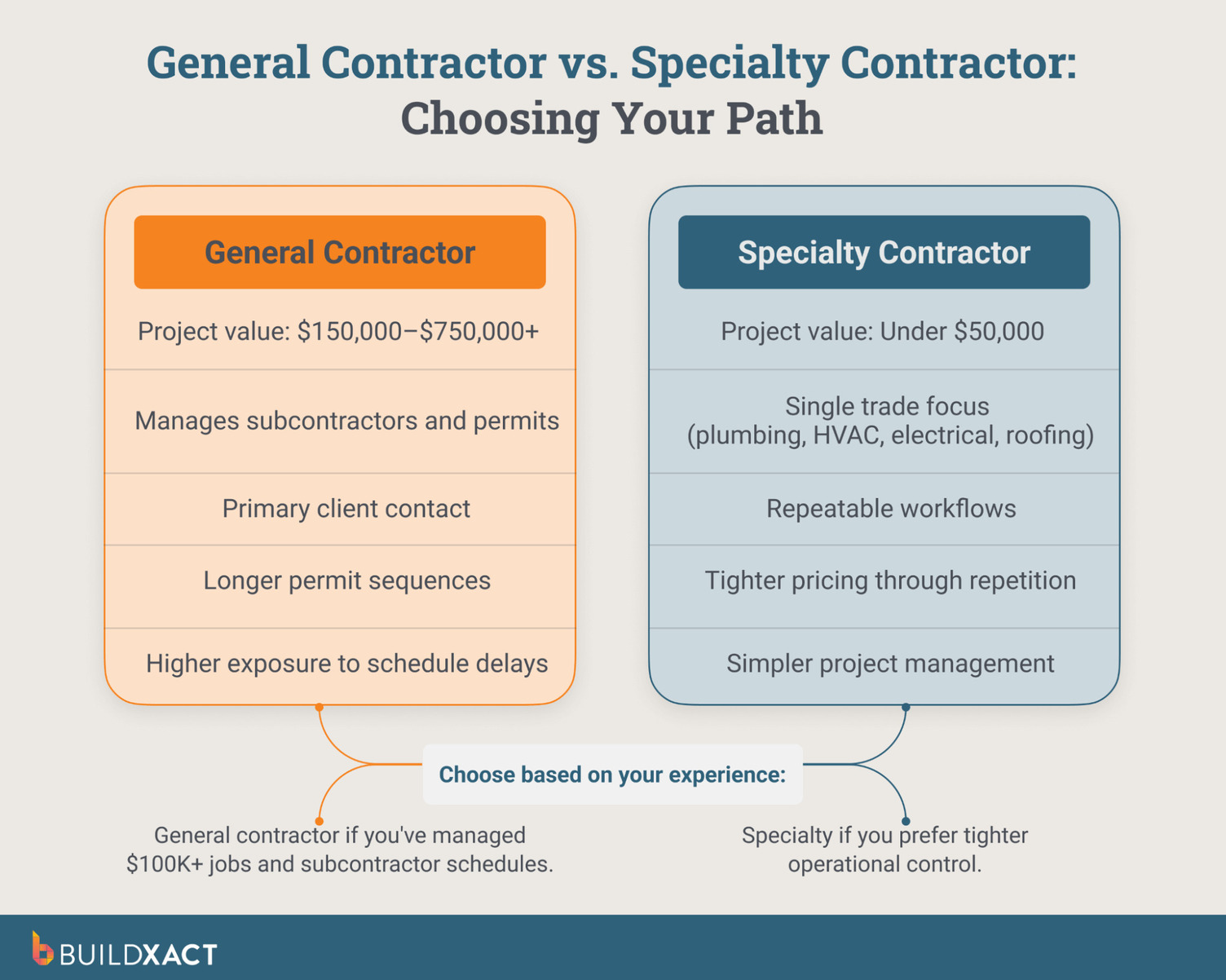
Consider this path if you prefer tighter operational control and fewer variables per job, particularly those building a business with limited staff or working as a subcontractor under GCs.
The Licensing Track: Experience, Exam, Registration
Licensing requirements vary by state, but the sequence is predictable: document your experience, pass the exam, register the business.
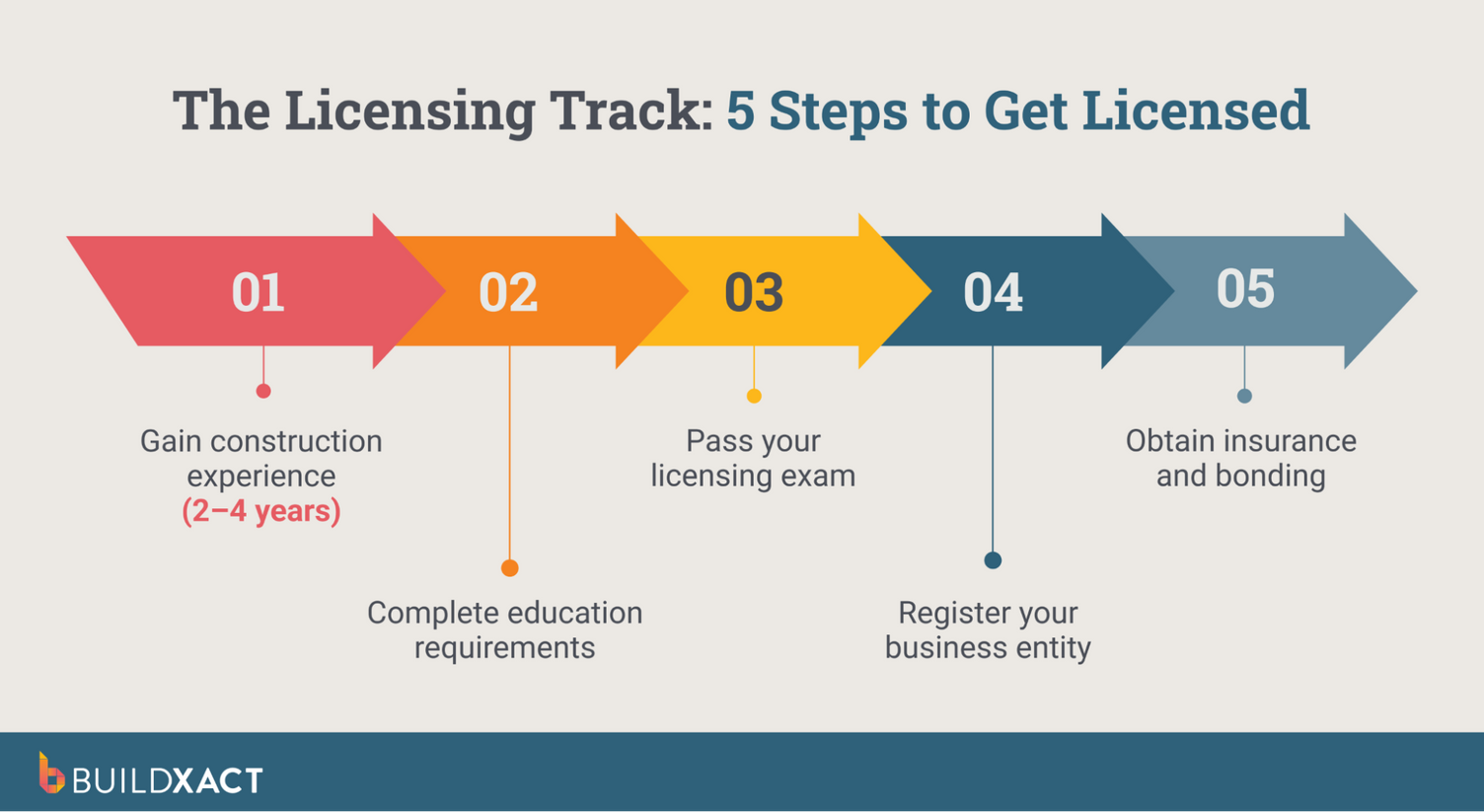
The steps below outline the requirements for licensing and provide guidance about where to build systems alongside each step.
Step 1: Gain construction experience (2-4 years)
Most states require 2–4 years of documented experience under a licensed contractor before you can apply. California, Utah, and Oregon require four years, while Georgia and Virginia accept two. Some states, such as New Mexico, allow you to substitute up to two years of formal education for field experience.
Requirements vary, but the documentation standards don’t. Licensing boards reject applications with vague timelines or gaps. From your first job under a licensed contractor document:
- Hours worked per project
- Project types and scope (new construction, remodel, commercial)
- Supervisor names and license numbers
- Tasks completed (framing, finish work, crew management
Use your state board’s experience verification form as a template and update your progress every month.
As you log hours, observe how your employer runs the business. How do they price jobs, handle scope changes and resolve client disputes? Track what works and what doesn’t as these observations inform your own systems later.
Step 2: Complete education requirements
Depending on your state and specialty, you might require formal education, union apprenticeships, community college programs, or trade certifications before you can sit for the licensing exam. Check your state board’s website for specific requirements.
Before enrolling for a program to help you meet these requirements, request a course outline. Look for modules on estimating, project management, and job costing, in addition to the baseline trade skills. If the curriculum skips business fundamentals, plan to learn them independently.
Step 3: Pass your licensing exam
With your experience documented and education complete, you’re ready for the exam. Licensing tests cover building codes, safety regulations, business law, and trade-specific knowledge.
Requirements vary across several areas:
- Exams for general contractors vs specialty contractors
- Trade vs business tests, which some states choose to differentiate between
- Scoring, retake rules, and fees
Check your state licensing board’s website for exact details. For a nationwide breakdown, use this state licensing guide.
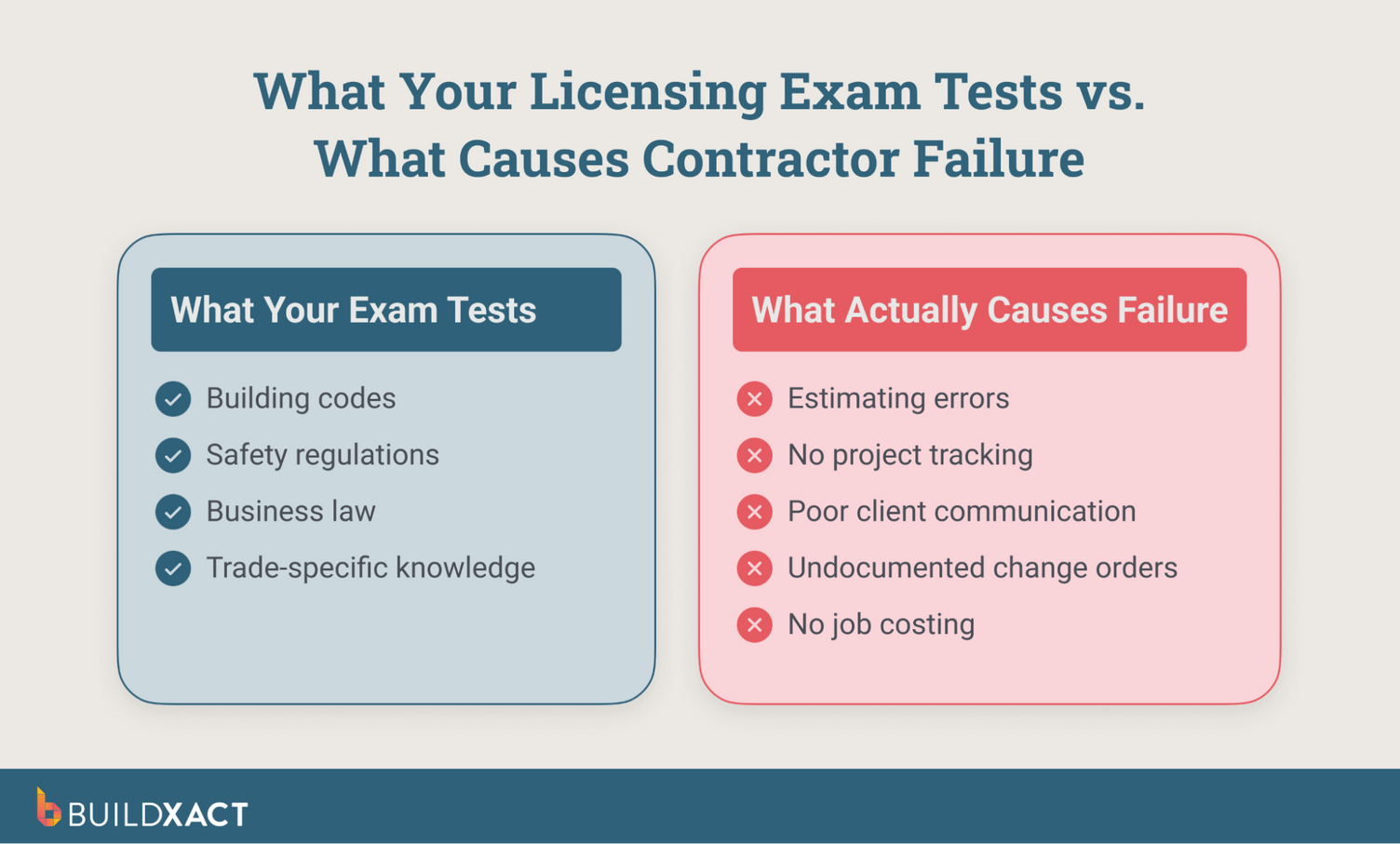
The exam proves you understand construction law, not how to run a business. While studying codes, learn about the tools you’ll actually use on jobs, such as:
- Estimating software
- Project tracking platforms
- Proposal templates and digital signatures
Step 4: Register your business entity
With your license approved, register the business. Your legal structure determines how you’re taxed and what happens if a client sues.
Common business structures include:
- Sole proprietorship: You operate under your own name and tax ID. Income from jobs is reported on your personal tax return. No separation between you and the business.
- LLC: A registered entity that separates your personal assets from business obligations. If a project leads to a legal dispute, the business is liable.
- S-Corp or C-Corp: Formal corporate structures suited for contractors with employees or higher revenue. More tax filings, but potential savings on self-employment taxes.
You’ll also need a federal EIN, state and local registrations, and a dedicated business bank account. Keeping business income separate from personal funds simplifies tax filings and protects your personal assets.
While you’re handling registration, set up the systems you’ll use to run jobs:
- Estimating: How you’ll price work and send proposals.
- Project tracking: How you’ll manage schedules, tasks, and subcontractors.
- Accounting: How you’ll track income, expenses, and receipts.
- Document storage: Where you’ll keep contracts, change orders, and project photos.
These systems work together. Your estimate becomes your project budget. Your budget feeds your job costing. Your documents protect you when scope changes.
Real contractors will attest to the importance of business systems for contractors who intend to strike out on their own:
“It’s important for me to be independent and be able to do takeoffs on my own. My salesman from BFS love it because I send them takeoffs and they’re all ready and he just has to review them.”
— Jeremy De Paz, Project Manager for Waterloo City Construction
Step 5: Obtain insurance and bonding
Before you can bid on most jobs, you’ll need proof of insurance. Clients, general contractors, and permit offices will ask for it.
- General liability insurance: Covers property damage or injuries on the job. Most states require it. Policies typically cost $500–$1,500/year for new contractors.
- Workers’ compensation: Required once you hire employees, or sooner, depending on your state. Covers medical costs and lost wages for work-related injuries.
- Surety bonds: A guarantee that you’ll complete the work. If you don’t, the bond pays the client and recovers from you. Many commercial and government projects require bonding. Your bond capacity also limits project size — a $50,000 bond means you can’t bid a $200,000 job, regardless of skill.
Bond underwriters evaluate how you run your business. The National Association of Surety Bond Producers notes they look for contractors who “run a well-managed, profitable enterprise…and perform obligations in a timely manner.”
In practice, that means showing how you track jobs, manage change orders, and document client approvals.
Before meeting with a bond underwriter, prepare a summary covering relevant information like the construction site management software you use, how you track project status, how you handle approvals, and more.
Contractors who demonstrate organized operations typically qualify for higher bond limits, which in turn provide access to larger projects.
Build a Better Business From the Ground Up: Systems That Protect Your Margins
Congratulations — you’re ready to take on work!
The next step is to develop the operational infrastructure necessary to keep you focused on what you love doing most — working in the business — without losing money to issues like scope creep, pricing errors, or undocumented changes that occur when you’re stuck working on the business.
Set up business systems
With the legal requirements, licensing, and registration out of the way, your next mountain to scale and conquer is the operational side: how you price work, track jobs, and communicate with clients.
Believe it or not, when designed and implemented strategically, these systems can become your greatest competitive advantage.
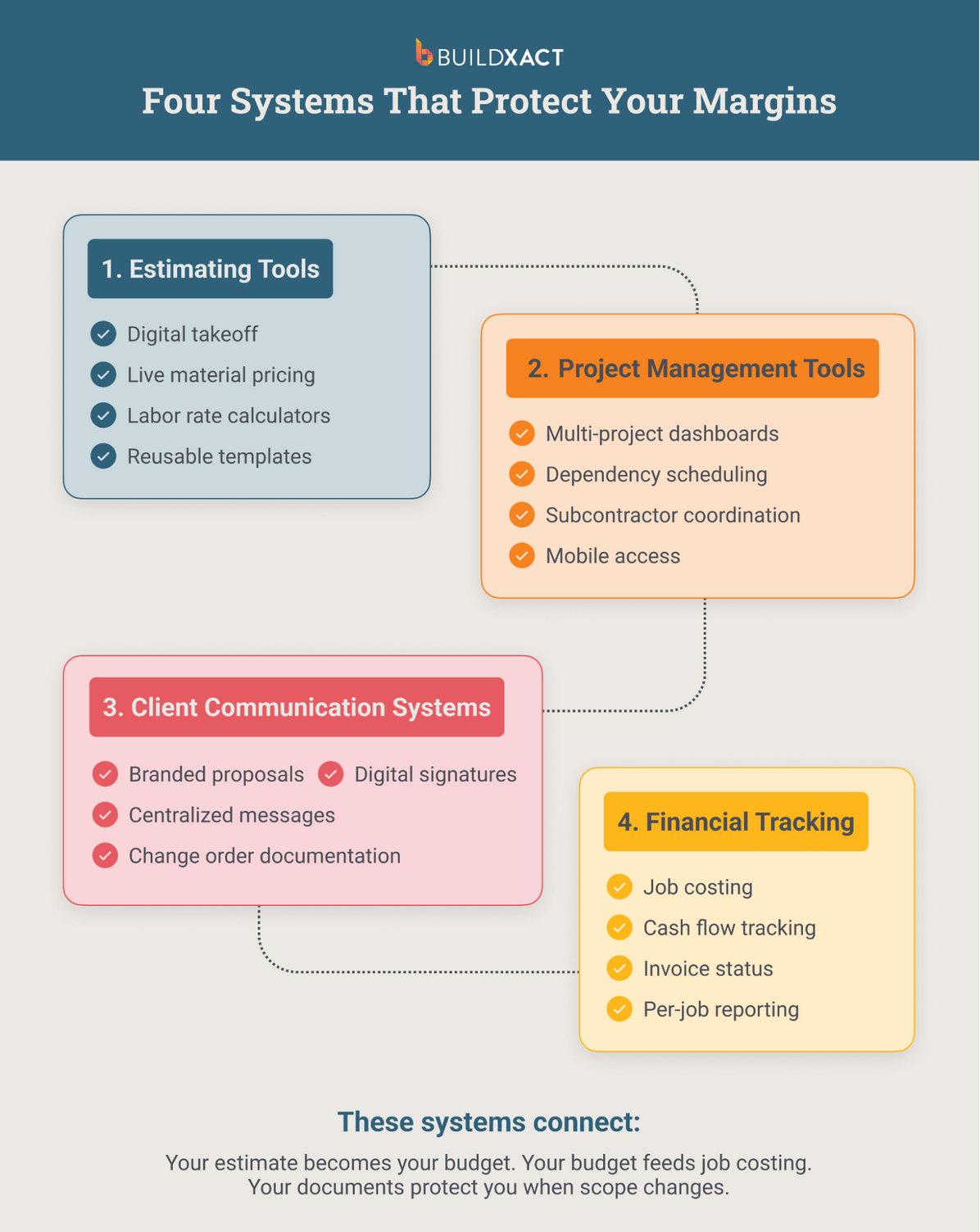
So let’s take a deeper look at four systems that keep jobs profitable and clients confident in your ability to deliver:
- Estimating tools
- Project management tools
- Client communication tools
- Financial tracking
Estimating tools
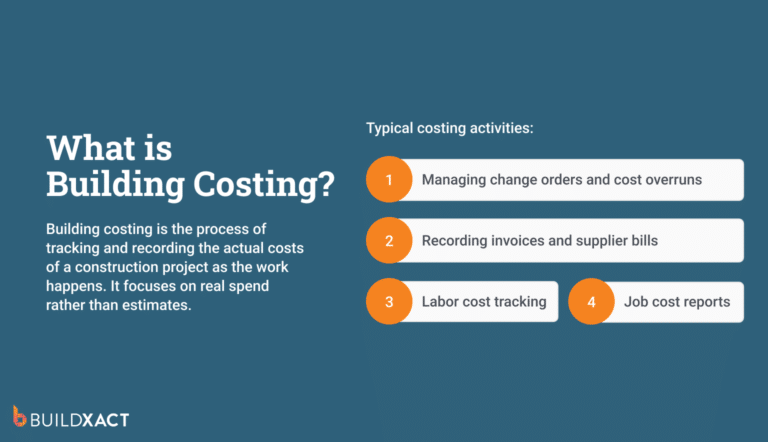
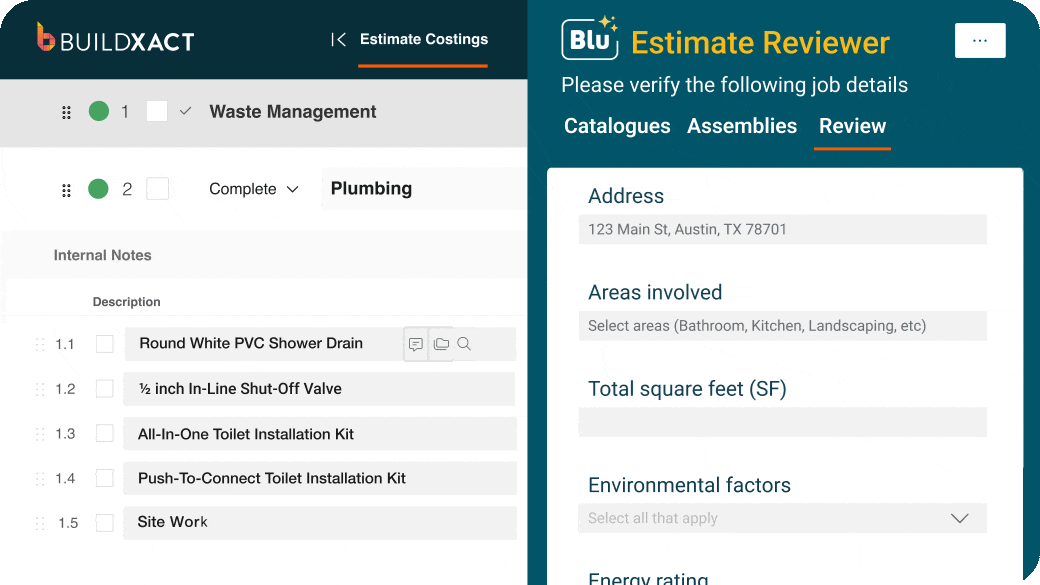
A 10% labor underestimate on a $30,000 bathroom remodel costs $3,000 in margin before the tile goes in. Solutions like Buildxact’s construction estimating software reduce pricing errors by connecting measurements directly to cost items.
An effective estimating platform includes:
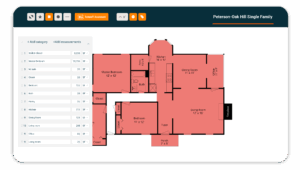
- Digital material and quantity takeoffs let you measure plans on-screen, with quantities automatically flowing into your estimate.
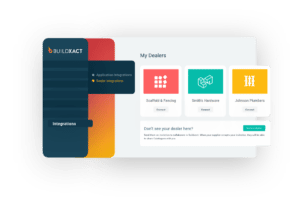
- Live dealer integration pulls the most up-to-date material pricing into your bid, replacing outdated averages (and guarding against underbidding).
- Labor rate calculators adjust time and cost based on task complexity and crew size.
- Reusable templates allow you to create assemblies for typical jobs, such as decks or bathroom remodels, refining accuracy with each project.
Spreadsheets can work for simple jobs. However, as project complexity increases, the risk of manual error also increases, which is why successful contractors and builders seek integrated construction estimating tools.
Project management tools
A contractor managing two jobs can mentally track schedules. However, a contractor managing four jobs with overlapping timelines, three subcontractors, and a permit inspection due Thursday needs a system.
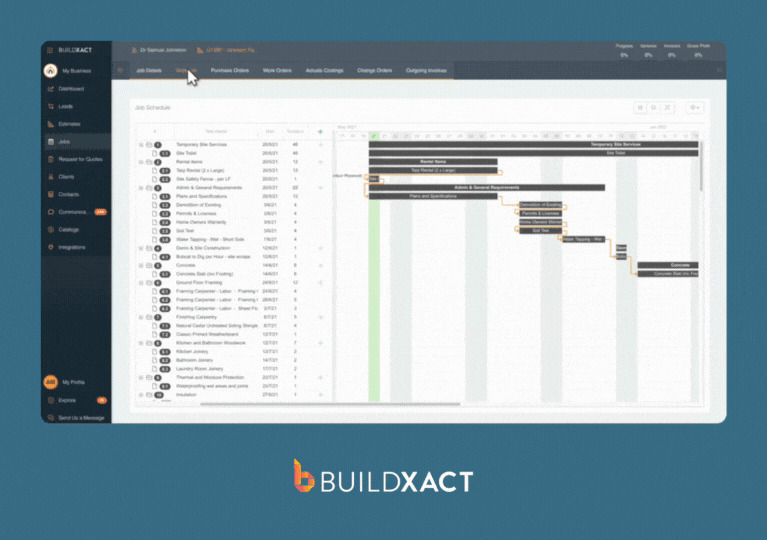
Buildxact’s construction project management software provides visibility across all active work:
- Multi-project dashboards display the status of every job in one view.
- Dependency scheduling connects tasks in sequence, so delays in one area automatically adjust the work downstream.
- Subcontractor coordination keeps task assignments, confirmed dates, and communication in one place.
- Mobile access enables updates from the job site, ensuring project status remains current.
So, while generic task apps handle to-do lists, you’ll benefit most from construction-specific tools that enable essential workflows like work breakdown structures, critical path method for construction scheduling, construction Gantt charts, and more.
Client communication systems
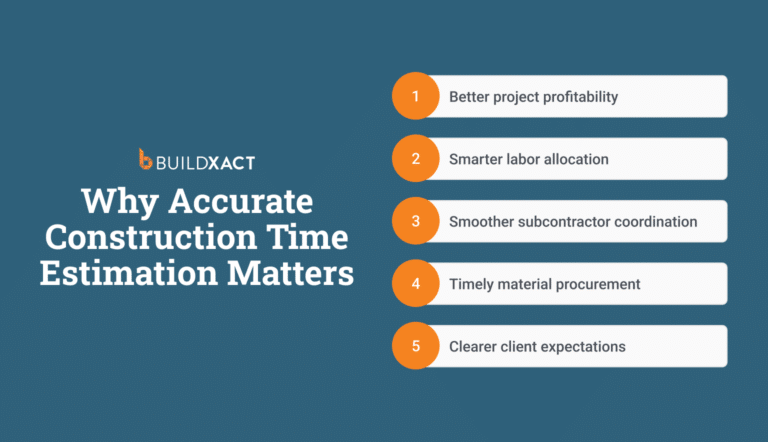
New contractors compete without a reputation. Clients evaluate what they can observe: response time, proposal clarity, and process organization.
A structured communication system enables you to:
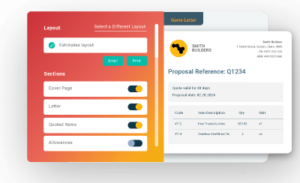
- Send branded proposals with line-item pricing and clear scope descriptions.
- Capture digital signatures instantly, eliminating delays caused by printing or scanning.
- Centralize communication so that messages and documents are accessible by relevant team roles in one place.
- Document change orders with timestamps and approvals, creating a clear record of when scope shifts occur.
When a client disputes an approval three weeks into a remodel, your documentation determines whether you bill for the work or absorb the cost.
Financial tracking
Revenue is not profit. A contractor billing $40,000 per month can lose money if job costs exceed estimates and cash flow gaps force delays.
And that’s the kind of insight that only financial tools designed specifically for contractors can enable:
- Job costing compares estimated construction costs against actual spending in real-time.
- Cash flow tracking monitors incoming payments and outgoing expenses.
- Invoice status shows what has been billed, paid, and remains overdue.
- Per-job reporting breaks down profitability by individual project, revealing which job types make money.
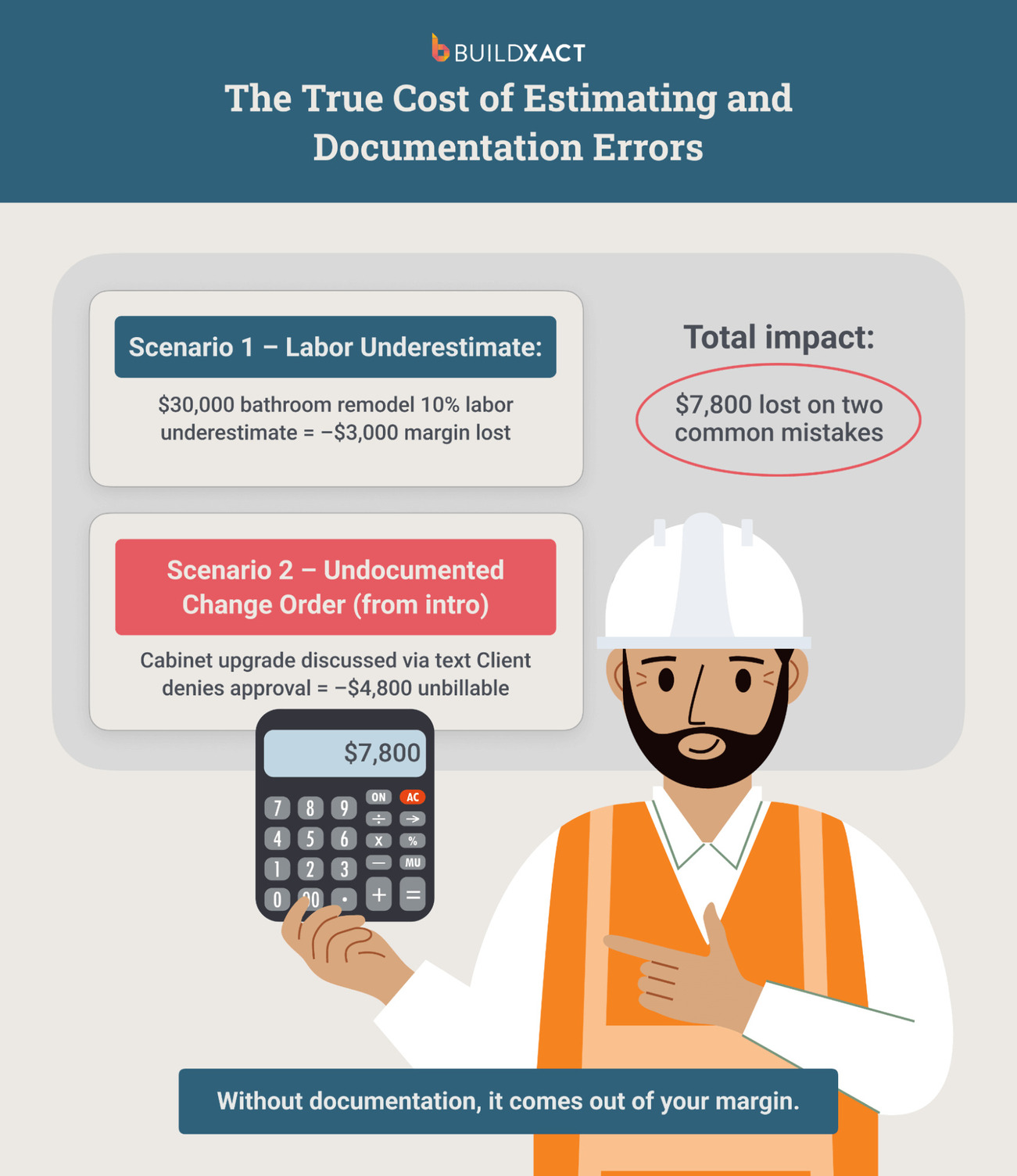
Without per-job visibility, profitable projects subsidize losing ones.
Integrated vs. siloed tools
If you were setting up your business in 2014, maybe relying on separate tools — spreadsheets for estimating, a generic scheduling app, QuickBooks for accounting, and email for communication — would set you apart.
At that time, siloed digital tools were not only “better than nothing,” but they also helped distinguish your business from competitors.
Now, they’re not only the baseline, but they’re likely also costing you far more than you think because it’s simply inefficient to rely on double data population across tools. Not only does a siloed tech stack increase the risk of errors, but it also cuts into your profits.
Think about it: You’ve essentially hired yourself, at your day rate, to spend time doing repetitive tasks that purpose-built construction software can do for you — better, faster, and error-free.
In 2026 and beyond, Buildxact’s integrated platform, which is geared specifically toward residential construction realities, is the new standard customers expect, and which your business needs to connect these functions:
- Your estimate becomes the project budget.
- That budget feeds job costing.
- Change orders stay attached to the job record.
- Timelines update seamlessly based on estimate costing changes.
For contractors without administrative staff, this type of cross-connected integration reduces manual work and maintains consistent information.
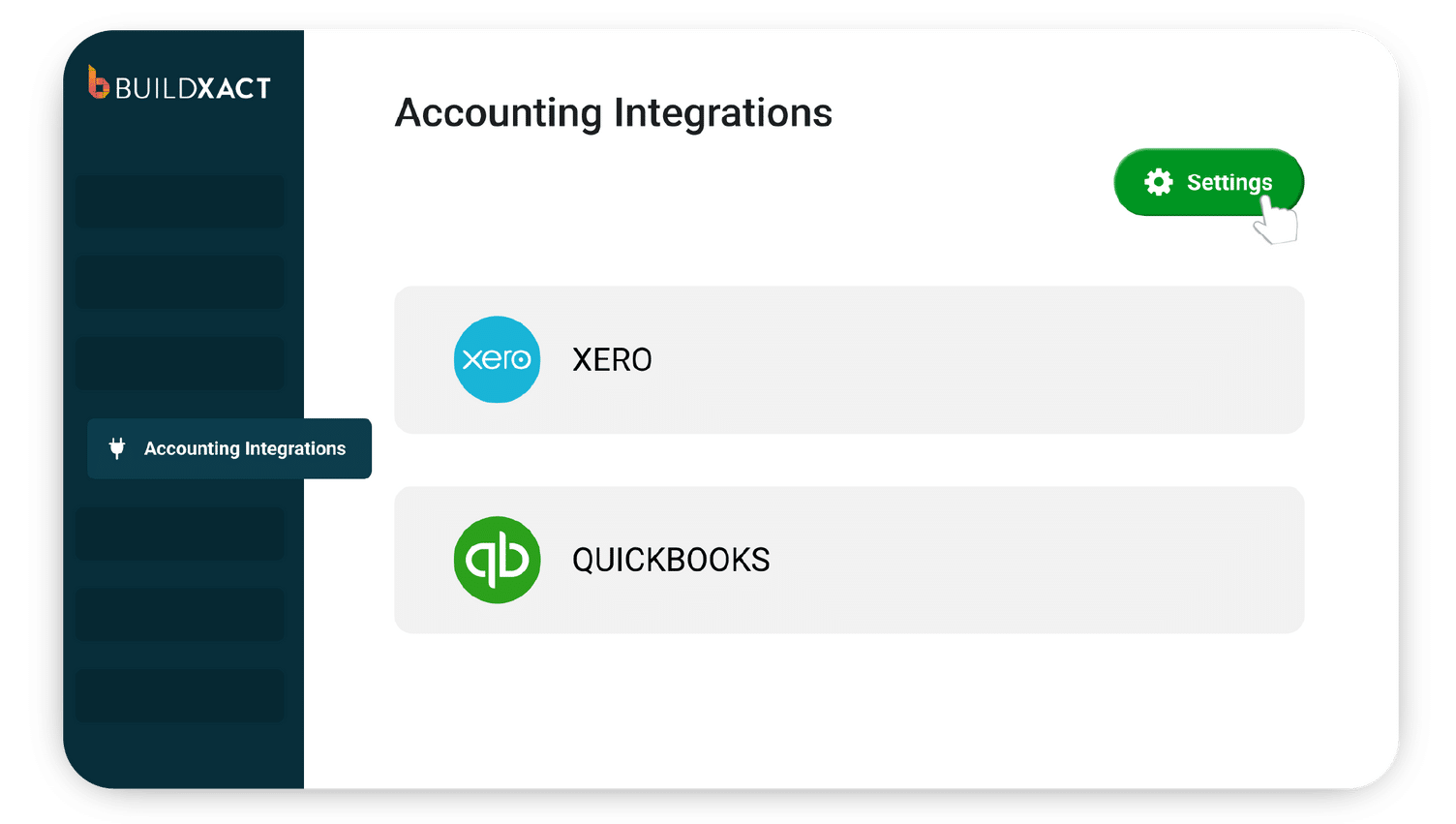
Buildxact also integrates with accounting tools, suppliers, and other business applications, ensuring you’re not locked into a single workflow. That ecosystem reduces the time and money you’d otherwise spend stitching together your own tech stack.
Start bidding and build your portfolio
With your license, insurance, and systems in place, you can start bidding work. The goal in your first few months is not to maximize revenue, but to test whether your pricing holds, your systems work, and your process delivers projects profitably.
Here’s how to choose the right projects, win them professionally, learn from each one, and build a reputation that lands larger work.
Start with smaller projects
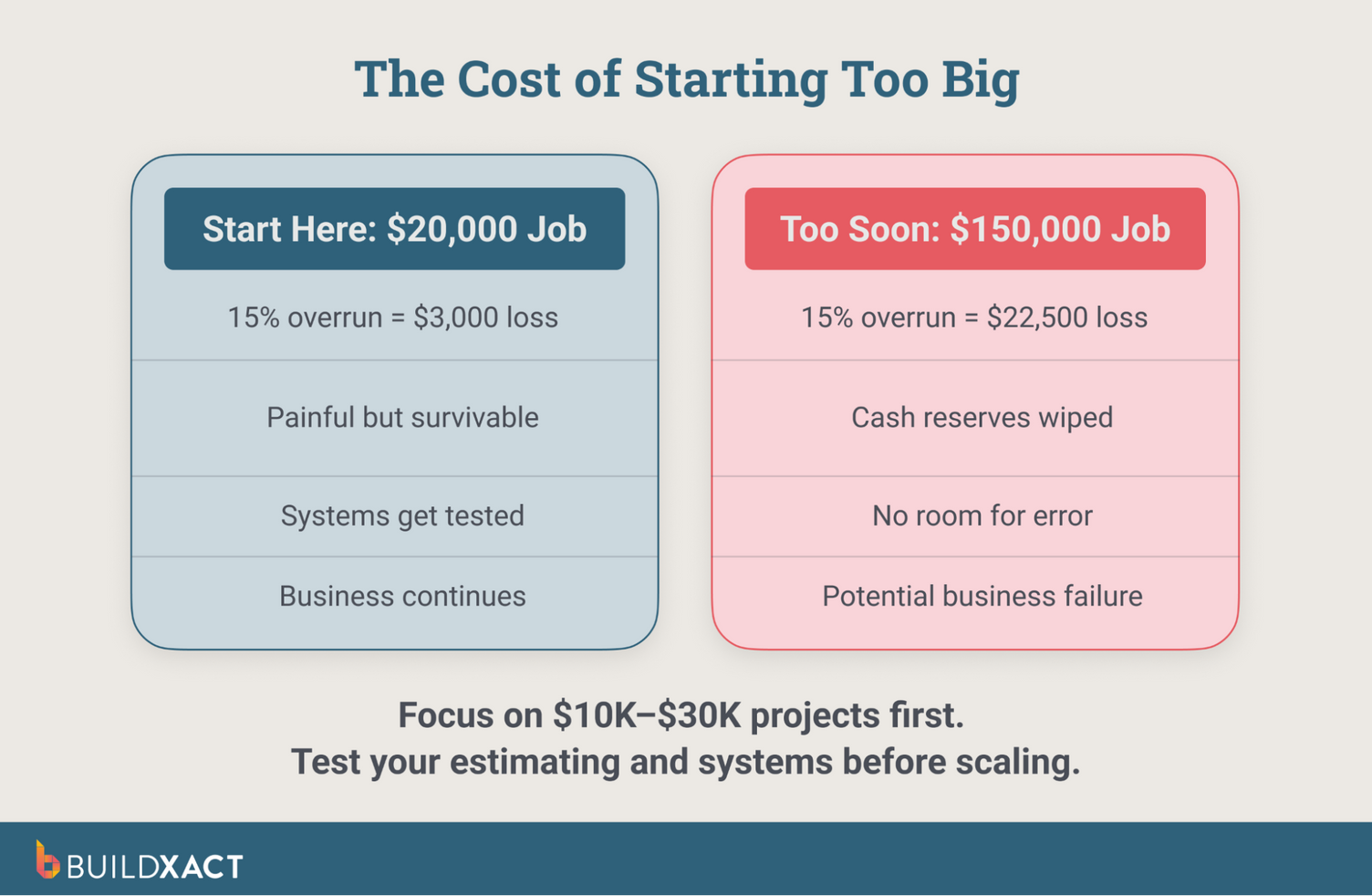
Focus on jobs in the $10,000–$30,000 range. These projects are large enough to test your estimating and project management systems, but small enough that a pricing error does not wipe out your cash reserves.
A 15% cost overrun on a $20,000 job is a $3,000 lesson. The same error on a $150,000 addition is a $22,500 problem that can end your business before it starts.
Use professionalism and the customer experience to stand out
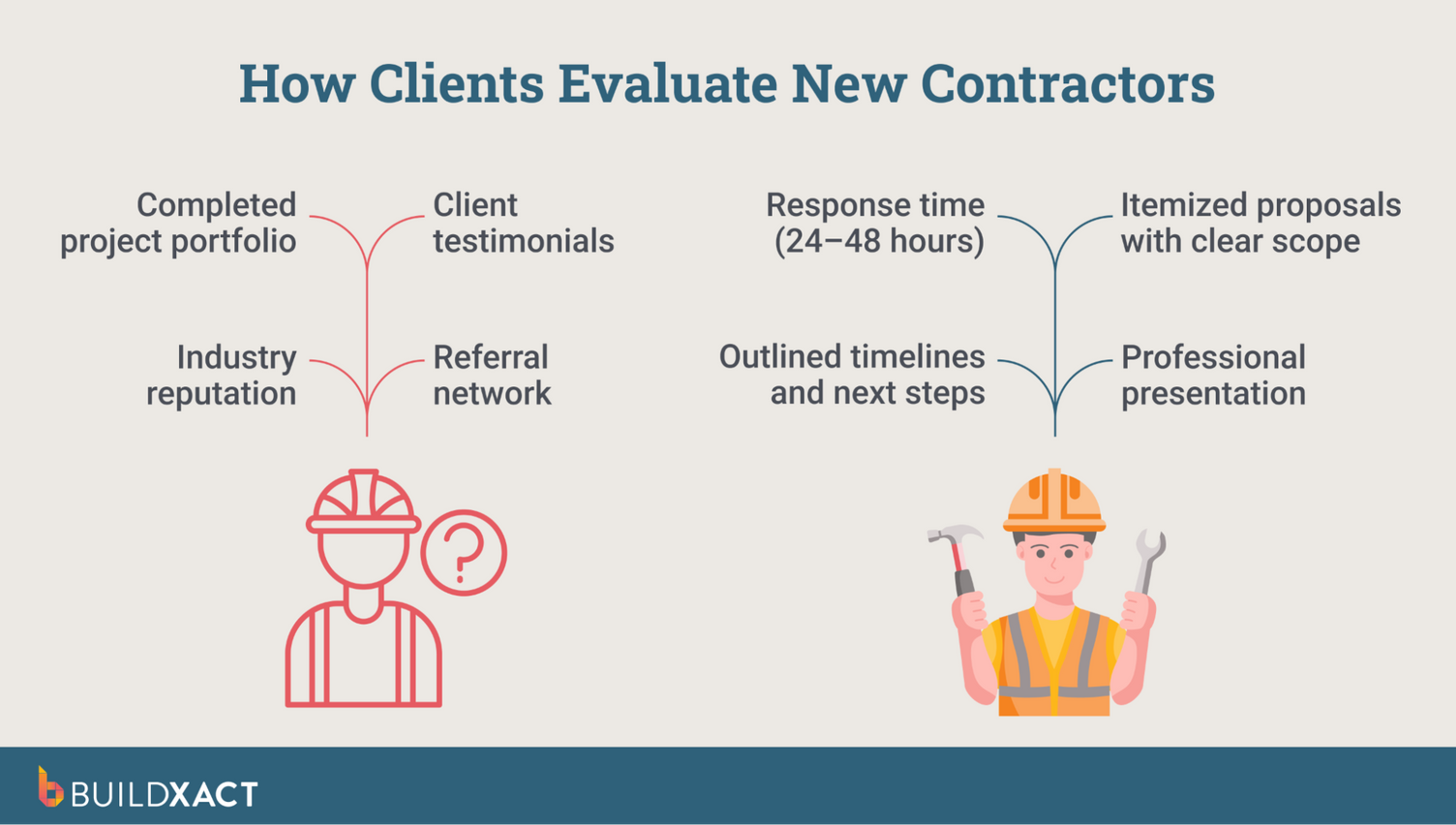
New contractors compete without a track record, so clients evaluate them based on what they can observe.
Response time signals reliability and proposal clarity signals competence.
- Respond to requests for information within 24–48 hours.
- Deliver itemized proposals with clear scope descriptions.
- Outline timelines and next steps upfront.
Track every job
After each project, compare your estimate against actual costs:
- Where did materials exceed budget?
- Which tasks took longer than expected?
- Did the client add a scope you did not price?
Contractors who systematically track job costs improve pricing accuracy with each project, rather than repeating the same errors.
Build your reputation
At project closeout, request a review. Send your Google Business profile link directly rather than asking clients to search for it. Completed projects with documented photos, scope descriptions, and client testimonials become the proof that wins you higher-value contracts.
Start Your Contracting Business With the Right Foundation in Place
Every successful contracting business starts with more than a license. It requires documented experience, proper registration, the right insurance, and operational systems that keep jobs profitable from first bid to final invoice.
A construction management platform like Buildxact brings these capabilities together: estimating, project management, client communication, and job costing, so you can run your business from one place instead of juggling disconnected tools.
Ready to build on solid infrastructure? Get started for free or book a demo to see how Buildxact supports contractors from their first bid.