
On busy residential sites, safety planning often happens alongside quoting, scheduling, material deliveries, and trade coordination. But with crews and conditions changing frequently and work often starting before every detail has been checked, safety documentation tends to be reused, rushed, or completed off-site.
This creates gaps in safety planning that can escalate into problems during inspections or after a near-miss.
A Job Safety Analysis (JSA) documents task-specific hazards and controls. It shows that builders are taking a proactive stance toward hazards, which can be helpful when responding to OSHA inquiries or insurance reviews. A well-run JSA ties safety decisions directly to the way work is planned and carried out on site, giving crews a shared reference point before high-risk tasks begin.
In this guide, we’ll explore how a job safety analysis works in residential construction, with a clear, step-by-step breakdown of how to perform an effective JSA that helps keep safety issues at bay.
What is a Job Safety Analysis (JSA) in Residential Construction?
A Job Safety Analysis (JSA) is a key safety document used to identify hazards and develop strategies for managing them before a project begins. In residential construction, JSAs focus on the specific activities that subcontractors perform on-site.
JSAs are typically prepared before high-risk or non-routine work begins and reviewed whenever site conditions, sequencing, or trades change. For small builders, a JSA is an important bridge between the planning and construction phases, helping crews understand the risks they face in the context of the actual job.
In residential builds, a JSA usually covers:
- The specific task being performed (e.g., roof framing, excavation, electrical rough-in)
- The hazards associated with that task, given the current site conditions
- The controls required to reduce risk, including tools, PPE, sequencing, or supervision
- Who is responsible for implementing and monitoring those controls
Used properly, a JSA supports safer work, clearer communication with subcontractors, and clear, auditable documentation in the case of inspections or incident reviews.
“Residential construction is the building sector with the most injuries, amounting to 10,000 in 2023”
How a Job Safety Analysis works on a residential jobsite
On a residential build, a Job Safety Analysis is tied directly to the work conducted on-site. It’s developed before a task begins and shared with the subcontractors doing the work, so everyone involved knows what to watch for on that job, that day.
In simple terms, a JSA on a residential build should be:
- Based on the task about to start, not a generic safety template
- Reviewed with the crew or subcontractor before work begins
- Easy to check during the day if conditions or access change
- Kept up to date as trades or timings shift
Site issues are more likely to arise when safety conversations happen only in passing or when documents are scattered across different places. With a clear and consistent process for creating and sharing JSAs, you can stay in control of hazards and reduce delays that cause setbacks.
The Benefits of JSAs in Residential Construction
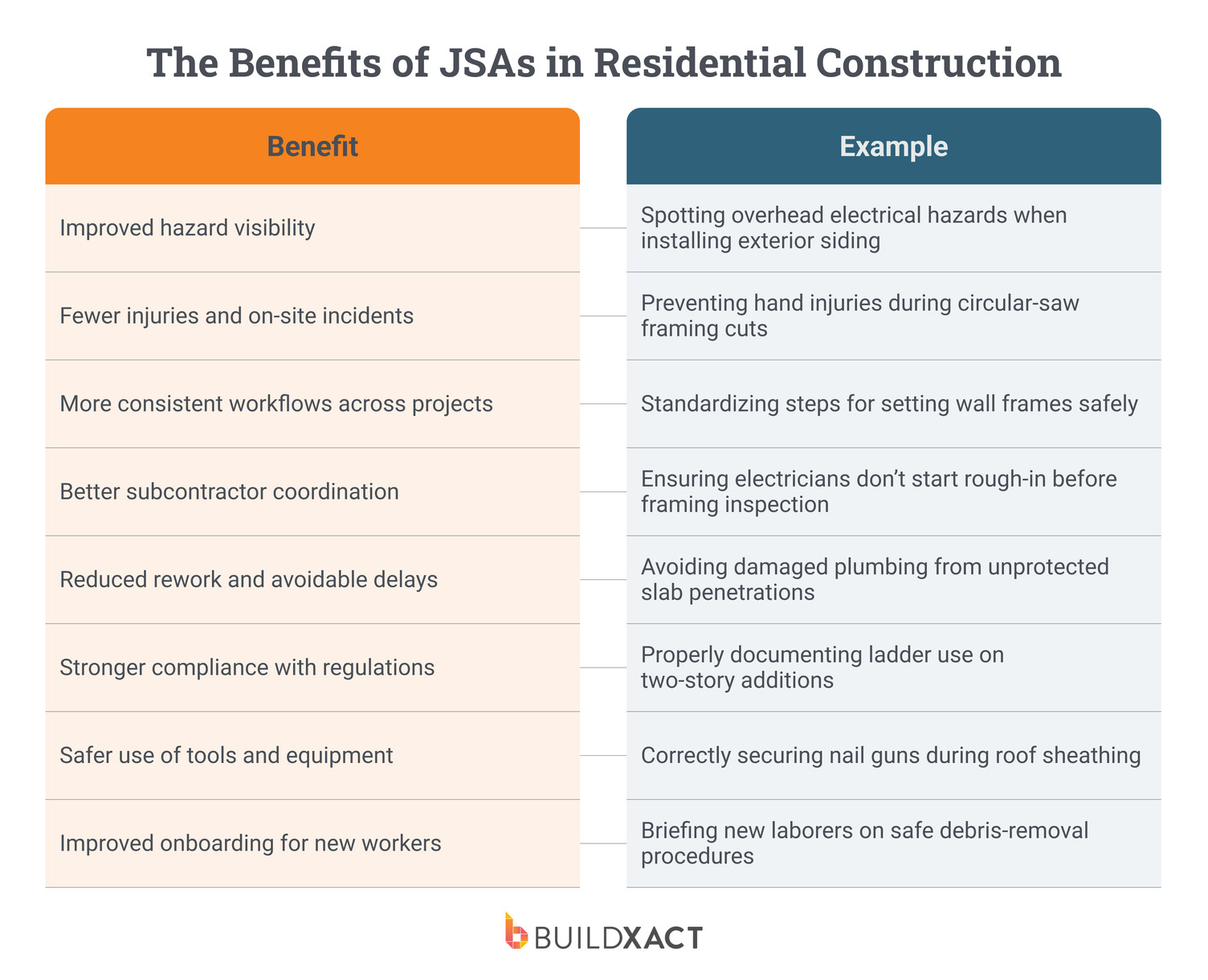
For small home builders, safety planning often competes with tight timelines and changing site conditions. When work progresses quickly, safety details are often overlooked or handled informally, resulting in coordination issues, rework, and delays.
A well-run JSA helps bring order and clarity by setting clear expectations and providing everyone with a shared reference as the job progresses.
Improved on-site safety and risk control
Routine residential tasks like lifting, cutting, or working at heights carry multiple risks, even when they feel familiar. When those risks aren’t clearly thought through, crews fall back on habit.
Documenting hazards and agreed controls upfront reduces reliance on guesswork and assumptions, and lowers the chance of incidents caused by missed or underestimated risks.
“Nearly 1 in 5 workplace deaths occurred in the construction industry; 38.4% were due to falls, slips, and trips.”
More consistent workflows across projects
When builders rely on experience rather than documented processes, the same task may be performed very differently from job to job – and this inconsistency can lead to dangerous mistakes.
A JSA creates a repeatable and safe way to approach common residential building tasks, helping standardize how work is planned, sequenced, and carried out across every project.
Better subcontractor coordination
Subcontractors often arrive on site without clear safety expectations or an understanding of what needs to happen before or after their task. That uncertainty can cause unsafe overlaps, risky shortcuts, or crews working out of sequence.
Clear task-based safety planning helps define job-specific safety information, work order and site access, and handoffs between trades, keeping jobs moving safely and efficiently.
Reduced rework and avoidable delays
Unsafe or poorly planned methods increase the risk of mistakes, stop-work events, or costly rework that quickly throw project schedules off track.
Agreeing on the correct and safest way to complete an activity upfront reduces trial-and-error on-site and prevents unnecessary (and expensive) interruptions.
Stronger compliance with regulations
When safety decisions aren’t clearly documented, small builders are left exposed to fines or liability gaps if an inspection needs to be conducted.
Although JSAs aren’t a legal requirement for OSHA, recording hazards and controls in a single, accessible document helps support compliance obligations and demonstrates that risks were managed correctly.
Improved onboarding for new workers
New workers may know their trade, but they don’t yet know your site, your setup, or how the job is meant to run safely. Without clear guidance, important steps are easily missed.
Covering task-specific hazards and controls in a JSA gives new starters a clear reference from the start, reducing early errors and helping them work safely without holding up the job.
Understanding the benefits is one thing, but creating a JSA that holds up under actual site conditions relies on knowing how to approach hazards and what to watch out for.
How to Complete a Job Safety Analysis
JSAs don’t have to be complex to be effective. In fact, they work best when they’re practical, clear, and easy to apply on site.
Below is a straightforward guide to creating JSAs that align with the way residential projects operate in real life.
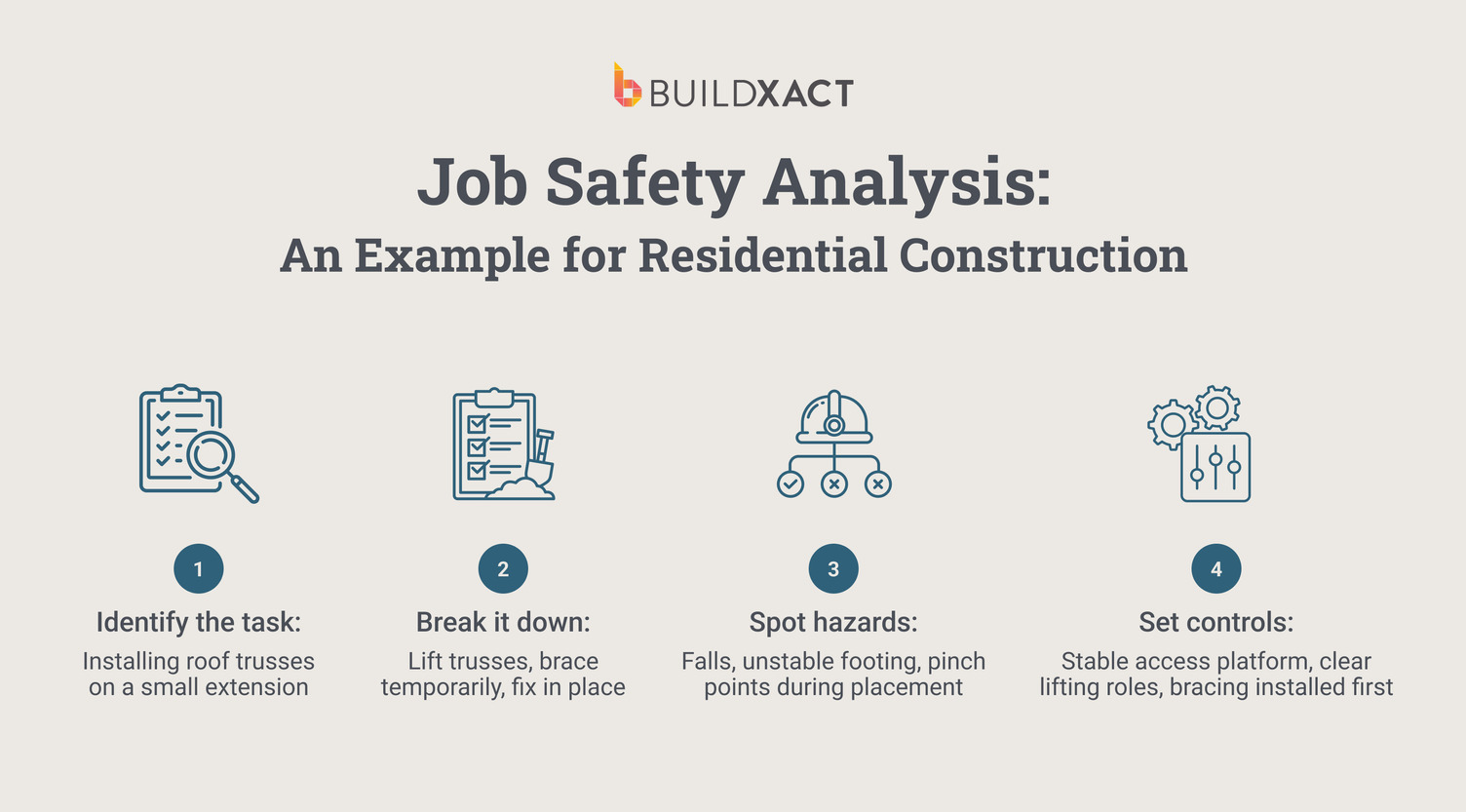
1. Identify the task
Start by identifying the exact task that could expose workers to risk. Focus on activities that involve tools, equipment, manual handling, confined areas, or working at height.
Being specific matters, because vague task descriptions make it harder to spot real risks before work begins.
What to watch out for: When schedules are tight, tasks are often defined too broadly or skipped entirely, which makes hazards easier to miss.
2. Break the task into steps
Watch how the work is actually done on-site and break it down into clear, simple steps in the order they happen. This should reflect real site behaviour, not how the task is meant to run in theory.
Clear steps help everyone understand what comes first and what must be completed before the next stage can safely begin.
What to watch out for: Steps are often based on habit or experience, which leads to gaps, shortcuts, or inconsistent sequencing between jobs.
3. Determine hazards for each step
Look at each step and identify the risks tied to tools, materials, access, nearby work, and site conditions. Pay attention to common residential issues like uneven ground or limited space.
Hazards should be noted step by step, not lumped together.
What to watch out for: Hazard identification depends heavily on who’s involved and is often rushed or incomplete on familiar tasks.
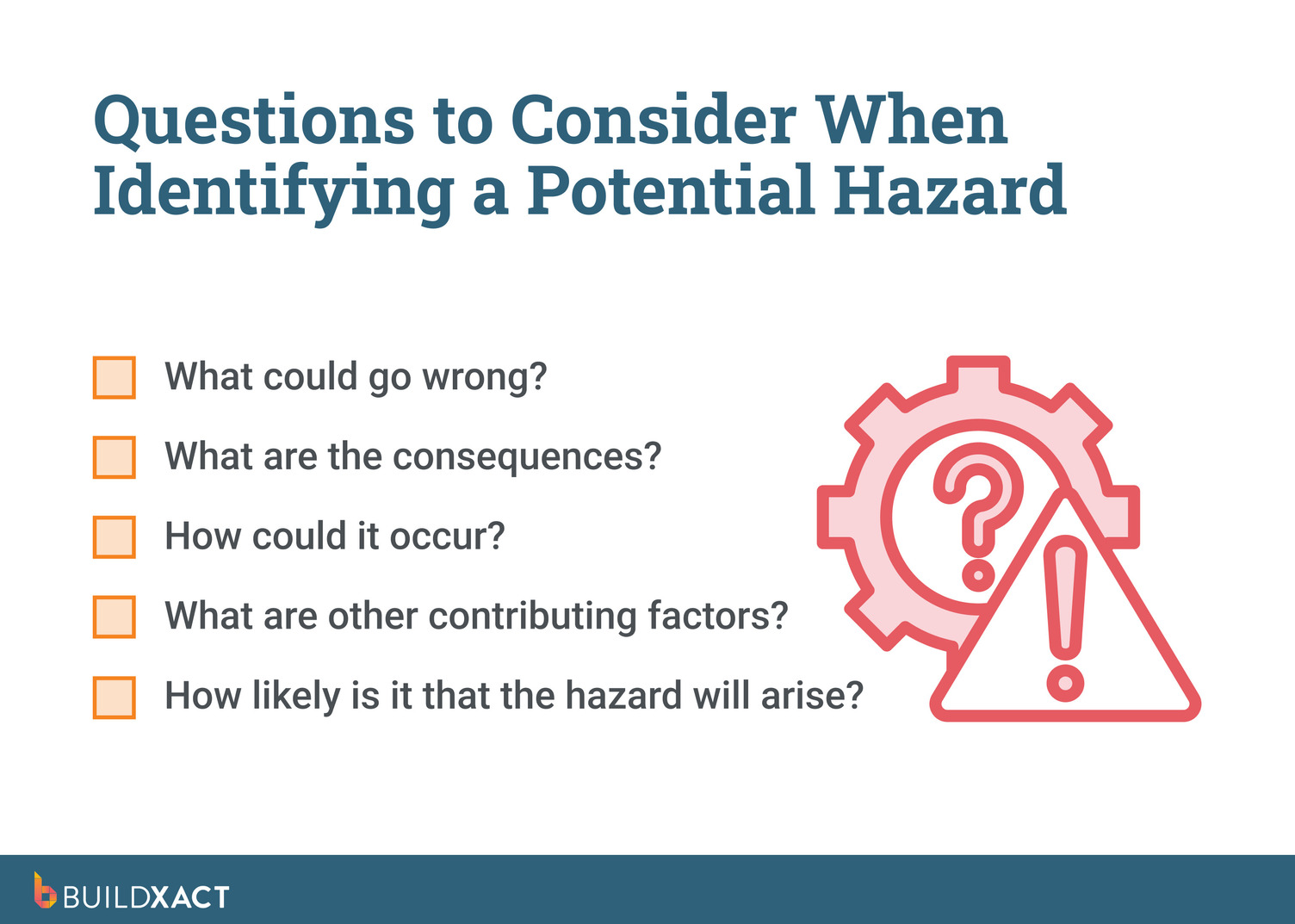
4. Define controls for each hazard
Decide how each identified hazard will be managed before work starts. Where possible, change the setup or method of work rather than relying only on rules or protective gear.
Controls should be practical and easy to follow so they hold up once the job is underway.
What to watch out for: Controls are often too generic or not clearly communicated, making them easy to ignore on site.
5. Review and update on every project
Revisit the JSA as the project moves forward and update it when conditions change. New materials, altered access, or overlapping work can all introduce new risks.
Remember, a JSA only works if it reflects what’s actually happening on site at the time.
What to watch out for: As projects evolve, safety information quickly becomes outdated and stops matching real site conditions.
Preventing or minimizing hazards
Once hazards are identified, the next step is deciding how to remove or reduce the risk. These controls should be considered in order, starting with the most effective options first.
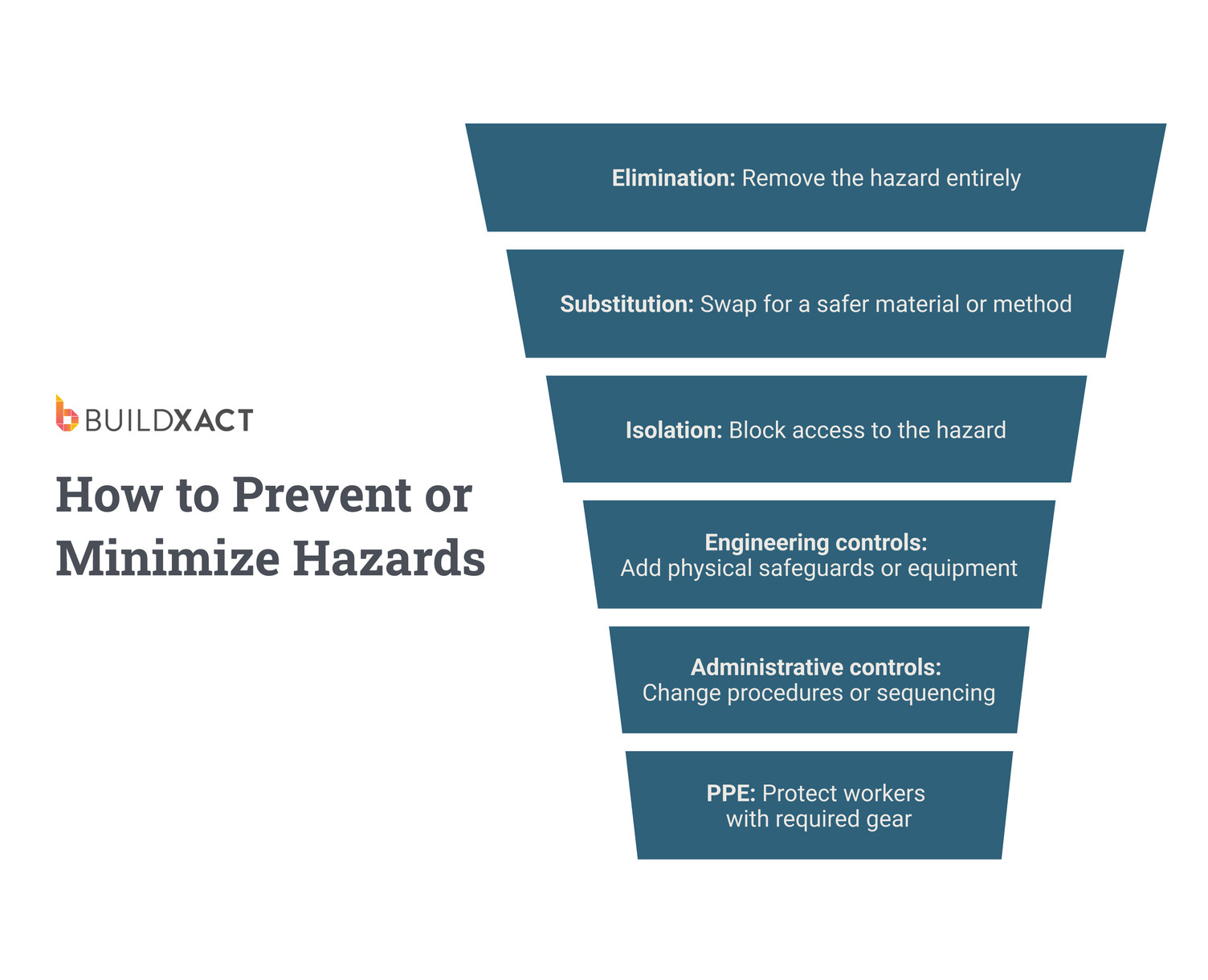
Elimination
Remove the hazard completely by changing the scope, timing, or method of work so the risk no longer exists.
Substitution
Replace the hazardous material, tool, or process with a safer alternative that achieves the same result with less risk.
Isolation
Separate people from the hazard by restricting access, creating exclusion zones, or scheduling work to avoid overlap.
Engineering controls
Use physical solutions such as barriers, guards, supports, or mechanical aids to reduce exposure to the hazard.
Administrative controls
Adjust how work is planned and carried out through procedures, sequencing, signage, or supervision to limit risk.
PPE
Use appropriate protective equipment when hazards can’t be fully controlled through other measures.
Even with the right controls in place, safety planning can fall behind once the job gets underway. As work changes day to day, keeping hazards and controls current becomes harder without a reliable way to manage and share site information.
Improving Site Safety With Construction Management Software
So you’ve created a JSA, briefed the crew, and started the job. Then bad weather shifts the schedule, or materials arrive late and the timeline blows out. The JSA is still sitting there, but the job has changed. When safety planning doesn’t keep pace with day-to-day site changes, gaps open up quickly.
This is where having everything in one centralized system can make all the difference. Construction management software can improve visibility, coordination, and consistency across day-to-day site work, helping to keep safety planning aligned with what’s actually happening on site.
Here’s how residential construction software like Buildxact can support safer work and keep jobs on track:
Clear task sequencing
Seeing the job laid out in the right order makes it clear when a task is ready to start and when it’s not. That stops crews from arriving too early, working around unfinished areas, or overlapping in ways that weren’t allowed for in the JSA.
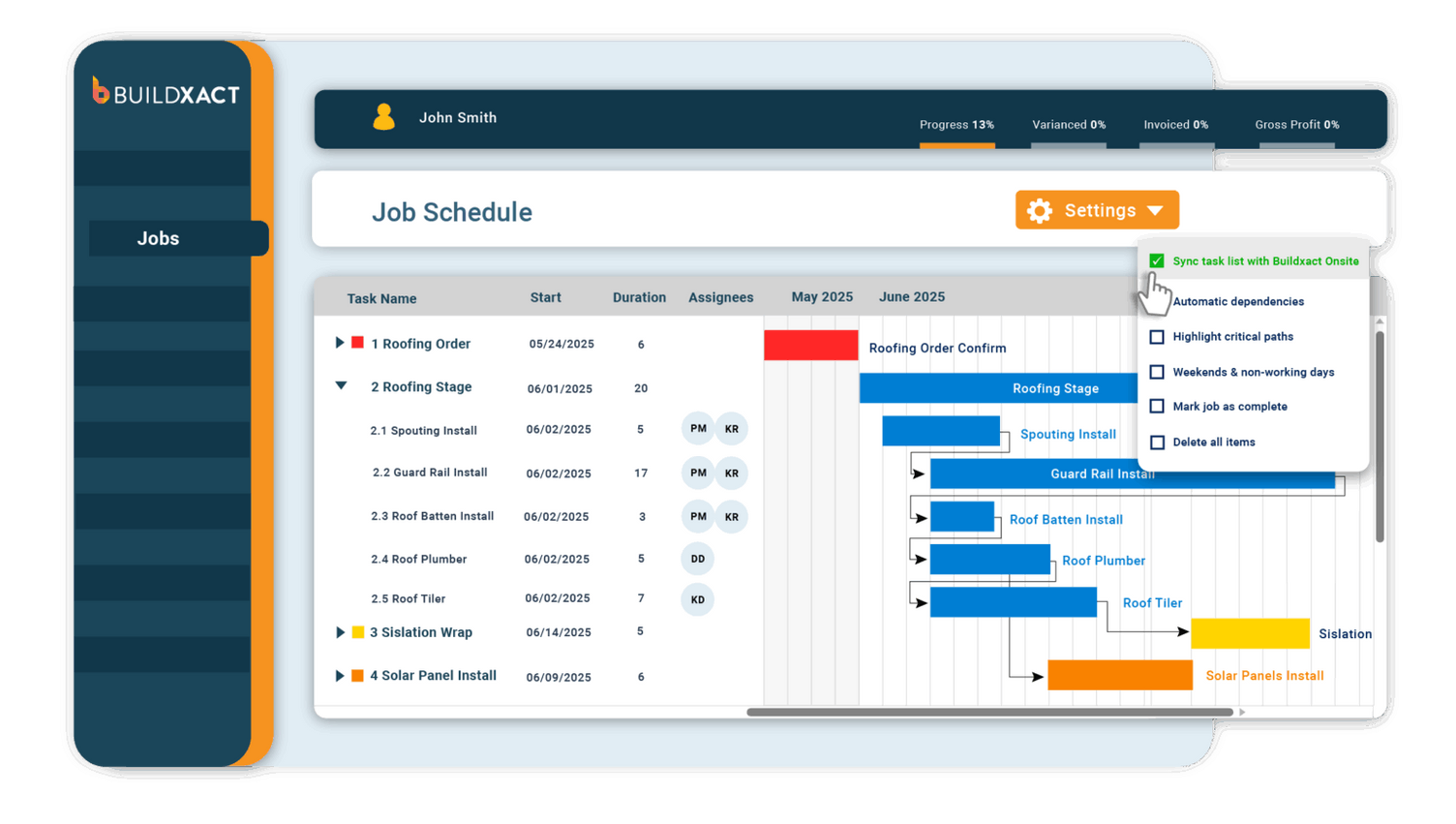
For example, with Buildxact’s digital scheduling tool, you can easily generate Gantt charts that show the order of tasks using clear color-coding, making it easy to identify who’s doing what.
Shared, up-to-date schedules
When the schedule changes, everyone sees it straight away. That matters because JSAs are built around timing, access, and who’s on site. If the schedule changes but the safety plan doesn’t, people end up working under conditions that were never planned for.
Mobile access to job details
Having job details on a phone or tablet means safety information is available where the work is happening. Someone arriving mid-job can check what’s planned before starting, instead of relying on second-hand explanations or trying to piece things together on the fly.
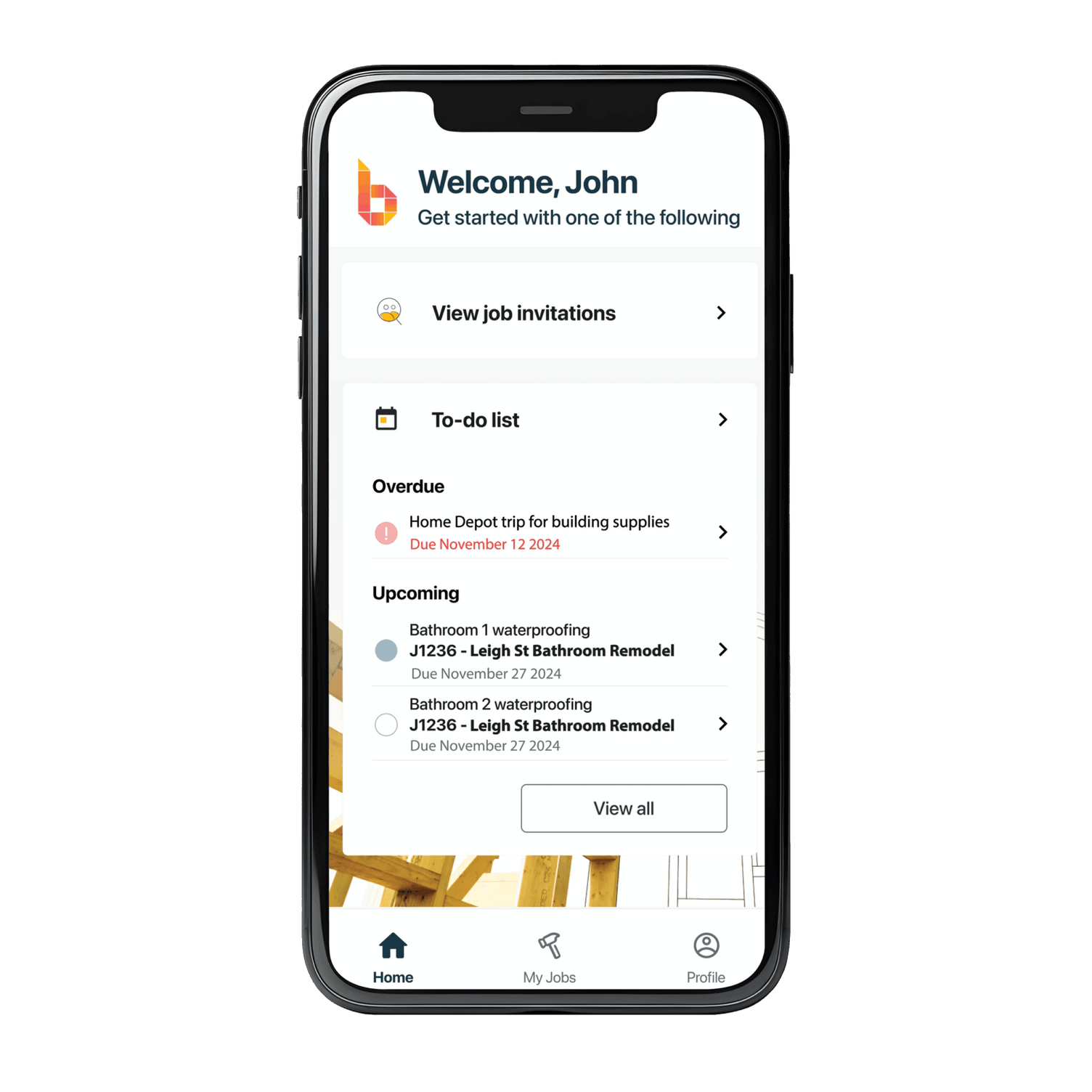
Buildxact’s Onsite app lets you create mobile and tablet-ready to-do lists to share and track progress, which site teams can view and access while on the job.
Better visibility into task timing
Seeing which tasks are delayed and which ones are scheduled next shows where pressure is building. When that pressure is visible early, work can be re-sequenced properly instead of being rushed at the last minute, when safety steps are most likely to be skipped.
Job photos and notes
Photos and notes capture changes that don’t always make it onto a plan, like restricted access, temporary supports, or altered work areas. These updates make it easier to see when site conditions no longer match the JSA and need to be addressed.

For example, the Daily Logs feature in the Onsite app makes it simple to share project progress and site conditions via photos, so teams can be kept in the loop.
Improved material planning
When materials are tracked properly, work isn’t forced to start with substitutes or temporary fixes. That reduces situations where crews change methods just to keep moving, often bypassing the controls that were originally planned in the JSA.
As every builder knows, unexpected changes and adjusted plans are just part of the job. A JSA is only valuable if it keeps up with these changes and stays aligned with the way the work evolves.
Construction management software helps builders keep safety planning connected to real site activity, so hazard controls are followed even (or especially) when the job doesn’t go as planned.
Job Safety Analysis: FAQs
What are the common hazards identified in a job safety analysis?
Common hazards in a JSA come from everyday site activities like working at height, manual handling, power tools, moving materials, uneven ground, and overlapping work. Changing site access, weather, and tight spaces also introduce risks that need to be considered before work starts.
How does job safety analysis differ from risk assessment?
A risk assessment looks at safety risks across the whole site or business. A JSA is more practical and task-focused. It breaks a specific job into steps, identifies hazards at each stage, and sets out how the work should be done safely on site.
When should a job safety analysis be updated or reviewed?
A JSA should be reviewed whenever something changes on the job. That includes schedule shifts, new materials, different access, or overlapping work. It should also be checked when new people start or when work methods change, so it still reflects what’s happening on site.
Build Safer, Work Smarter: Supporting Site Safety With Connected Software
A job safety analysis can be invaluable for keeping teams safe and jobs moving. But it only works if it stays connected to the way the build is actually progressing.
Construction software like Buildxact keeps safety at the forefront of your day-to-day job operations. By placing schedules, tasks, and site updates in one place, teams can see exactly what’s happening and adjust quickly. That means safer work, fewer delays, and jobs that stay on track even when they don’t go to plan.
If site safety is a priority for your small business, choose a construction management platform that keeps every part of the project connected. Start your free trial today or book an interactive demo.