
Before the first shovel hits the ground, most residential builders have already made their biggest commitment: the price.
The problem is that this commitment is often made while designs are still evolving, selections are marked “TBC,” and unknowns remain unresolved. The build hasn’t changed, but pricing expectations have. And when certainty is forced too early, something has to give. Usually, your time, your margin, or both.
Progressive design-build was developed to change when those decisions are made. It can be a powerful approach in the proper context. But it isn’t a silver bullet. And for many small to medium builders, it’s not the right fit at all.
Here’s a rundown of what progressive design-build means, how it works, and whether it’s the right approach for your residential construction project.
What is Progressive Design-Build?
Progressive design-build is an approach where the builder, designer, and client work together early, before the design is fully resolved and a final price is set. It allows key decisions to be made with better information, rather than guessing upfront.
Instead of completing the design first and pricing it afterward, scope, design, and cost are developed simultaneously. As decisions firm up, pricing is updated alongside them, keeping expectations aligned.
The goal is early collaboration and gradual cost certainty, rather than forcing a final price too early.
Progressive design-build vs design-build
To understand where progressive design-build fits, it helps to compare it with the more traditional design-build approach.
On paper, both aim to take a project from start to finish under one contract. In reality, they run very differently once the job hits the site and real-world issues show up.
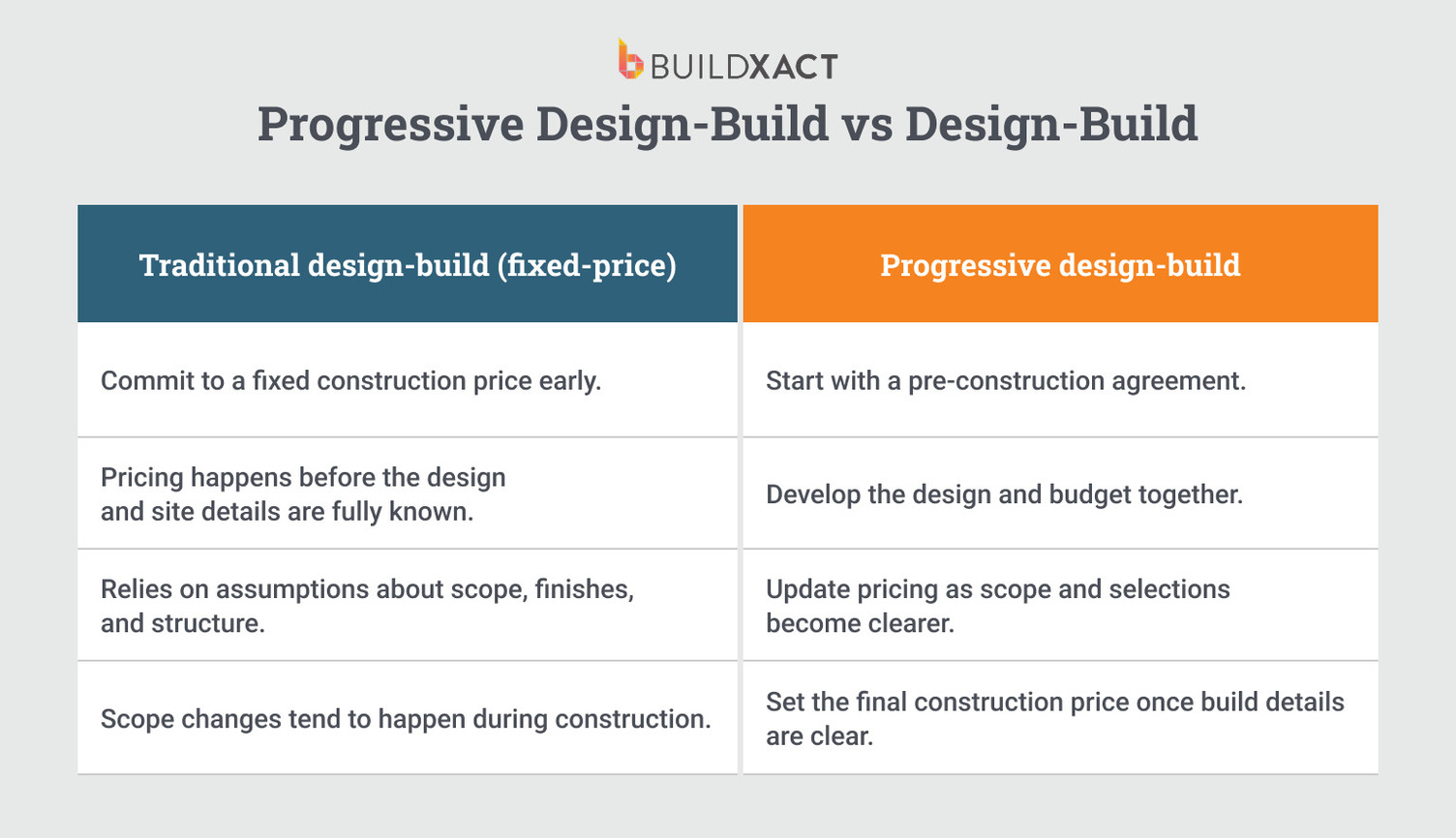
Traditional design-build asks you to commit to a fixed construction price early, often before the design is fully developed, and you know all site conditions. You’re usually pricing based on incomplete drawings and making assumptions about the job, adding padding to protect yourself from the unknown.
Once construction starts, those assumptions are quickly tested. Clients change their minds, and change orders become part of how the job stays on track. While this approach can work on simple, predictable builds, it often creates stress and rework on custom homes or renovation projects.
Progressive design-build takes a more realistic approach. Instead of locking everything in upfront, you begin with a pre-construction agreement and develop the design and budget alongside the client.
Pricing is updated as selections are made and the scope becomes clearer, with the final construction price only set once there’s a solid understanding of what’s actually being built. By the time construction begins, you’re working from clarity rather than guesswork.
The Progressive Design-Build Process
Progressive design-build works by slowing things down at the start so the job runs better later. Instead of trying to price everything upfront, you move through the project in stages, reducing unknowns as you go and locking things in only when they’re known.
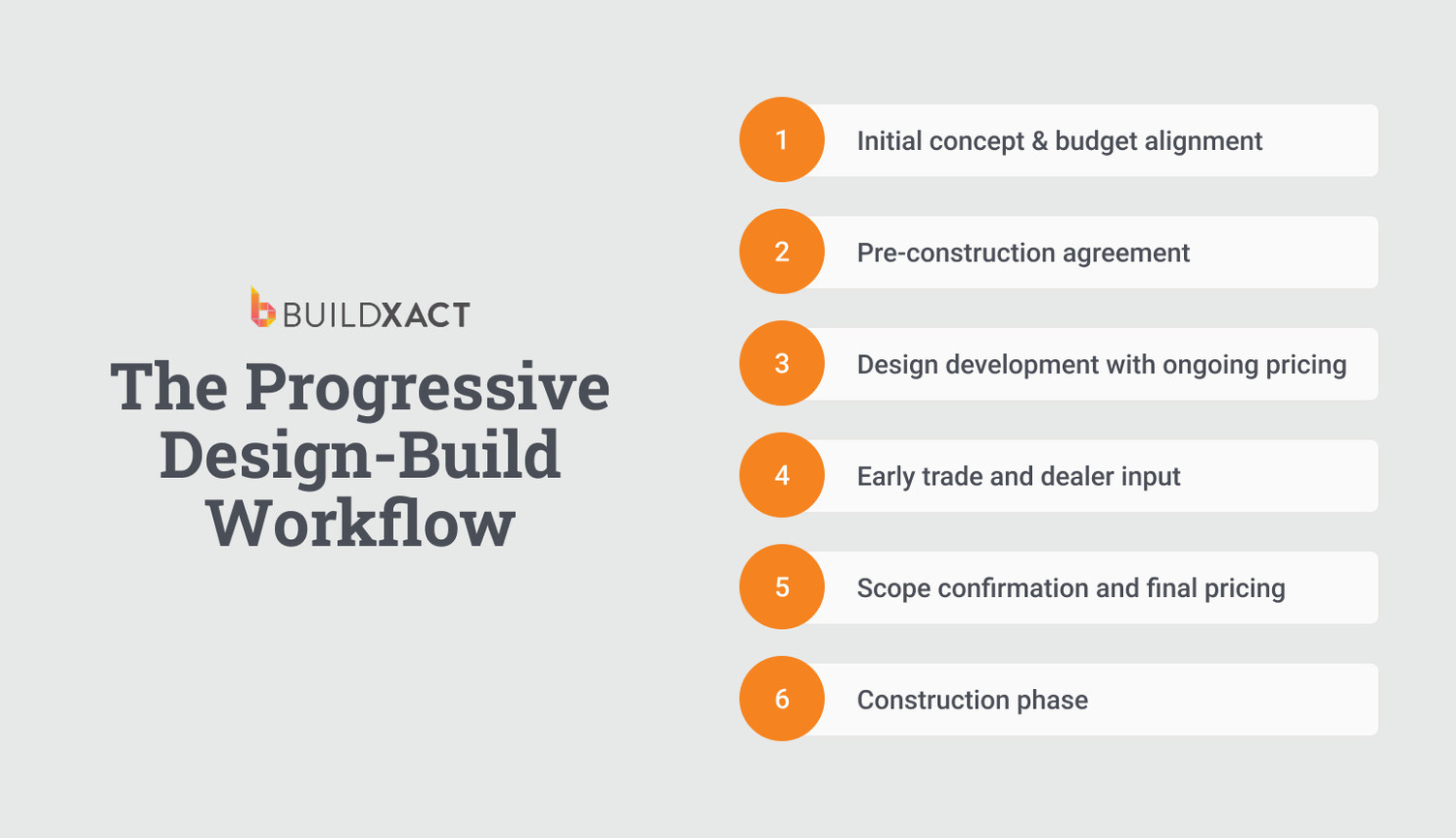
1. Initial concept & budget alignment
This is where you sense-check the job before it goes too far. You talk through the client’s goals, a rough scope, and budget expectations, and determine whether the project is realistic. Any early assumptions are clearly treated as assumptions, not promises. It’s a feasibility checkpoint that helps avoid chasing work that was never going to stack up.
2. Pre-construction agreement
Instead of guessing or doing weeks of unpaid work, you’re paid to work through the pricing of the job properly in the pre-construction phase. The focus here is on managing risk, not locking in a final number.
- Design coordination
- Budget development
- Early estimating and feasibility checks
- Trade input where needed
3. Design development with ongoing pricing
As the design comes together, the numbers are updated alongside it. When clients make decisions, the cost impact is priced straight away. That keeps expectations aligned and stops budget blowouts while the drawings progress.
4. Early trade and dealer input
Key subcontractors and dealers are brought in early to validate assumptions and flag issues. This improves buildability and pricing accuracy and avoids last-minute surprises when the job is meant to be ready for the job site.
5. Scope confirmation and final pricing
Once the design is properly defined and the scope is clear, the final construction price is prepared. At this point, both you and the client can commit with confidence, knowing the price reflects the real job.
6. Construction phase
Because most of the uncertainty has already been dealt with, construction runs more smoothly. Subcontractors are easier to schedule, and change orders are genuine client changes rather than corrections. There’s less back-and-forth, less paperwork, and a job that’s easier to manage from start to finish.
The Benefits and Challenges of Using Progressive Design-Build for Residential Projects
Progressive design-build has clear upsides, but it shifts more responsibility onto the builder upfront. Before deciding if it’s the right fit for your business, it’s worth weighing up both sides.
Benefits
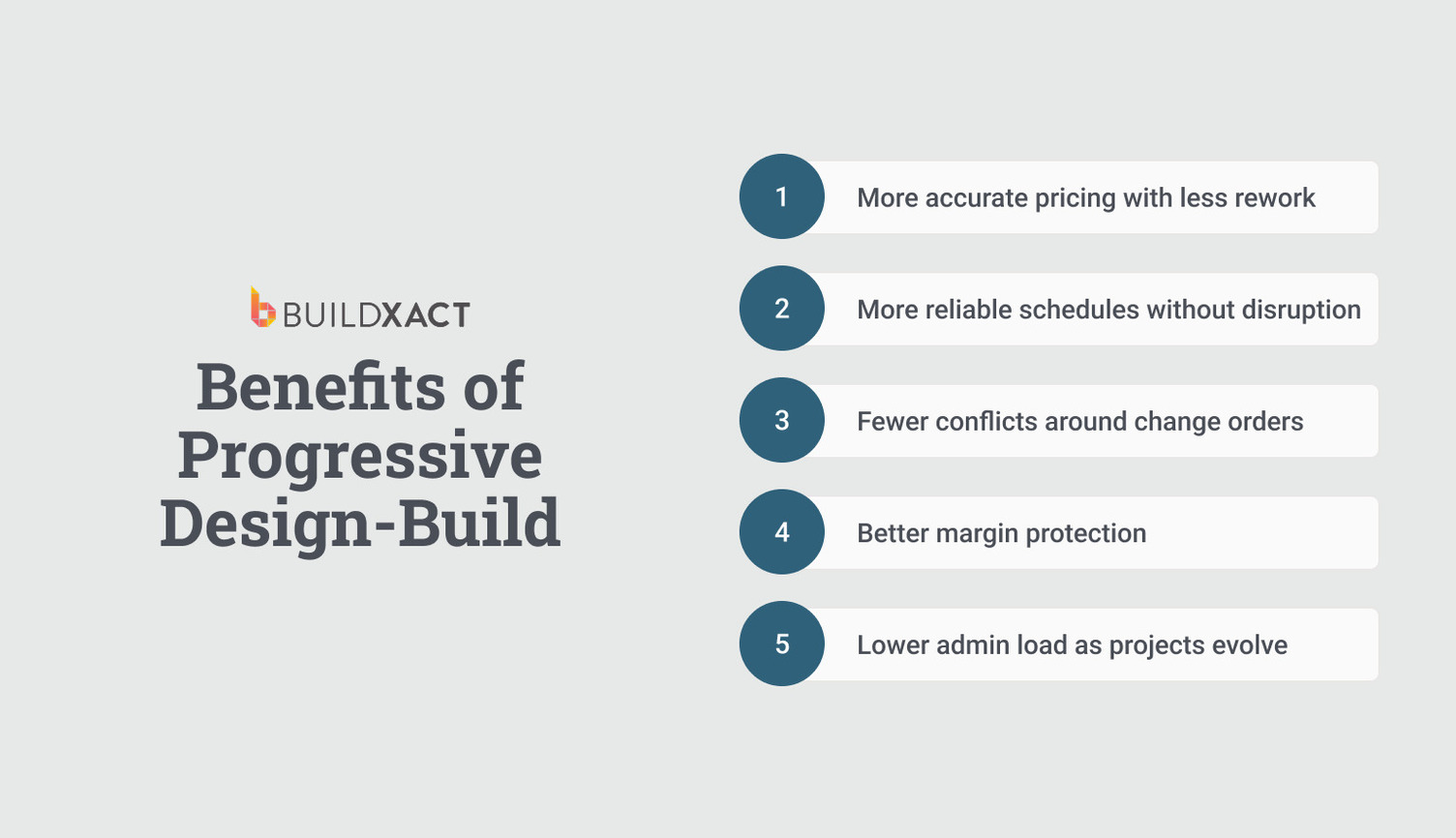
- More accurate pricing with less rework: You develop and refine pricing as the design becomes clearer, instead of constantly re-bidding based on assumptions.
- More reliable schedules without disruption: With key design decisions made before construction is locked in, trades can be sequenced with greater confidence and rescheduled less often.
- Fewer conflicts over change orders: Cost impacts are discussed and agreed upon during design, reducing surprises once the job is underway.
- Better margin protection: Small changes are captured early and priced properly, preventing slow margin erosion over the life of the project.
- Lower admin load as projects evolve: Decisions, pricing, and approvals are handled progressively, reducing late-night admin and constant backtracking.
Challenges
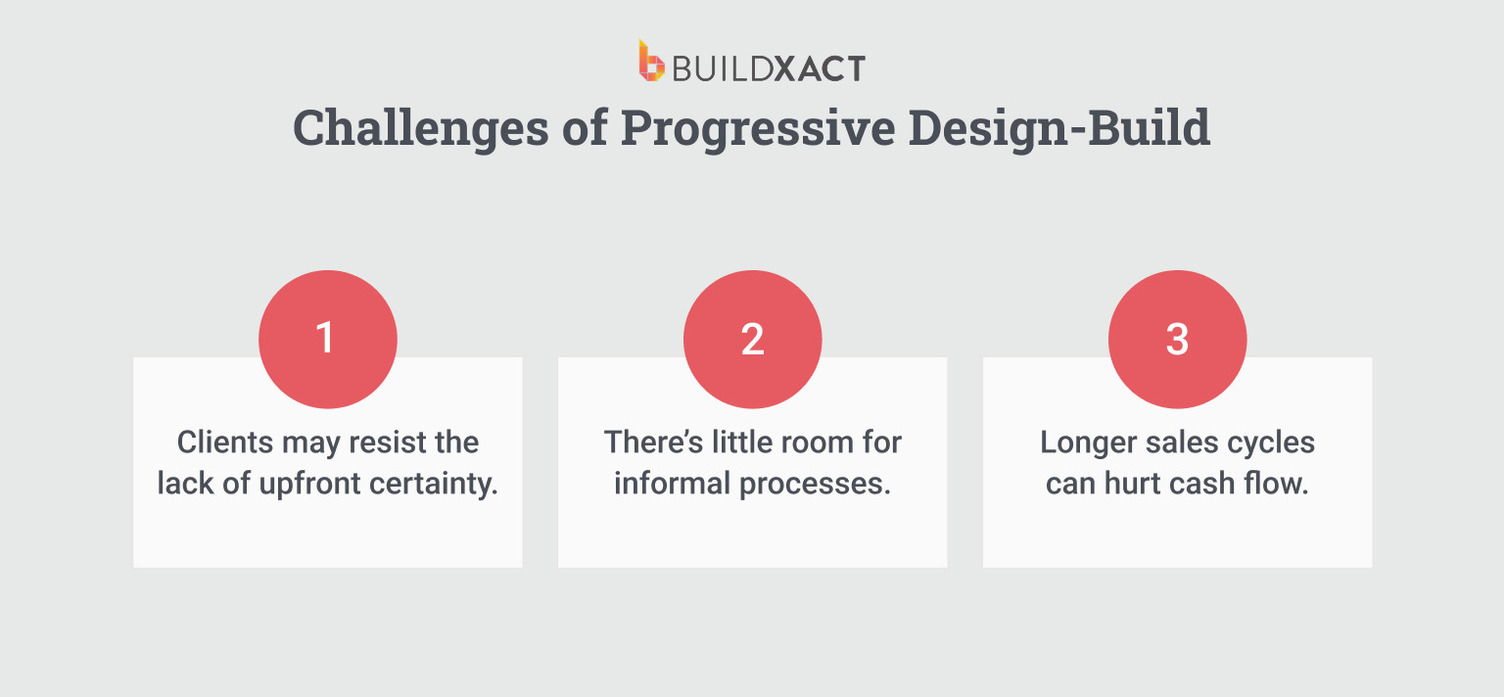
- Upfront uncertainty shifts risk onto the builder: Not every client is comfortable starting without a fixed price. Without a fixed price early, as the builder, you carry more responsibility for explaining unknowns, clarifying assumptions, and justifying evolving budgets.
- Higher process and admin overhead: You can’t run PDB informally. You (SMB builders) need clear pre-construction agreements and an established process for tracking scope and cost changes (like Buildxact). Without proper tools and processes, admin quickly piles up, canceling out any efficiency gains PDB creates.
- Longer sales cycles can hurt cash flow: Paid pre-construction slows the path from inquiry to signed build contract. For SMB residential builders, that delay can strain cash flow and pipeline predictability, especially when multiple projects stall in pre-construction at the same time.
Is Progressive Design-Build Right for You?
Progressive design-build isn’t a plug-and-play delivery model you can drop into every job. In practice, it works more like a business maturity step than a standard operating approach.
For some builders, it fits easily as their work becomes more specialized. For others, especially earlier on, it can feel like an extra process that slows things down and puts pressure on cash flow.
If most of your work is heavily price-driven, progressive design-build can be hard to sustain. It’s often a poor fit when you:
- Need to get a number out quickly to stay in the game.
- Work with different designers or client-appointed architects on every job.
- Deal with clients who want certainty early, even if the design isn’t there yet.
- Rely on fast turnarounds to keep cash flowing.
- Don’t get paid for pre-construction or early design coordination.
In those situations, the extra process doesn’t buy you much breathing room. Paid pre-construction stretches out the sales cycle, and walking clients through evolving costs takes time and trust. And if a client decides not to proceed after weeks of design development, you’re the one left carrying that effort.
Where progressive design-build starts to work well is when you’ve got a bit more control over how projects are set up. Builders who work repeatedly with the same designer, or who want to secure a client early and shape the scope together, tend to get the most value from it.
It also suits custom and semi-custom homes, where decisions genuinely can’t be locked in upfront, and trying to force a fixed price early just creates problems later.
Overall, progressive design-build is a useful concept, not a universal solution. It makes more sense as your business matures, your projects become more bespoke, and you start working with higher-value builds.
What Small to Medium Builders Can Take Away From Progressive Design-Build
Progressive design-build doesn’t have to be an all-or-nothing decision. For small- to medium-sized builders, the real value lies in borrowing parts that improve clarity and control, without taking on a process heavier than the business can comfortably handle.
Rather than adopting a full progressive delivery model, you can take the most practical lessons and apply them in a way that fits how you already work.
How? Consider the following tips:
- Be clear about pre-construction work — Even if you’re not charging for it, be clear about what design and feasibility work you’re doing, how long it should take, and where it stops.
- Call out assumptions upfront — Don’t hide unknowns inside allowances or vague sums. Say clearly what’s locked in and what’s still a guess.
- Keep pricing accurate and up to date as things change — When clients make decisions during design, update the numbers then. Don’t leave it until the job is already on site.
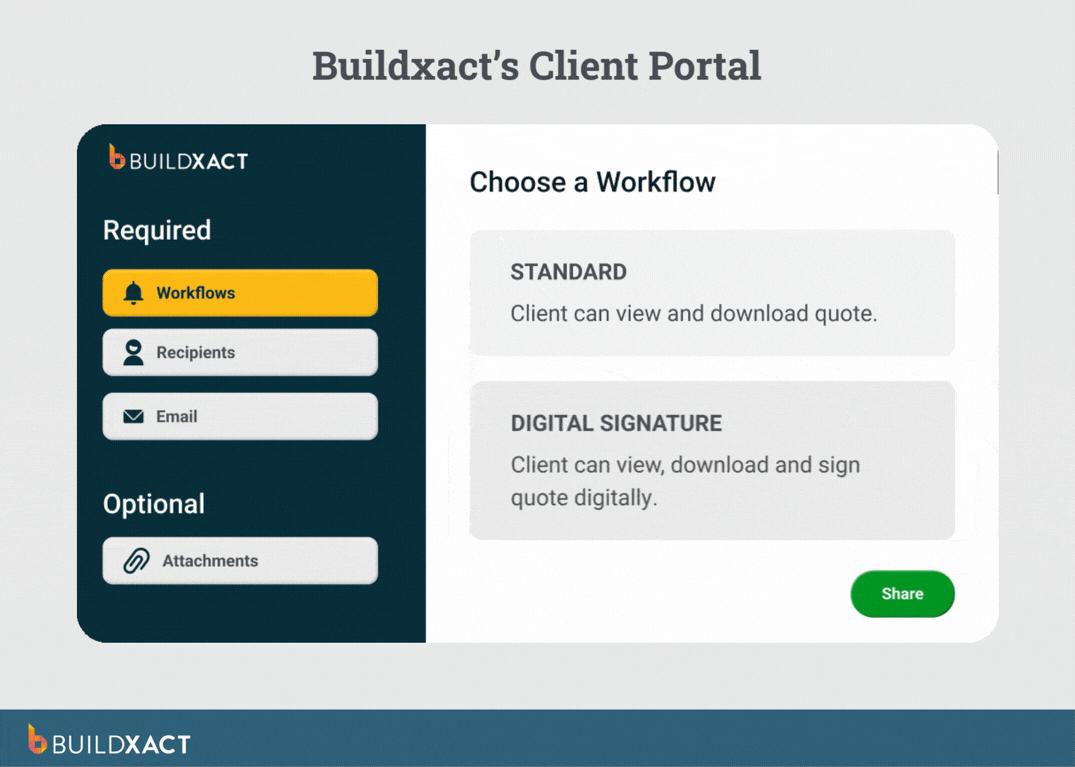
- Keep everything in one place — Jumping between spreadsheets, emails, and PDFs makes it harder to track scope, pricing, and decisions as the job evolves.
How the Right Systems Support Progressive Design-Build
Progressive design-build works best when your systems can keep up with how jobs actually change. If your pricing, scope, and schedules all live in one place, staying in control becomes far easier.
Instead of reshaping your whole business, tools like Buildxact let you work this way naturally, using the same process you already rely on to price and run jobs. The difference is that decisions, scope, and pricing stay connected as the job evolves, rather than being patched together later.
Start for free with Buildxact and see how connected workflows help you stay in control as jobs evolve.