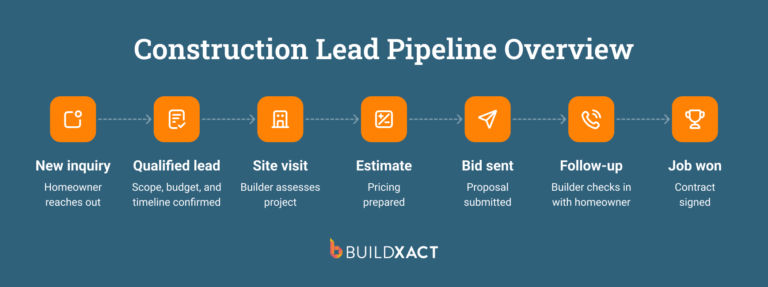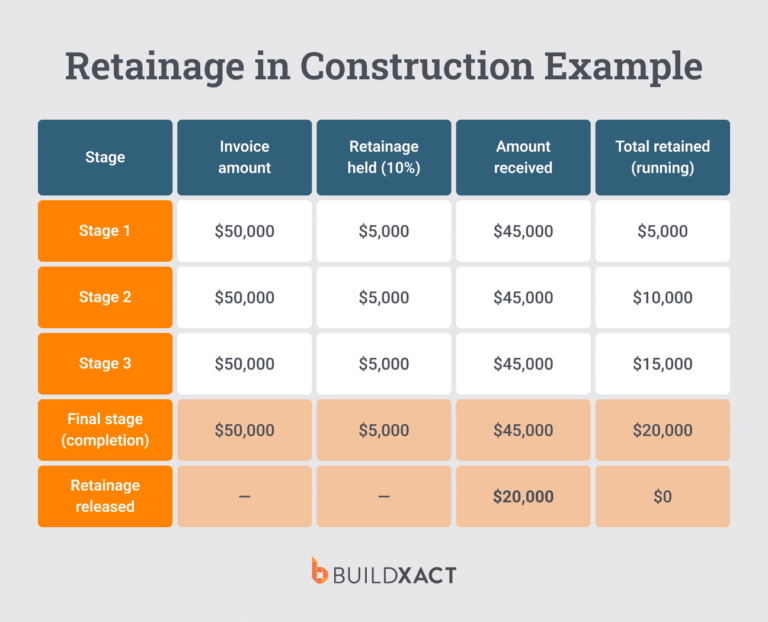


Estimating construction costs starts with a careful review of the project documents to determine the scope of work.
Many residential builders and remodelers use construction cost estimation and material takeoff software to quantify the work, price equipment and labor costs, and complete it. This ensures accurate project estimates.
Getting construction cost estimating right depends on correct material takeoffs and consistent pricing of project components.
We’re going to take a look at the estimating process and show you how construction estimating software, like Buildxact, can ensure an accurate estimate and efficiency throughout the construction process.
How to Estimate Your Construction Project Costs
A solid estimate starts long before the numbers get added up. It begins with understanding the project, carefully reviewing the plans, and working through the details so nothing important is missed.
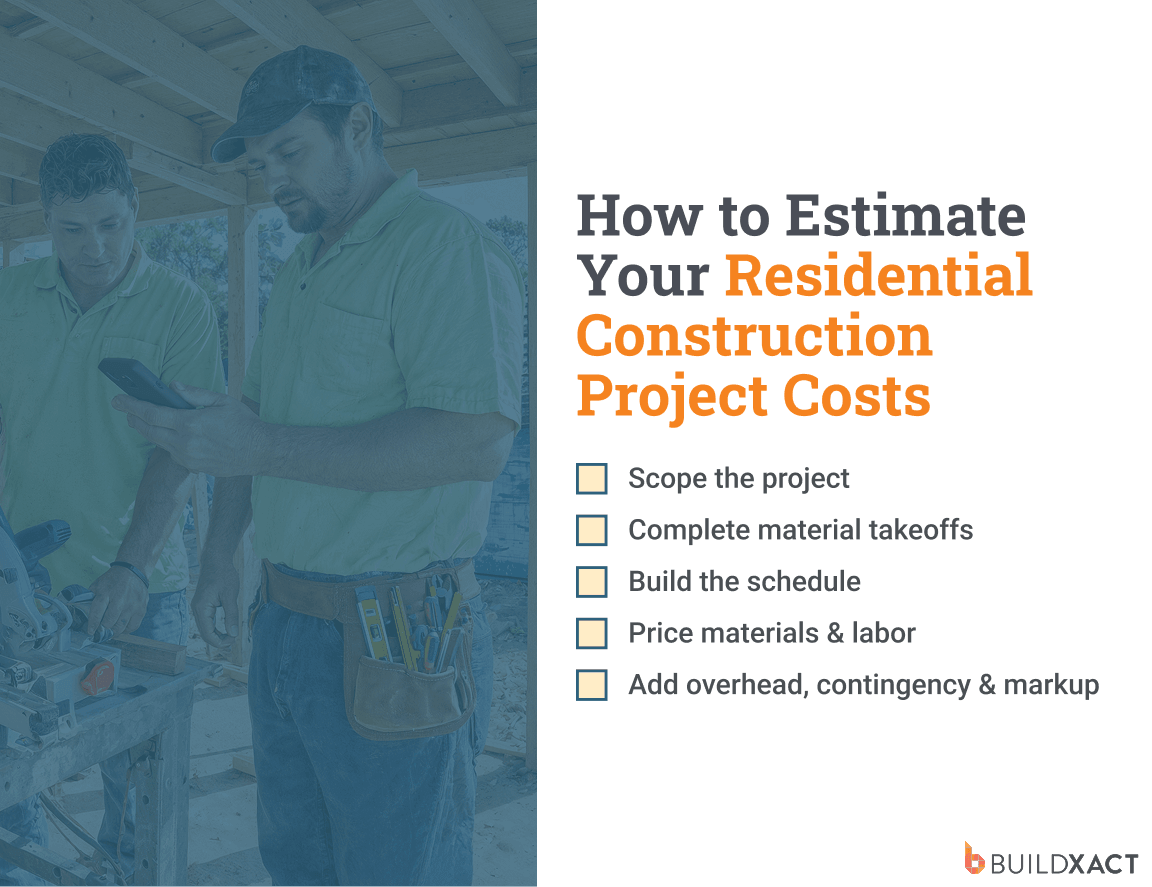
1. Scope the project properly
It is also good to establish the project scope early on so you can calculate labor hours and manage your building project efficiently. A construction project estimate is just that, an estimate. However, you want the final project cost to be as close as possible to your initial estimate.
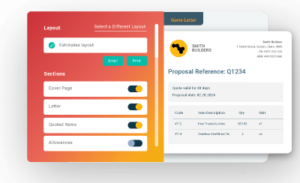
Estimating software streamlines the bidding process by speeding up material takeoffs and labor calculations. It also simplifies pricing, as the software’s material cost database can be updated quickly to reflect new pricing. Bid estimates that come back to customers quickly can help you win more work.
2. Complete material takeoffs
Once you’ve reviewed the project documents to determine the overall scope of the project and the portion(s) that you will be bidding, you are ready to perform a material takeoff.
This involves creating a list of materials and equipment needed to complete the work. The quantity you’ll need depends on the amount of work shown on the plans or documents.
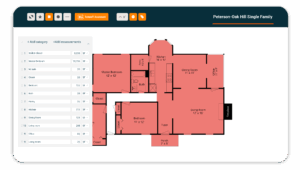
You can measure directly from printed plans using a scale ruler, but this approach increases the chance of mistakes, not to mention the hours it can eat up. Digital takeoff software lets you measure plans much faster and with greater accuracy.
Getting takeoffs right comes down to a few key practices:
Use a checklist
Develop a checklist of standard bid items included in most of your projects. This helps ensure that key items aren’t missed when bidding on a project.
General conditions, rental equipment, and other miscellaneous materials are often forgotten unless they’re on a checklist. Missed items can also lead to unexpected unit costs in today’s volatile materials market.
Automate as much as possible
Some takeoff software allows you to capture item assemblies or packages, which are collections of materials used as a unit in the project. At Buildxact, we call them assemblies.
An example would be an interior framed drywall wall with wooden studs at 16 inches on center. The package for this wall would include drywall, screws, insulation, wood, and nails.
By using assemblies, you don’t have to calculate how many studs are in the wall, because the program calculates that for you. You just measure the wall length, and the software tells you how many studs you’ll need. This saves you a lot of time and prevents missed items.
3. Build your project schedule
Next, you’ll put together an estimated schedule for the project based on your scope of work. This lets you know how long the work will take and how much labor to include in your cost estimate.
The schedule should be based on the amount of material to be installed and the production rate of your employees or crews. Often, historical data from previous time tracking informs how you build your schedule, and software can easily help you keep track of it.
Be sure to include crew time, supervision, and administration time in your estimate of the duration of the project. Record the contractors and labor hours that will be needed to complete the project. Refer the client to the schedule throughout the build for superior customer service.
4. Price the job
Now that you’ve got a full list of the building elements needed and know how much labor you’ll need for the project, it’s time to put together your cost estimate.
Cost estimates are based on material pricing, current labor rates, equipment costs, past projects, and your company’s experience with similar work, and the need to include other allowances, such as your markup.
First, you’ll want to make sure your material pricing is up to date, especially in today’s market. Also, check that the material will be available within the timeframe the project is scheduled for.
In Buildxact, you can upload your own price list or sync up your dealer’s price list with our latest material dealer integration.
Estimating labor costs in the construction industry
Your labor billing rates need to be high enough to cover wages and overhead, including employer-paid taxes, retirement contributions, vacation and sick time, etc. Aside from materials costs, labor costs are the trickiest to nail when estimating construction costs.
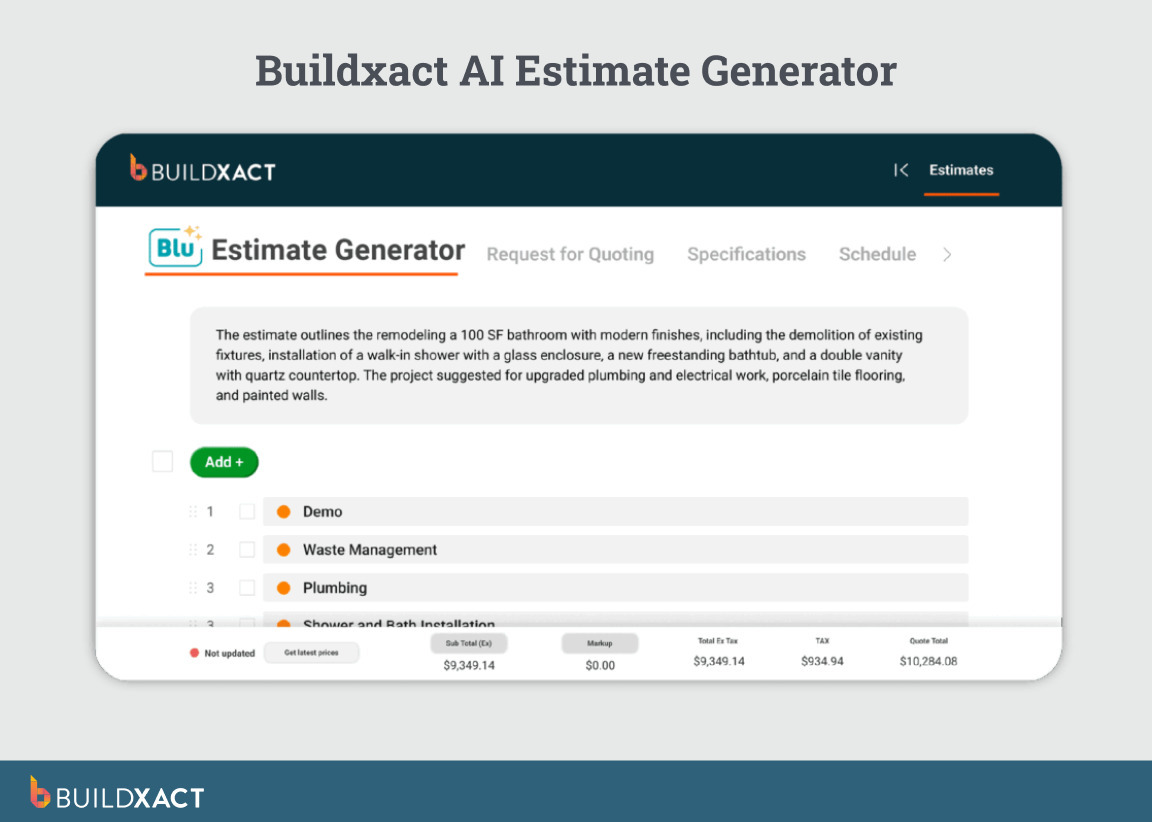
A preliminary estimate can give your client and you an idea of the total cost and the project timeline. It’s always best to keep your client aware of project costs as they come along. All of these should be included in your construction cost estimate. It’s very difficult to add a cost that wasn’t included in your original cost estimate.
A detailed estimate will be your best friend, and your client will appreciate you for it. Make sure your construction estimate is organized and easy for your client to understand.
5. Account for hidden project costs
Project costs can vary, and cost control is a huge challenge. However, clients will understand, as long as they are informed throughout the process.
Include an allowance for overhead costs not directly tied to labor that need to be covered by the project. This type of overhead includes vehicles, insurance, cell phones, computers, and office administration expenses.
As mentioned, add a markup percentage to help ensure profit, which will vary depending on how aggressive you want to be with your estimate and what the competitive market will bear. Using Buildxact, you can be confident that you are correctly adding up all costs and markups to determine your final price.
Other factors to look out for:
Last-minute price increases can be difficult to pass on to the customer, so it is best to do everything you can to avoid mistakes in the first place.
These factors include:
- Inaccurate material estimates can lead to serious delays in your project
- Cost variables based on the geographic locations of your materials
- On-site observations to evaluate labor requirements
- Accurate risk assessments of the work site
- Project-specific needs, such as environmental costs
Accurate estimating is so crucial to winning bids and making a profit, so it makes sense to use digital tools in your estimating process to save time and money.
Why Manual Estimating Costs You Money
Small errors become expensive mistakes
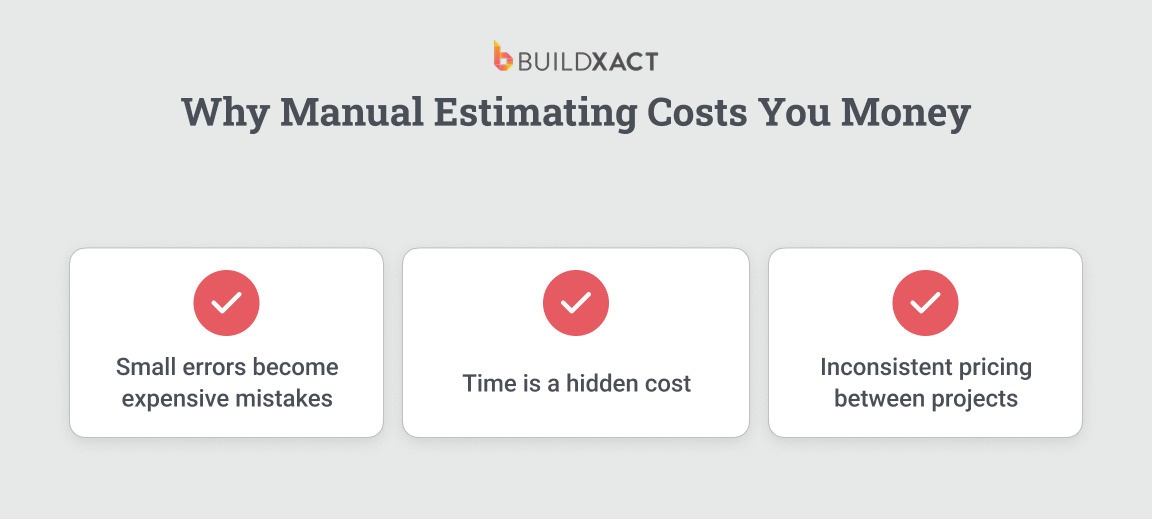
With manual estimating or when using spreadsheets, it’s easy to miss items or not calculate formulas correctly, which can lead to underpricing work. You can’t recover costs for work that you’ve missed on the estimate, so you need to be sure you are not put in a price bind right from the beginning.
Time is a hidden cost
You know that time is money, and any time saved putting together cost estimates is money in the bank. Construction estimating software helps streamline the bidding process, reduces errors, and calculates pricing accurately so that what you estimate ends up being close to the actual total cost at the end.
An inaccurate construction estimate can end up costing your construction business a significant amount of profit.
Inconsistent pricing between projects
Manual estimating often leads to inconsistent pricing across projects. If each estimate is built from a slightly different spreadsheet or outdated cost list, margins vary from job to job, even when the scope is similar.
Example of a Residential Construction Project Cost Breakdown
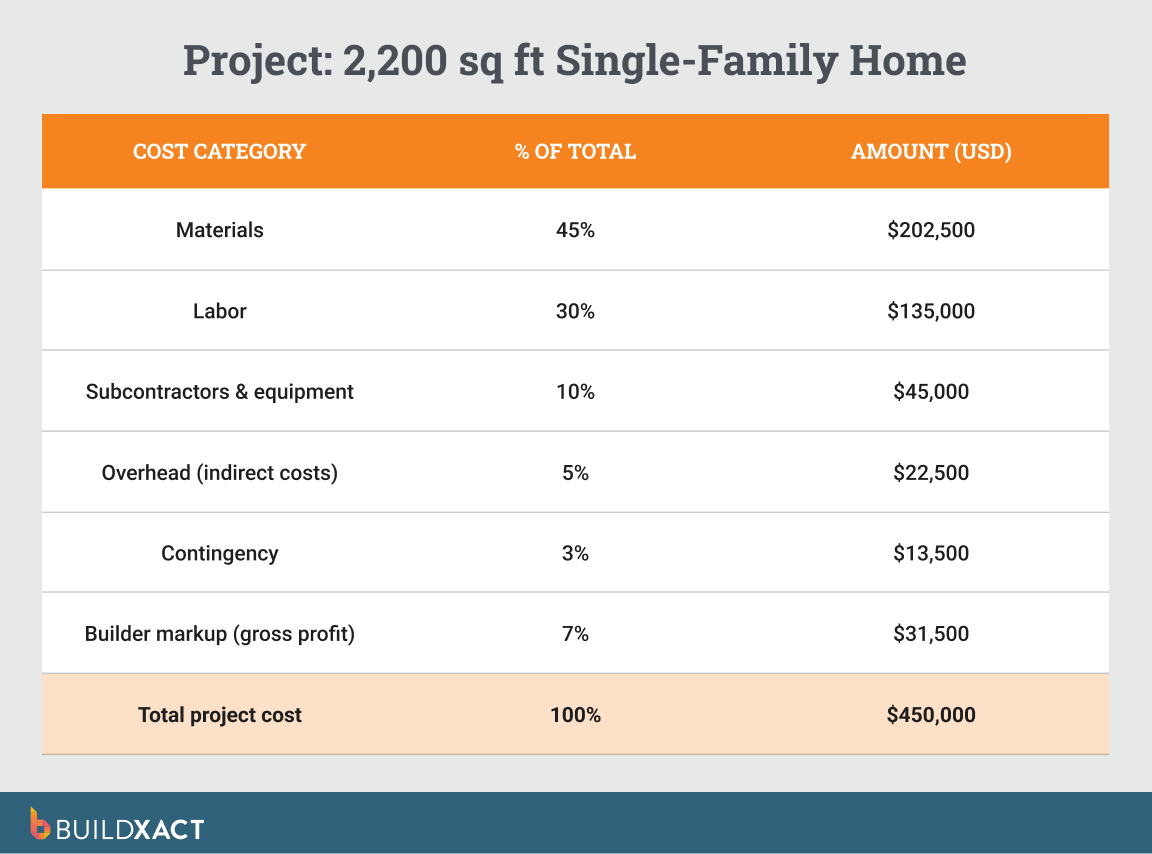
Imagine you’re building a single-family home with a total contract price of $450,000. A clear cost breakdown helps you understand where the money goes and ensures every major category is accounted for before submitting your bid.
Here’s how a typical construction project cost breakdown might look for a small-to-mid-sized residential builder.
Direct construction costs (hard costs)
Direct construction costs, often called hard costs, are the expenses directly tied to physically building the home. These are the items that go into the structure itself, along with the labor required to install them.
Materials – $202,500 (45%)
Materials usually take the biggest bite out of a residential build budget. And with prices moving around so often, accurate material estimating is one of the easiest ways to protect your margin.
- Concrete & foundation materials
- Roofing
- Windows & exterior doors
- Drywall & insulation
- Cabinets & countertops
- Flooring
Labor – $135,000 (30%)
Labor costs include wages for your crews, as well as employer costs such as payroll taxes, insurance, and benefits. Even small productivity changes can affect your bottom line, which is why builders often rely on historical production rates when estimating labor hours.
Subcontractors & equipment – $45,000 (10%)
Many residential builders subcontract portions of the work. These costs often include:
- Excavation and site prep
- Concrete pouring
- Roofing installation
- Scaffolding
- Equipment hire
- Waste removal
Indirect costs
Soft costs are not tied to a specific construction activity but must still be covered within the building project price.
Overhead allocation – $22,500 (5%)
These are the business expenses required to run your company. A portion of them needs to be allocated to every job.
- Vehicles and fuel
- Insurance
- Estimating or project management software
- Office administration
- Time for construction project management
Contingency – $13,500 (3%)
Contingency helps protect against unknowns. Not every job includes this type of soft cost, but smart builders allow for it.
- Site surprises
- Delays
- Minor client changes
- Small pricing fluctuations
Builder markup (gross profit) – $31,500 (7%)
Markup is your profit margin. It compensates you for risk, business overhead, and the expertise required to deliver the project.
Markup levels depend on:
- Market competition
- Project complexity
- Risk level
From this example, you can see why estimating a project cost with a full breakdown is so important. If you underprice construction materials by just 5%, that’s over $10,000 down the drain on a $450,000 build. A structured construction project cost breakdown forces you to account for every hard and soft cost and price confidently.
Common Mistakes in a Construction Project Cost Breakdown
Cost breakdowns look simple on paper, but anyone who’s priced a few builds knows how quickly things can go sideways. One missed line item, a forgotten overhead cost, or an outdated dealer price can quietly chip away at your profit.
The job will still get built, but the margin disappears along the way. Here are some of the most common estimating mistakes builders run into.
Mixing labor and subcontractor costs
It’s tempting to lump everything under “labor,” but mixing in-house labor with subcontractor costs makes it harder to understand where your money is really going.
Your internal crew costs should be tracked separately from subcontractors. That’s because they behave differently. Your crew productivity, overtime, and supervision directly affect your margins, while subcontractor costs are usually fixed quotes.
Keeping these categories separate helps you clearly see whether a job ran over because of crew efficiency, subcontractor pricing, or poor scheduling.
Not separating contingency from markup
Contingency and markup are not the same thing, but they are often merged together in estimates.
Contingency is there to cover unknowns: unexpected site conditions, minor design and construction changes, or small price fluctuations. Markup, on the other hand, is your profit.
If you treat contingency as profit, you’re taking a gamble. When the unexpected happens (and it usually does), that “profit” disappears quickly.
Using outdated pricing
Material pricing changes fast, and using old dealer price lists can quietly wreck your margins.
A lumber package priced three months ago might look fine on paper, but be completely different by the time you place the order. The same goes for windows, roofing materials, and specialty items.
That’s why many builders now rely on estimating software with live dealer pricing integrations. It reduces the risk of submitting a bid based on outdated numbers.
Not accounting for supervision time
Site supervision and project management are real costs, but they’re often forgotten during estimating. Someone needs to coordinate trades, manage schedules, communicate with clients, and keep the job moving. Those hours add up.
If supervision time isn’t included in the estimate, the project may still get finished, but the builder ends up paying for that time out of their own pocket.
A clear, structured cost breakdown helps prevent these issues and gives you confidence that every part of the project has been properly priced.
The Power of Going Digital for Your Estimating Needs
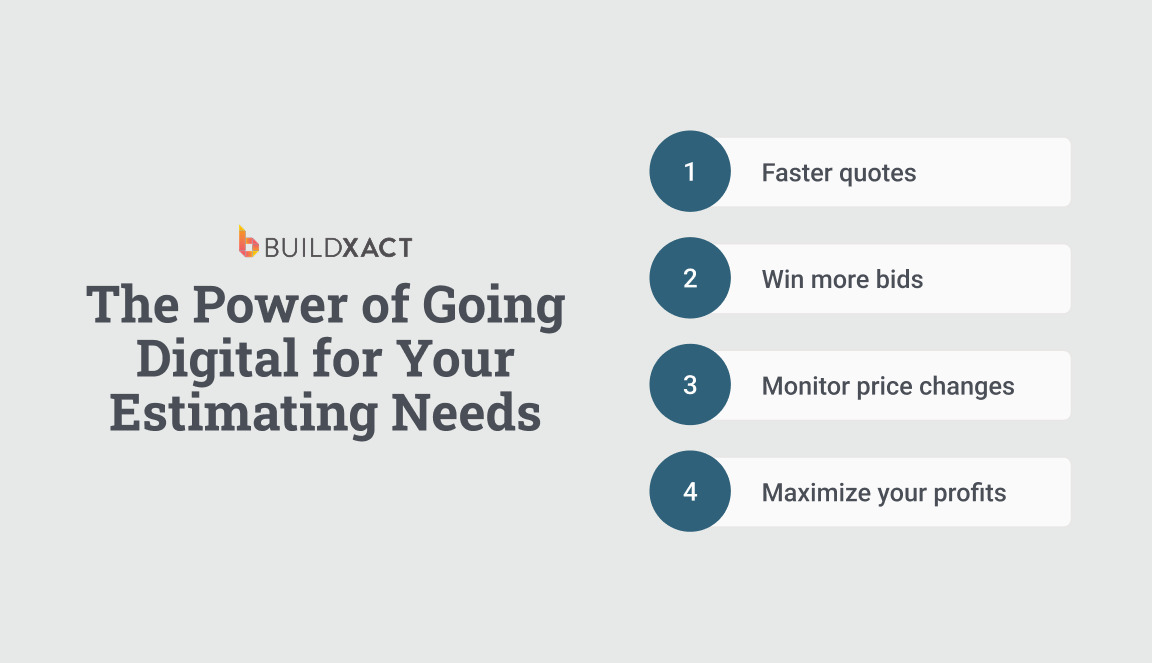
Digital technologies are becoming an increasingly important part of the construction sector, and companies that do not adopt them may find themselves at a disadvantage, as they struggle to efficiently manage their workflows.
Furthermore, companies that do not adopt digital technologies may encounter additional obstacles as customers increasingly demand faster turnaround times. These technologies save time and allow businesses to communicate with their customers more effectively.
Faster bids
Builder Jaye Ibrahim of Jetcon started his construction business in 2017 after 12 years plying his trade and honing his skills. With a well-established portfolio and a strong professional network, Jaye wanted to expand and chart a course for growth from the get-go.
While Jaye has never considered himself a ‘techie’, he has been eager to use technology and digitalize his processes.
He had always recognized that in this day and age, the only way to increase productivity and efficiency was to use technology. So when his vendor, Dahlsens, recommended he look into Buildxact, he did not hesitate.
“I found Buildxact pretty easy to get started with. All it took was 45 minutes, and I was already able to put together an estimate and produce a bid.”
Win more bids
With an industry-average bid turnaround time of 1 to 2 weeks, being able to submit a detailed, professional bid quickly sets Jetcon apart from its competitors, and this, in turn, helps increase the company’s win rate.
“Since using Buildxact’s estimating and job management software, I can produce estimates and bids much faster, and this ultimately helps me win more work.”
Before using Buildxact, it was standard for Jaye to work in the evenings in order to keep up with his admin, but now that is a thing of the past. The extra time he now has can be used to grow his business or simply do things he enjoys.
And because Buildxact is an end-to-end system, it delivers efficiencies from first takeoff through to the final invoice, saving countless hours in admin and ultimately improving the company’s bottom line.
Monitor price changes
Price volatility can cause havoc when estimating construction costs. Buildxact’s dealer integration gives custom home builders direct access to a dealer’s price files to support their construction cost estimation.
When estimating construction costs for a project, you want to ensure you have the latest pricing, and the dealer integration provides price files in real time. Knowing the latest unit cost when estimating helps boost your accuracy by a lot.
Control costs with accurate bid estimates
This is why it is important to ensure a construction project estimate accurately accounts for all costs involved in the project.
These costs include material costs, labor hours, supervision costs, direct costs, building costs, administrative costs, taxes, markup, and any other costs that might come up.
Maximize your profits
Accurate cost estimation is key to a successful, profitable business, and modern software also helps you boost your professionalism. Imagine having the ability to produce detailed estimates and keep construction documents organized so that they are at your fingertips whenever a client wants to see them.
Also, when you use the same pricing structure and item list, pricing is more consistent across your projects. This helps ensure that profits are also consistent from project to project. Today’s supply chain issues are causing havoc with construction costs, making cost estimation even more crucial.
Take Control of Your Construction Project Cost Breakdown
Every builder knows the feeling of finishing a job and wondering where the margin went. On paper, the estimate looked solid, but somewhere along the way, a few costs crept in that weren’t accounted for properly.
A full project cost breakdown tells the real story. And the fastest, most efficient way to do this is with estimating software.
With easy-to-use construction management software like Buildxact, you can create digital takeoffs and pricing integrations in no time, improving accuracy and ensuring consistent pricing across projects.
Ready to take the next step and go digital with your bid estimate?
Buildxact is easy-to-use construction management software that allows you to be more efficient and price more work. Buildxact can transform your residential construction business. Get started with a free trial.