
A potential client calls. “We’re thinking about a kitchen remodel. What would something like that cost?”
You hesitate because you don’t have plans, and you haven’t seen the space. But you know that if you say “I’ll get back to you,” you might never hear from them again.
So you give a number. And then one of two things happens: the number’s too high and you lose the lead, or the number sticks and you spend the next three months defending it.
As an experienced builder, you know the first number matters. It sets expectations, qualifies (or disqualifies) leads, and determines whether you’ll spend hours on a full takeoff or move on to the next opportunity.
This guide explains what a preliminary estimate is, when to use one, and how to set accuracy expectations with clients so your early numbers work for you, not against you.
What is a Preliminary Estimate?
A preliminary estimate is an early-stage cost range used to decide whether a project is worth pursuing before detailed plans, drawings, or specifications exist.
For residential builders and remodelers, it’s the number that helps you answer a practical question early: “Is this project even in the right range to justify more time?”
A preliminary estimate, also known as an abstract cost estimate, approximate cost, or budget estimate, is used in the early phases of a project, typically before the design documents have been completed.
In professional estimating standards, preliminary estimates are formally recognized under AACE International guidelines. They fall into Class 5, with a typical accuracy range of –30% to +50%.
That range exists because early-stage decisions rely on limited information, not because builders are being careless or imprecise.
A preliminary estimate is usually based on the costs you’ve experienced on similar projects that you have recently completed.
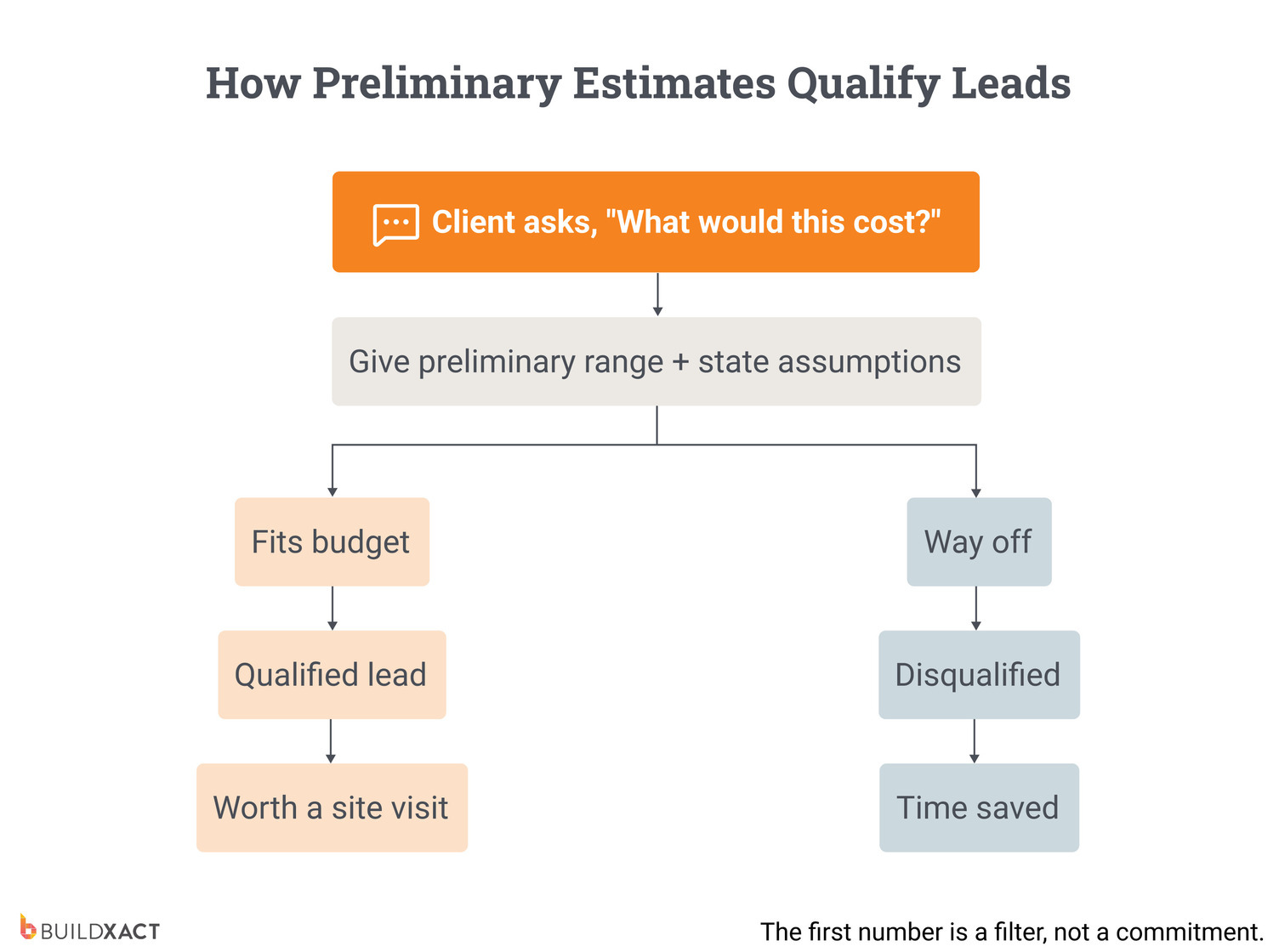
That’s why builders rely on preliminary estimates as a qualification tool. They’re used to test budget fit and align expectations before investing hours in a full takeoff, subcontractor pricing, and revisions.
This estimate is prepared with the understanding that a revised estimate with more specific cost details must be prepared before construction can begin.
Used correctly, preliminary estimates aren’t shortcuts. They’re a way to work deliberately: start with a defensible range, then refine only once the project has earned deeper effort.
When to Use a Preliminary Estimate
A preliminary estimate answers the “What would something like this cost?” question. That’s why it should give you room to respond without overcommitting and provide you with enough clarity to decide whether moving forward makes sense.
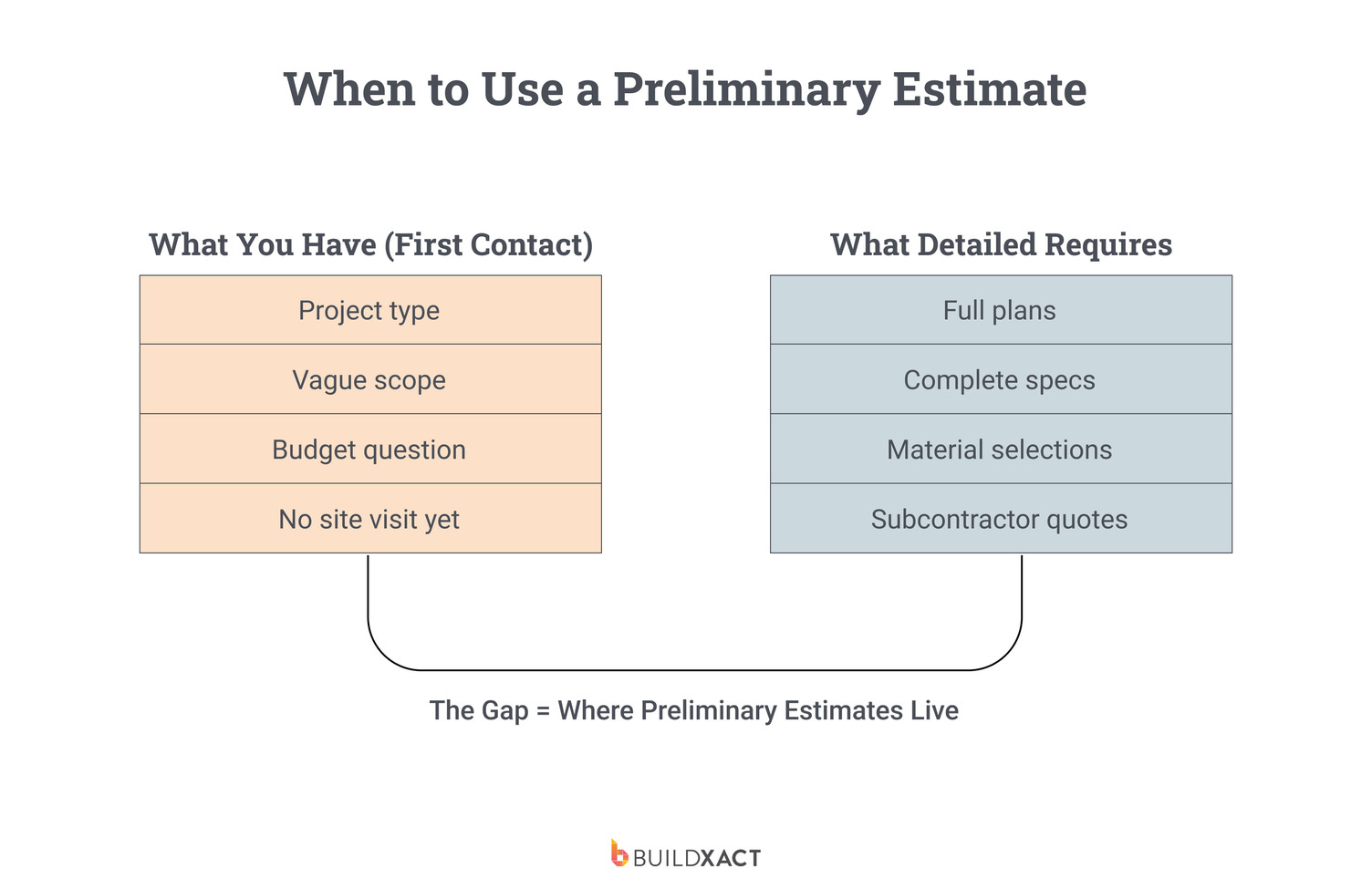
All of this happens before you draw plans, select materials, or define trade scopes. At this stage, both you and the client are still discussing broad terms, including rough size, general finish level, and budget ranges.
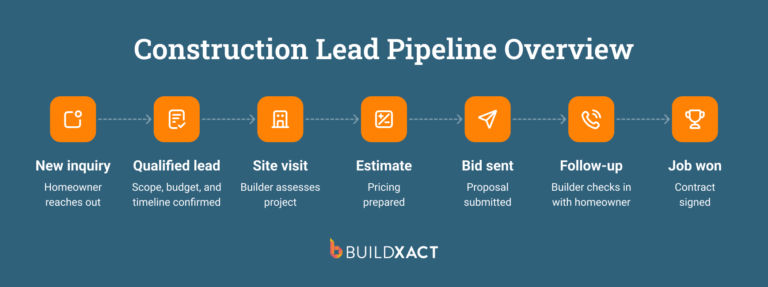
Builders use preliminary estimates to screen opportunities. The preliminary estimate can support a decision about whether to book a site visit, involve designers or trades, and spend time on a full takeoff, or to pause before effort turns into sunk cost.
Problems typically appear later, after you have drawn plans and the client has made material and finish selections, sometimes with input from a designer. You present a revised number based on those decisions, and the client compares it with the initial range discussed earlier.
That earlier figure reenters the conversation, not because anyone intended to misuse it, but because it was the only number discussed before details were available. The friction that follows doesn’t come from bad estimating. It comes from treating an early conversation as if it reflected decisions the client hadn’t made yet.
Preliminary Estimate Accuracy and Limitations
The accuracy of a construction estimate is based on the amount of information provided in the design documents.
At the preliminary stage, that information is, by definition, limited. You’re working from early conversations, rough scope signals, and comparisons to similar past jobs, not drawings, selections, or confirmed quantities.
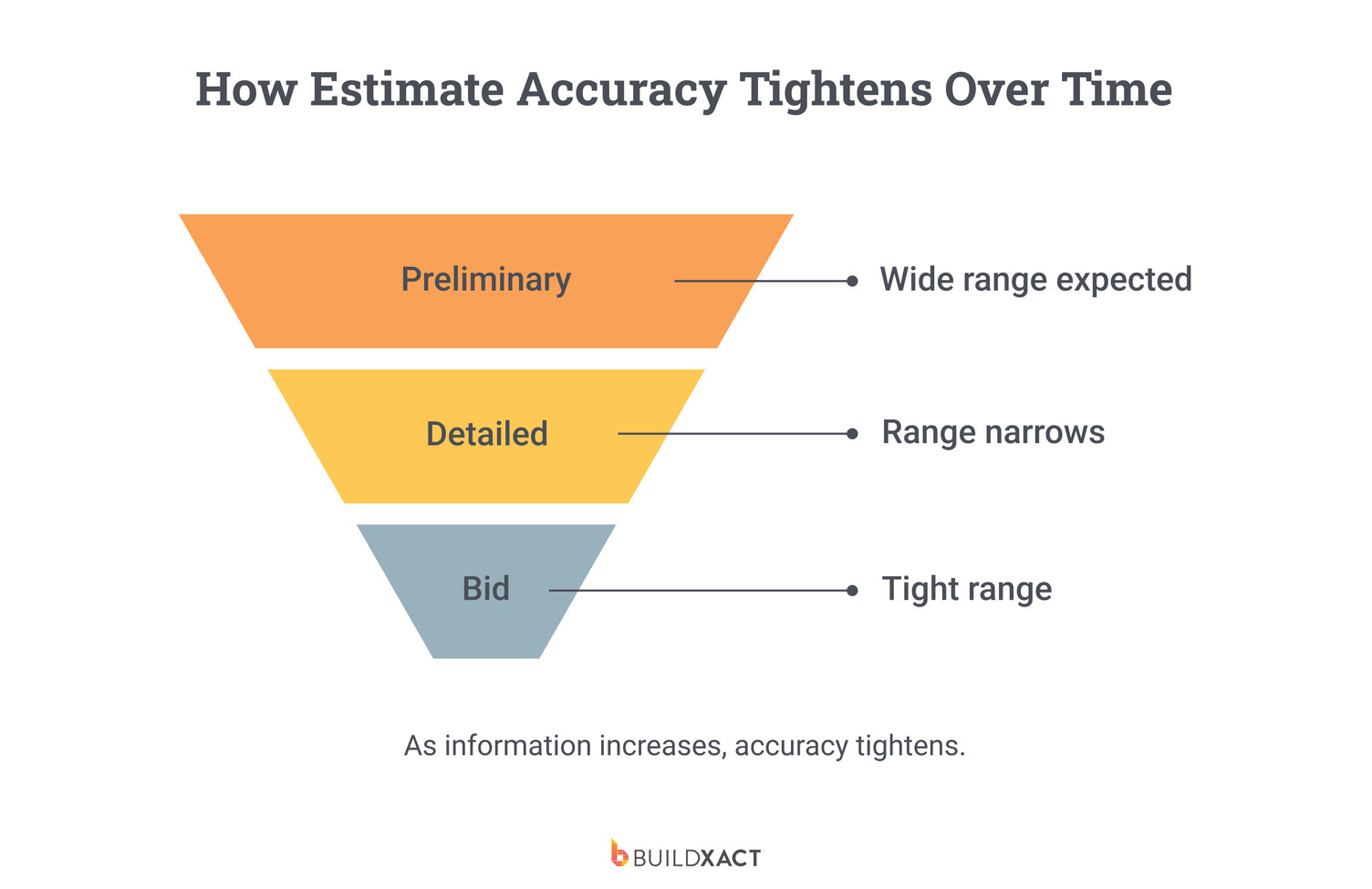
That’s why the industry classifies preliminary estimates as AACE Class 5, with a typical accuracy range of –30% to +50%.
That range exists because early assumptions don’t stay still. Layouts change. Clients make material and finish selections. Site conditions surface. Each of those decisions adds clarity, but none of them are available when a preliminary estimate does its job.
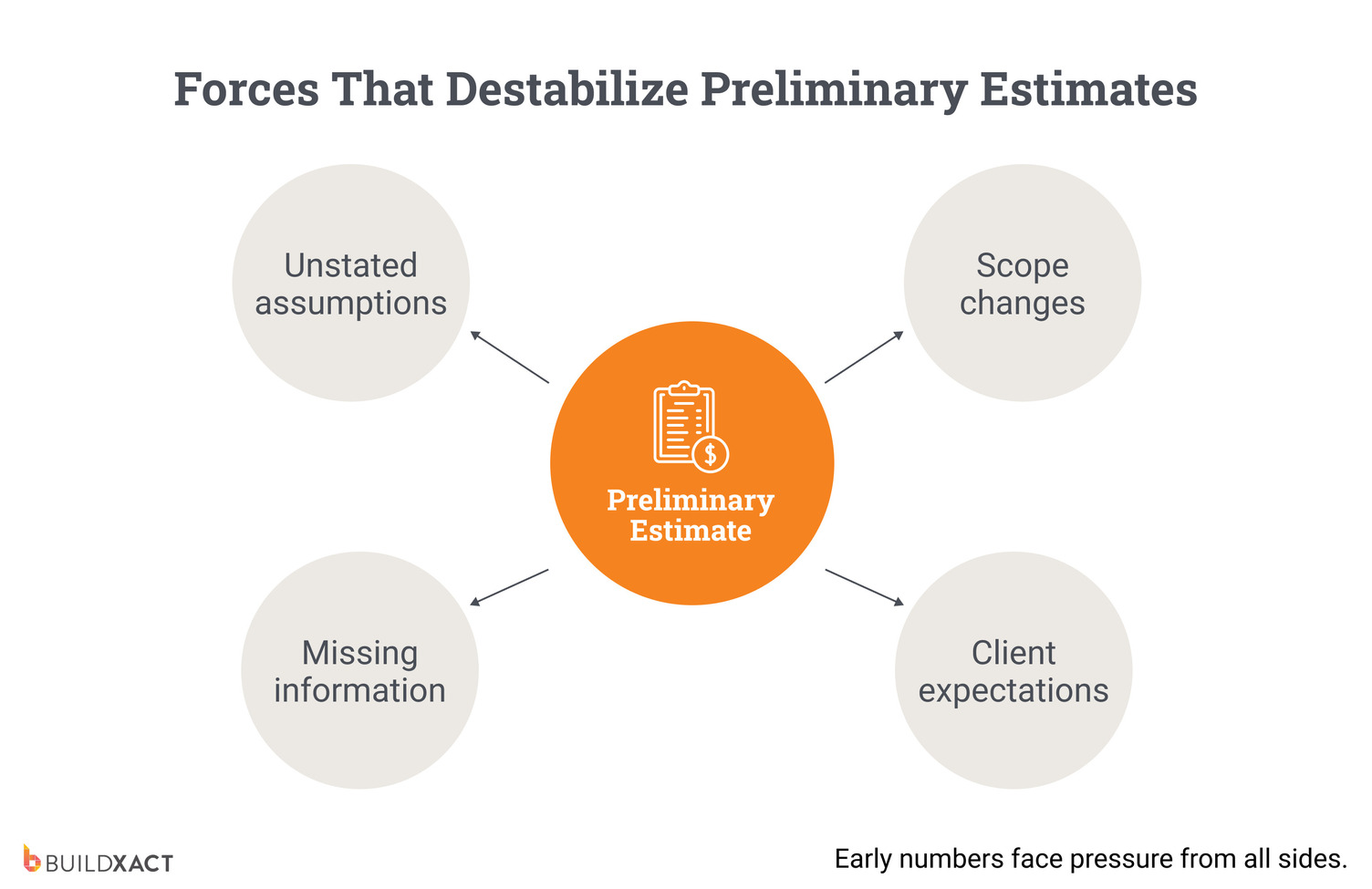
Because of this, a preliminary estimate isn’t intended to serve as a commitment. It isn’t a contract price, and it doesn’t guarantee the job’s final cost. It’s an early signal, shared before the scope exists in a form that supports precision.
As you invest more time in site visits, drawings, and detailed takeoffs, the estimate naturally becomes more accurate. Accuracy improves because information improves.
Until then, the preliminary estimate protects your time. It helps you decide which projects are worth deeper effort and which ones aren’t, before hours get spent on details that may never turn into work.
Types of Construction Cost Estimates
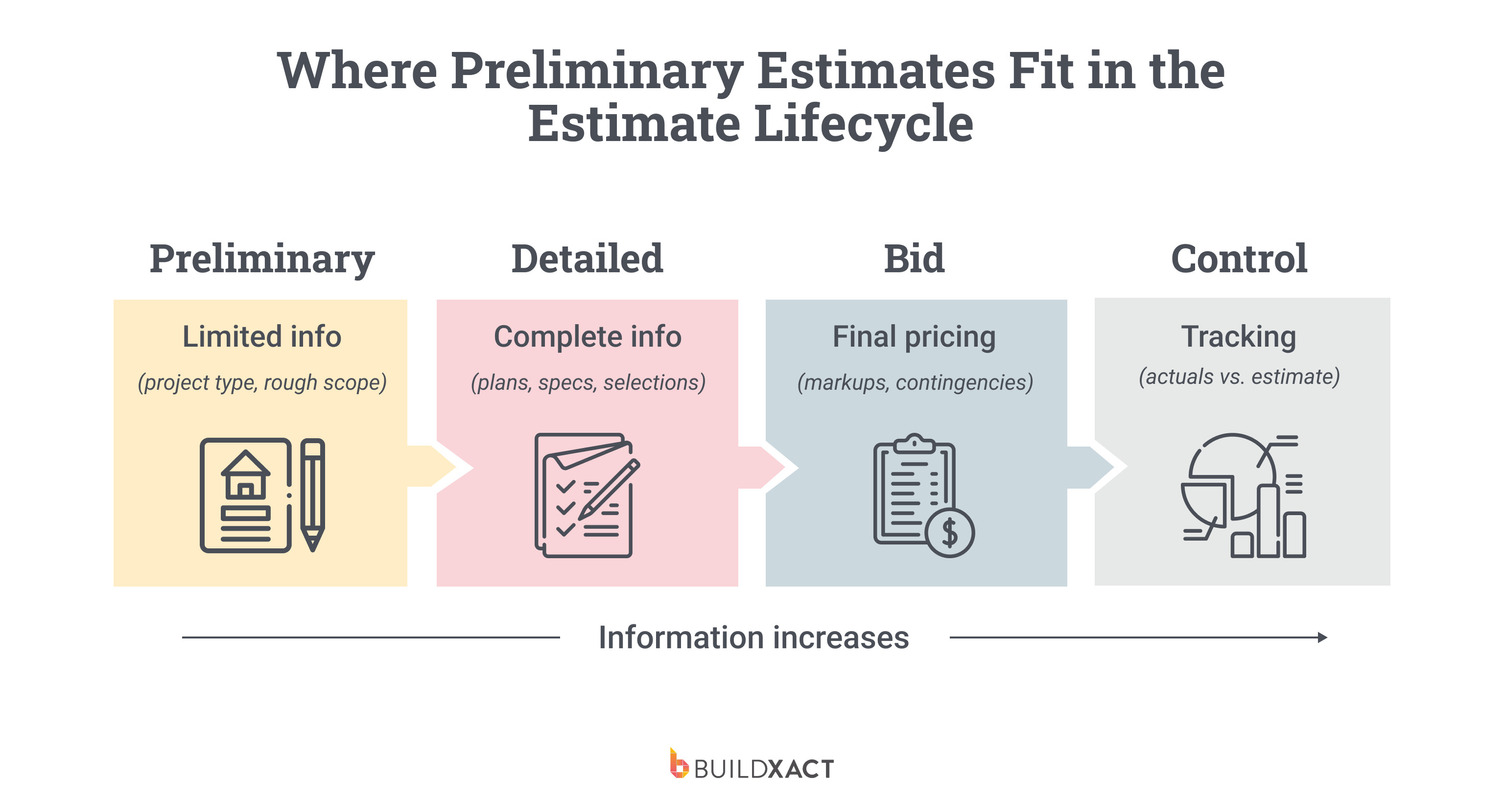
There are five main types of construction cost estimates: preliminary, detailed, quantity, bid, and control. Each serves a different purpose at a different point in the project lifecycle. Since we’ve covered preliminary estimates above, let’s look at how the other estimate types take shape as clients make selections, designers produce drawings, and builders quantify the work.
Detailed estimate
A detailed estimate breaks the project scope into specific, individually priced tasks. It accounts for materials, equipment, and labor required to complete the work, then rolls those costs into a total project number.
Builders create a detailed estimate once the design documents are available. At that point, you or your estimator can quantify the work with precision because the scope, layout, and specifications are clear.
As Dave Shank, owner of Shank Glazing Solutions, puts it:
“An estimator needs to get to know the job inside and out and fully understand scope and design requirements to provide a responsible estimate.”
Because it reflects completed drawings and defined labor requirements, the detailed estimate often serves as the basis for the project’s working budget.
Quantity cost estimate
A quantity estimate prices a job based on measured units of work. You break the project into quantifiable components, assign a unit cost to each, and total them to arrive at the estimate.
Builders rely on counts and measurements, such as square footage, fixture counts, openings, or linear runs, which are captured through a takeoff. Each trade applies its own logic; for example, roofing prices vary by area, plumbing prices are determined by fixture, and electrical prices are based on openings.
As Bill Samuel, general contractor at Blue Ladder Development, notes, different trades require different estimating approaches. Digital takeoff tools help manage those differences by adapting measurement methods to the work being priced.
Bid cost estimate
A bid estimate is the number you submit to a client to win the job. It includes direct project costs, overhead, profit, and any contingencies necessary to undertake the work responsibly.
Because the bid estimate often becomes the contract price, builders account for more than materials and labor. They layer in operating costs, risk, and margin to protect the business once work begins.
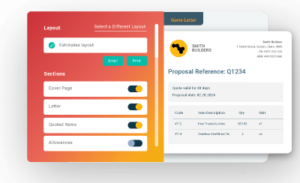
Most estimating tools support this step by allowing builders to add markups and adjustments directly to the estimate before submission.
Control cost estimate
A control estimate tracks costs during the construction process. Builders use it to compare planned spending with actual costs as the project progresses.
This estimate typically includes three views: the budget used for financing, the budget after contracting but before construction, and the projected cost to complete the project. Builders update these numbers as change orders are approved and actual costs are recorded.
Used consistently, the control estimate helps builders spot overruns early and explain cost movement while corrective action is still possible.
How Estimating Methods Change as Projects Take Shape
Early estimates lean on experience and comparison. Once designers issue drawings and clients make selections, that approach stops holding. Builders must adjust their estimate preparation methods to reflect the confirmed scope rather than relying on assumptions.
Estimating techniques
Builders change estimating techniques as the job becomes more defined.
Initially, they use a top-down approach. They anchor the estimate to similar past projects and spread it across the major scope areas. This allows them to respond quickly during early conversations, qualify the lead, and determine whether the project is worth further effort without pretending the details are settled.
Once designers issue drawings and homeowners finalize selections, builders switch to a bottom-up approach. They price the work task by task, measure quantities directly from plans, and build the estimate from the ground up. At this stage, the estimate supports bidding and contracting, not just screening.
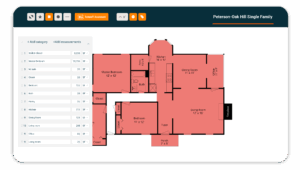
The transition between these two approaches is where estimating often breaks down. Without a system to carry numbers forward, builders end up rebuilding estimates from scratch, first from memory, then from drawings, losing context along the way. Takeoff software helps bridge that gap by converting drawings into measured quantities while preserving earlier assumptions, so the estimate tightens instead of being reset.
Data sources for estimates
Estimating techniques depend on the source of the numbers.
At the preliminary stage, builders rely most on analogous data, which is the actual cost of similar projects. When drawings are not available, and selections remain open, past jobs provide the fastest and most reliable signal. This is why preliminary estimates almost always start with comparison, not measurement.
As the scope takes shape, builders introduce parametric data. Unit costs for labor, materials, or assemblies help narrow the range, but those rates still depend on assumptions about quantity and complexity.
Later, builders lean on expert judgment informed by takeoffs. Experience shifts from shortcut to safeguard, checking whether the measured work and pricing align with reality before the number becomes a bid.
Tools that track historical project costs make this progression easier. Instead of rebuilding estimates from memory, builders can reference real outcomes and carry that data forward as projects move from early pricing to committed scope.
Keeping Estimates Intact From First Ballpark to Final Bid
Early estimates shouldn’t be discarded as more info pours in.
In Buildxact, preliminary estimates are based on historical project data rather than memory. Builders can refer to completed jobs and reuse templates to quickly form an early ballpark estimate and determine whether a project is a good fit before committing hours to a full takeoff.
That makes the first pricing conversation faster and more grounded without pretending the details are settled.
As the project progresses, those initial estimates remain in effect. Builders can expand the estimate as drawings arrive and selections are made, adding measured quantities and refining assumptions rather than rebuilding the numbers from scratch. The estimate evolves from preliminary to detailed to bid, carrying its structure forward rather than fragmenting at each stage.
Once construction begins, that same estimate framework inside the tool supports ongoing cost tracking. Actual costs align with the original estimate categories, making it easier to identify where assumptions start to drift and respond before small gaps become larger problems.
This continuity is what gives preliminary estimates real value. Instead of serving as disposable numbers, they become the starting point for every stage that follows, helping builders qualify leads earlier, protect their time, and keep financial clarity intact from the first conversation through project completion.
Qualify Faster and Estimate Smarter With Buildxact
Preliminary estimates protect your time. They give you a way to qualify opportunities early, before you commit hours to a full takeoff that may never convert. Experienced builders use them as filters, not shortcuts.
That only works when early numbers carry forward into later estimating stages rather than being discarded. When you track historical project data and refine the estimate as the scope and decisions develop, you avoid rebuilding pricing from scratch at each step.
Buildxact, ideal for homebuilders, supports that continuity, helping residential builders move from an initial ballpark estimate to a detailed estimate to a final bid within a single workflow.
Start a 14-day free trial or book a demo to see how it works in practice.